
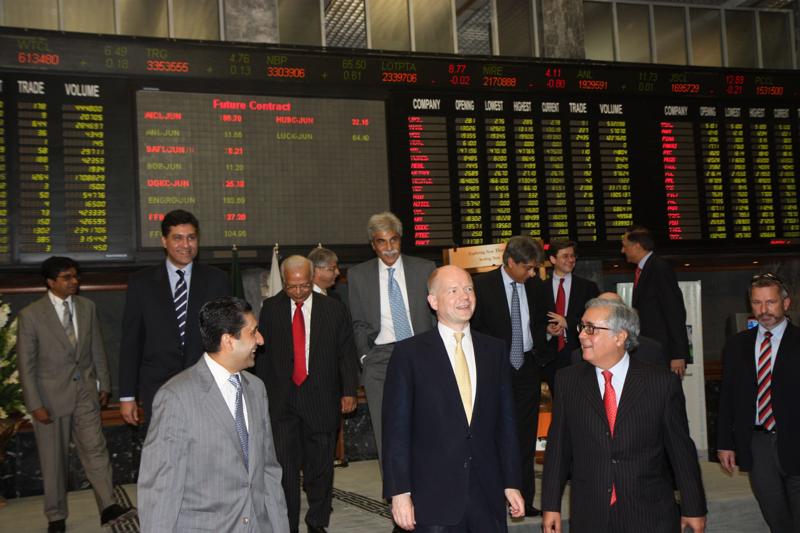
PSX ends October on a weekly gain: KSE-100 up 2.5% despite a 784-point fall on Friday
Pakistan’s stock market finished a bumpy week on a high note — even though the last day of the month ended in the red.
The benchmark KSE-100 Index closed on Friday, 30 October 2026, at 166,409.25 points, down 784.18 points, or 0.47%, on the day. But over the whole week it gained 4,034.37 points, or 2.48%, rising from 162,374.88 points on 23 October.
In plain terms, the market had a strong week, then gave back part of its gains. Investors who bought early in the week were still ahead by Friday evening; those who bought at Thursday’s top, when the index closed at 167,193.44, saw their shares fall on Friday.
October as a whole was still a losing month. The index ended the month down 2.09%, after swinging between a high of 170,688 points and a low of 161,250 points. The weekly gain was a recovery inside a difficult month — not the end of it.
What happened, why it matters, and what happens next
What happened: The KSE-100 rose for four sessions in a row, gaining about 4,800 points, then fell 784.18 points on Friday, 30 October, to close the week at 166,409.25 — still up 4,034.37 points, or 2.48%, on the week. Banks and fertiliser companies led the rise. Oil prices climbed during the week, and that worried investors on Friday.
Why it matters: The stock market is where Pakistan’s biggest companies are valued every day, and it reacts fast to news about oil, interest rates, inflation and politics. This week tells you what investors are hopeful about — company profits and calmer diplomacy — and what still scares them: expensive oil and tension in the Middle East.
What happens next: The market reopens on Monday, 2 November. Traders will watch oil prices, any news on talks involving Iran, and the official October inflation figure, due from the Pakistan Bureau of Statistics in the first days of November. The State Bank’s next interest-rate decision is not due until 14 December.
The week in numbers
- KSE-100 close: 166,409.25 points on Friday, 30 October
- Change on Friday: down 784.18 points, or 0.47%, from Thursday’s close of 167,193.44
- Change over the week: up 4,034.37 points, or 2.48%, from 162,374.88 on 23 October
- Change over October: down 2.09% for the month, or about 3,500 points
- Friday’s trading range: a high of 167,338.72 and a low of 166,326.69
- Friday’s volume: 825.47 million shares, worth Rs23.12 billion, against 816.83 million shares worth Rs31.54 billion on Thursday
- Friday’s breadth: out of 501 companies traded, 173 closed higher, 300 closed lower and 28 were unchanged
- KMI-30 Index: the Shariah-compliant index fell 986.41 points, or 0.41%, on Friday to 237,971.74
- All-Share Index: the broader index settled at 100,707.77, down 457.17 points, or 0.45%
Note one detail: traded value fell sharply on Friday, from Rs31.54 billion to Rs23.12 billion, even though the number of shares traded rose slightly — suggesting cheaper shares changed hands, or big shares were the ones sold.
In dollar terms, the market’s return was 2.51% for the week, against minus 2.40% the week before, according to Mettis Global — relevant because foreign investors measure gains in dollars.
Friday: four days of gains, then a sharp pullback
Friday’s fall ended a four-session winning run. Over those four sessions the index had gained about 4,800 points, so Friday’s drop took back roughly one-sixth of that recovery. The index touched its high early in the session, then slid to its low and closed near the bottom of the day’s range. Arif Habib Limited’s Ali Najib noted that the market could not hold its early gains.
Market watchers gave two linked reasons: rising oil prices and profit-taking — selling after a fast rise to lock in gains, which itself pushes prices down.
The second reason was oil. Brent crude, the international oil price that matters most for Pakistan, rose above $116 a barrel during the week, its highest level since the end of April. AKD Securities put the Friday price at $117.1 a barrel, up 0.7% on the week. Pakistan imports almost all of its oil, so dearer oil means a bigger import bill, more pressure on the rupee, and higher fuel and transport costs at home.
Topline Securities linked Friday’s mood to climbing crude prices, expectations of heightened US-Iran tensions after the US midterm elections, and reported attacks on tankers in the Strait of Hormuz. Mettis Global added concerns about possible attacks on Saudi Arabia’s energy facilities.
The biggest drags on Friday were United Bank Limited (UBL), Lucky Cement, Habib Bank Limited (HBL) and Attock Refinery. Meezan Bank and Oil and Gas Development Company (OGDC) gave some support.
What pushed the market up during the week
If Friday was about oil and profit-taking, the rest of the week was about two hopeful stories: diplomacy and company profits.
Mettis Global said the market recovered as easing crude oil prices, supported by renewed diplomatic efforts to resolve the US-Israeli conflict with Iran, eased concerns about prolonged supply disruptions and encouraged buying in heavyweight stocks. When investors thought the risk of a wider war that could block oil supplies was falling, they were more willing to buy.
AKD Securities said diplomatic initiatives were led by Pakistan, which proposed dialogue in Tehran between the Makkah Pact states and Iran — a sign that countries are talking rather than moving towards conflict.
The second hopeful story was company results. Market reports said the recovery was driven by unexpectedly strong corporate earnings during the ongoing results season. When big companies report better profits than expected, their share prices usually rise — and because banks and fertiliser companies are among the biggest in the KSE-100, their results move the whole index.
Commercial banks were the largest contributor to the weekly gain, adding 1,383.73 points. Fertiliser companies added 854.09 points, cement added 425.54 points, investment banks and securities companies added 369.30 points, and oil and gas exploration companies added 322.71 points.
Among individual companies, Fauji Fertilizer Company (FFC) was the biggest single contributor, adding 698.73 points. MCB Bank added 353.75 points, Engro Holdings added 350.44 points, UBL added 326.46 points and OGDC added 199.24 points. Technology and communication was the biggest drag, taking off 75.11 points, and Meezan Bank was the largest individual drag, erasing 92.41 points.
Who was buying — and who was selling
Foreign investors were net sellers of shares worth $60.58 million during the week, driven mainly by foreign companies selling $63.48 million worth. Overseas Pakistanis were net buyers of $2.94 million worth.
Local investors bought what the foreigners sold. Their net purchases were about $60.58 million. Other organisations led the local buying with net purchases of $50.89 million, followed by individual investors at $7.34 million. Insurance companies were net sellers of $4.01 million, while mutual funds were net buyers of $1.25 million.
In plain terms, the week’s rally was driven by Pakistani buyers, not foreign money.
The wider economy: rates, the rupee and gold
Interest rates rose to 12%
On 26 October, the State Bank of Pakistan raised its policy rate — the benchmark interest rate — by 50 basis points to 12%, effective from 27 October. It had been 11.5%. Nine of the ten members of the Monetary Policy Committee voted for the rise, and one wanted a larger increase. The State Bank said the move was needed because the outlook for inflation had worsened, largely because of the Middle East conflict and high global energy prices. It kept its forecast for economic growth in the current financial year, FY27, at 3.5% to 4.5%.
Higher rates make borrowing more expensive, but they can help banks earn more from lending — one reason bank shares did well — and can support the rupee.
In the same week, the State Bank raised Rs1.91 trillion through an auction of Market Treasury Bills, the short-term debt the government sells to raise money. The cut-off yields — the interest rates the government agreed to pay — rose across all tenors, with the 12-month yield rising to 12.89%. The government is now paying more to borrow, just as households and businesses are.
The rupee was steady
The rupee was little changed. The State Bank’s mark-to-market rate was Rs276.7522 to the dollar on 30 October, against Rs276.8236 on 23 October — a small strengthening over the week. In the interbank market, the dollar was reported at Rs276.65 for buying and Rs277.15 for selling on 31 October. In the open market, it was reported at Rs277.50 for buying and Rs280.00 for selling. The open-market rate is usually higher, and it is the one an ordinary traveller is more likely to pay.
The State Bank’s foreign exchange reserves stood at $21.5 billion as of 23 October, up $33 million on the week, with cover for about three months of imports.
Gold fell sharply
Gold had a very different week from shares. On Saturday, 31 October, 24-karat gold fell by Rs10,800 per tola to Rs409,736, according to rates issued by the All Pakistan Sarafa Gems and Jewellers Association and reported by the Associated Press of Pakistan. Ten grams fell by Rs9,259 to Rs351,282. That followed a fall of Rs5,100 to Rs420,536 a tola on Friday — so gold lost Rs15,900 per tola in two days.
The international price fell too, down $108 to $3,872 an ounce. Silver fell Rs142 to Rs5,388 per tola in Pakistan, while the international silver price fell $1.42 to $49.10 an ounce.
Shares rose on diplomacy hopes and strong profits; gold fell as the world price dropped below $4,000 an ounce.
Households are feeling cautious
Consumer confidence fell 1.7 points to 34.9 in October, down from 36.6 in September, according to the State Bank, while inflation expectations rose to 73.2 points. The Finance Division projected October inflation at between 9.5% and 10.5% year on year, against 10.3% in September. The official figure will be published by the Pakistan Bureau of Statistics in the first days of November.
What this means for ordinary people
Most Pakistanis do not own shares, so why does a weekly rise or a daily fall matter to them? First, the stock market is a quick summary of what investors think about the economy. When the market falls on dearer oil, it is a warning that fuel, transport and food prices may come under pressure, because Pakistan imports its oil and pays for it in dollars.
Second, the same forces moving the market are moving household budgets. The rate rise to 12% affects the cost of loans. The gold price affects anyone buying jewellery for a wedding or saving in gold. The rupee’s value affects the price of imported goods, from fuel to cooking oil to mobile phones.
Third, the market’s mood and the household mood are not the same right now. Shares ended the week higher, but consumer confidence fell. A rising stock market does not mean every household is feeling better off, and none of this is a reason to buy or sell shares.
What to watch next week
When the market reopens on Monday, 2 November, five things will matter most. Oil prices: if Brent keeps rising, or there is fresh news about tankers in the Strait of Hormuz or attacks in the Gulf, the market is likely to stay nervous. Diplomacy around Iran: the rally was partly built on hopes of dialogue, and any progress — or any sign talks have stalled — is likely to move the market. October inflation: the official figure is due in the first days of November, against a forecast of 9.5% to 10.5%. A figure above that range would raise questions about further rate rises. Company results: the results season is still going on, and more announcements from big banks, fertiliser companies and energy firms could move the index either way. Foreign investors: foreign companies sold $63.48 million of shares this week, so local buyers will need to keep stepping in if that selling continues.
Brokers pointed to support near 160,000 — a level below which buyers have tended to step in before, not a promise the index will not fall below it.
Frequently asked questions
What is the KSE-100 Index?
It is the benchmark index of the Pakistan Stock Exchange, the main stock market in Karachi. It tracks 100 of the largest companies listed on the exchange, weighted by size. The exchange dates back to 1947, when it was founded as the Karachi Stock Exchange, and the Karachi, Lahore and Islamabad exchanges were merged in January 2016 to form the Pakistan Stock Exchange.
What does “profit-taking” mean?
It means selling shares after they have risen, to lock in the profit. After four days in which the index gained about 4,800 points, some investors decided Friday was a good day to sell. That selling pushed prices down.
Why does the price of oil move the Pakistan stock market?
Pakistan imports almost all of its oil, so when world prices rise, the import bill rises, the rupee comes under pressure, and fuel and transport become more expensive. That hurts many companies’ costs. Oil and gas exploration companies can benefit from higher prices, but on Friday the worries won.
Conclusion
The last week of October gave Pakistan’s stock market two stories at once. The first was a recovery: four days of gains, led by banks and fertiliser companies, helped by hopes of diplomacy and strong profits, left the KSE-100 up 4,034.37 points, or 2.48%, on the week at 166,409.25. The second was a warning: a 784-point fall on Friday, dearer oil above $116 a barrel, an interest rate now at 12%, and falling consumer confidence all point to an economy still under pressure.
October as a whole was a down month, and the weekly gain did not erase that. Investors are ready to buy when the news improves — and quick to sell when oil rises or the outlook darkens. Monday will show which story they believe more.
This article is for general information and education only. It is not legal or financial advice.
Sources
- Mettis Global, “Weekly Market Roundup”, 31 October 2026 — https://mettisglobal.news/Weekly-Market-Roundup-64700
- Mettis Global, “PSX Closing Bell: Bears Flip the Script”, 30 October 2026 — https://mettisglobal.news/PSX-Closing-Bell-Bears-Flip-the-Script-64696
- Pakistan Today, “PSX Today: KSE-100 Falls 784 Points, KMI-30 Drops 986 Points”, 30 October 2026 — https://pakistanstoday.com.pk/business/psx-today-kse-100-falls-784-points-kmi-30-drops-986-points/
- Pakistan Business News, “KSE100 Index Rises Amid Diplomatic Engagements and Strong Corporate Earnings”, 30 October 2026 — https://pakistanbusinessnews.com.pk/kse100-index-rises-amid-diplomatic-engagements-and-strong-corporate-earnings/
- Associated Press of Pakistan via Tez Khabar, “Gold prices decline by Rs10,800 per tola”, 31 October 2026 — https://en.tezkhabar.tv/gold-prices-decline-by-rs10800-per-tola/
- The Pakistan Daily, “Dollar Rate Fixed at Rs276.75 by the State Bank”, 31 October 2026 — https://thepakistandaily.com/dollar-rate-276-75-sbp-interbank-rupee/
- Mettis Global, “Half a point, and a longer road to target” (State Bank policy rate rise to 12%), 27 October 2026 — https://mettisglobal.news/Half-a-point-and-a-longer-road-to-target-64542
- Wikipedia, “Pakistan Stock Exchange” (history: founded 1947 as Karachi Stock Exchange; merged January 2016) — https://en.wikipedia.org/wiki/Pakistan_Stock_Exchange

Pingback: PSX Ends a Strong Week Up 4.5% Despite Friday's 1,493-Point Fall - Findivoza