
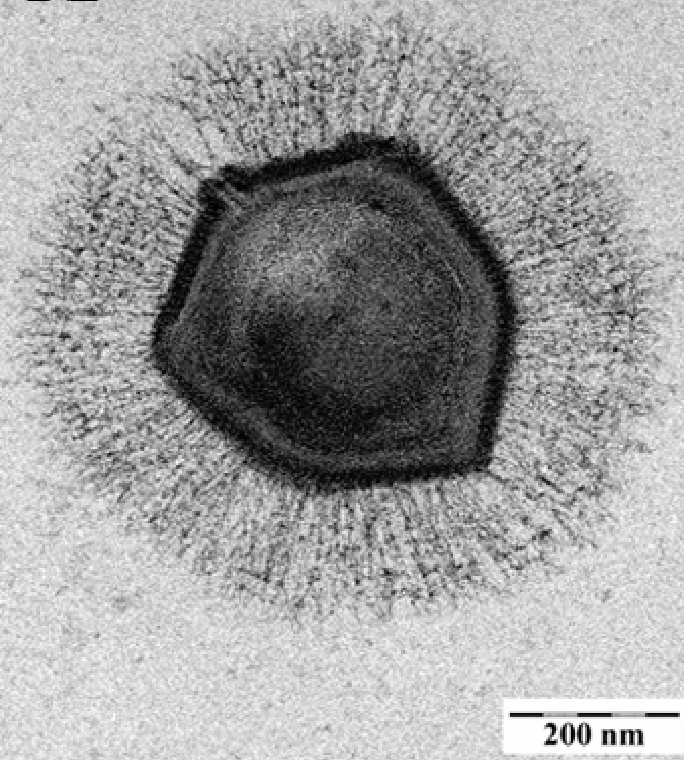
Giant virus found carrying a potassium channel like the ones in our nerves
A virus that infects tiny marine algae is carrying a gene for a kind of potassium channel that also works in the human body, scientists have found. The discovery, reported on 31 October 2026, helps answer a long-standing question about where one of the most important pieces of machinery in our nerves and muscles came from.
The channel is called a tandem potassium channel, also known as a two-pore-domain potassium channel. In people, channels like this sit in the walls of cells and let potassium ions pass in and out. That flow of charged particles helps keep a cell’s electrical balance steady, which controls how easily a nerve cell fires or a muscle cell contracts. Until now, scientists had not found the ancestors of these channels in bacteria, which left their origin unexplained.
The new study, published in the journal Proceedings of the National Academy of Sciences, reports that the gene for such a channel exists in the genome of a large DNA virus that infects marine algae. The international team included researchers from the Department of Biology at Technische Universität Darmstadt in Germany and the Department of Natural Sciences at Bonn-Rhein-Sieg University of Applied Sciences, working with colleagues in other countries. The researchers named the viral channel Kpov.
What makes the finding striking is that the evidence suggests the virus did not steal the gene from its host. For most viral genes that resemble host genes, the usual explanation is that the virus picked the gene up from an organism it infected. The team compared the new viral channel with the tandem potassium channels already known in animals and plants, and concluded that this gene looks as if it belongs to the virus itself.
“This finding further reinforces a new perspective according to which the giant mimiviruses, to which this virus belongs, have played a central role in the evolution of proteins in higher organisms,” said Professor Gerhard Thiel of the Department of Biology at TU Darmstadt. In plain terms, giant viruses may have helped build these proteins, which later found their way into more complex life, including us.
At a glance
What happened: Scientists found a working gene for a tandem potassium channel in a large DNA virus that infects marine algae, and published the result in the Proceedings of the National Academy of Sciences. The work was reported on 31 October 2026.
Why it matters: Tandem potassium channels help control the electrical activity of nerve and muscle cells in people, but their ancestors had never been found in bacteria. The new result points to giant viruses as a possible source of these channels.
What happens next: Researchers are expected to keep searching viral genomes for other pieces of complex cell machinery, and to study how the viral channel works in detail. The finding is basic research, not a medical treatment.
What the researchers found
The team started with the genome of a large DNA virus that infects marine algae. Inside it they found a gene whose sequence resembled the genes for tandem potassium channels. A gene on its own, however, only shows that the instructions are there. It does not prove that they produce a working channel.
So the researchers tested the gene in experiments. “Our experiments show that this gene encodes a protein with the functional properties of a potassium channel,” said Dr Oliver Rauh, a scientist at Bonn-Rhein-Sieg University of Applied Sciences. In other words, when the gene was switched on, the protein it produced behaved like a potassium channel.
The paper was written by Oliver Rauh, Sebastian Mach, Oliver Clarke, Jonas Toews, James L. van Etten, Mike Althaus, Anna Moroni and Gerhard Thiel, and appeared in volume 123 of the Proceedings of the National Academy of Sciences.
The second half of the finding came from the evolutionary comparison. If the virus had stolen the gene from its algal host, the viral channel would be expected to look most like the host’s own channels. Instead, the analysis pointed the other way: the gene appears to be of viral origin, meaning it evolved within the virus lineage rather than being copied from a host.
What is a potassium channel, in plain English?
Every cell in the body is wrapped in a thin membrane, a wall that separates the inside of the cell from the outside. Potassium ions are tiny charged particles, found in different amounts inside and outside the cell. A potassium channel is a tunnel through the membrane that lets potassium ions move across it in a controlled way.
That movement matters because cells run on electricity. A nerve cell sends a signal by briefly changing the electrical charge across its membrane. A muscle cell contracts when its electrical state changes. Potassium channels help set the resting charge of the cell and help bring it back to normal after a signal. If the channels do not work properly, the cell becomes too excitable or not excitable enough.
Tandem potassium channels are one particular family within this larger group, and they get their name from their shape. Most potassium channels are built from four separate pore-forming parts that come together to make the tunnel. In tandem channels, two of those four parts are directly joined to each other, like two links in a chain that were made as one piece. That linked structure is unusual, and it is part of what sets these channels apart from all other potassium channels.
In people, tandem potassium channels are found in many tissues, including the brain and the heart. They help stabilise the membrane potential, the electrical difference between the inside and the outside of the cell, and by doing that they help regulate how easily nerve cells fire. Scientists have linked faults in these channels to a range of health problems, but the new study is not about treating any disease. It is about where the channels came from.
Why the origin of these channels was a puzzle
Scientists often trace a protein’s history by looking for simpler versions of it in simpler organisms. That pattern holds for most other kinds of potassium channel: researchers have found their precursors in bacteria, which supports the idea that the channels evolved step by step from a simple starting point. Tandem potassium channels broke that pattern. Unlike every other type of potassium channel, no precursors of tandem channels had been found in bacteria. That left an open question: if the channels did not come from bacteria, where did they come from?
Viruses are an unusual place to look, because they are not usually thought of as inventors. The common picture is a stripped-down parcel of genes that must hijack a host cell to reproduce. That fits many viruses, but not giant viruses, which have large genomes — sometimes larger than those of some bacteria — and carry genes for many proteins other viruses do not have.
Giant viruses: the unlikely builders
The virus in the new study belongs to the giant mimiviruses, a group of very large DNA viruses. The first mimivirus was discovered in 2003, and its genome was sequenced in 2004. That genome turned out to be about 1.2 million letters of DNA long, far bigger than scientists expected a virus genome to be, and the discovery forced researchers to rethink what a virus could be.
Giant viruses infect a wide range of hosts. Some infect amoebas, the single-celled organisms found in soil and water. Others, like the virus in the new study, infect algae in the sea, the tiny plant-like organisms that form much of the base of the ocean food chain. When a giant virus infects an alga, it takes over the cell and uses it to make copies of itself.
The idea that giant viruses helped shape the proteins of higher organisms is not new, but it has gained support as more viral genomes have been sequenced. Each time researchers read another giant virus genome, they find genes that look like they belong to cellular life rather than to a virus. The new study adds a prominent example, because tandem potassium channels are central to how nerve and muscle cells work.
Earlier work had already pointed in this direction. The first viral potassium channel gene was found in a chlorovirus, a virus that infects the alga Chlorella, and was reported in the journal Science in 2000. That channel, called Kcv, is very small: its building block is only 94 amino acids long, yet it forms a working channel with a pore and a selectivity filter that picks out potassium ions. A study published in 2020 then found functional potassium channels in members of the mimivirus family itself.
The new study goes further in one important way. The channel it describes is a tandem channel, with the linked structure that sets this family apart. That is the type whose origin was unexplained, and the new result offers a plausible source.
How sure can we be?
The comparison is important because it addresses the question of origin. Genes passed down from a common ancestor tend to resemble each other in ways that reflect their shared history. Genes recently copied from another organism tend to resemble the donor’s genes most closely. The researchers found that the new viral channel did not cluster with the channels of the virus’s algal host. Instead, its relationships suggested that it arose within the viral lineage.
It is worth being clear about what this kind of evidence can and cannot show. An evolutionary comparison is a reconstruction based on the sequences available today. It can make one explanation much more likely than another, but it cannot replay the history of life directly. The researchers describe the gene as appearing to be of viral origin, which is the careful way of putting it. The finding strengthens the case for viruses as builders of complex proteins, but it does not settle the whole question on its own.
Why it matters, and what it does not mean
The finding matters for our understanding of evolution. It suggests that some of the machinery inside our own cells may have a viral past. That is a shift in perspective: viruses are usually seen as destroyers, or as thieves of genes. This result adds to the view of them as a source of new proteins, and of giant viruses in particular as places where complex proteins could evolve.
It also matters for how scientists search for the origins of other proteins. If tandem potassium channels can be traced to viruses, other protein families whose origins are unexplained may also have viral roots. Viral genomes are now being sequenced in large numbers from oceans, soils and other environments, so there is plenty of material to search through.
At the same time, it is important to say what the finding does not mean. It does not mean that people caught this channel from a virus, or that the virus in the study infects people. It infects marine algae, not humans. It does not mean that a new treatment for nerve or muscle disease is on the way. The study is basic research into the history of a protein family, and any medical use would be many steps and many years away, if it ever came at all. And it does not mean that all of our proteins come from viruses. Most have other origins, and the viral contribution is one thread in a much larger story.
What happens next
The most likely next step is more searching through other giant virus genomes, for more tandem channels and for other proteins whose origins are unclear. Each new example will test whether the pattern holds or whether the Kpov channel is an exception.
Another next step is to study the viral channel itself in more detail. Researchers will want to know how it opens and closes, how selective it is for potassium over other ions, and how its structure compares with the tandem channels in animals and plants.
Frequently asked questions
What is a tandem potassium channel?
It is a channel in the wall of a cell that lets potassium ions pass through. Its name comes from its shape: two of its four pore-forming parts are directly linked to each other. In people, these channels help keep a cell’s electrical balance steady and control how easily nerve cells fire.
What did the scientists actually find?
They found a gene for a tandem potassium channel in the genome of a large DNA virus that infects marine algae. They showed in experiments that the gene produces a working potassium channel, and their comparison suggested the gene is of viral origin rather than stolen from the virus’s host.
Does this virus infect people?
No. The virus in the study infects marine algae, not humans. The finding is about the history of a protein, not about a disease or a health risk.
Does this lead to a new treatment?
Not directly. This is basic research about evolution. The study does not test or propose any treatment, and any medical use would be a long way off.
Why is it surprising that the gene is of viral origin?
Most viral genes that resemble host genes are thought to have been picked up from a host the virus infected. Here the evidence points the other way: the gene appears to have evolved in the virus lineage. That supports the idea that giant viruses helped build complex proteins rather than only borrowing them.
What are giant viruses?
They are viruses with very large genomes, sometimes bigger than the genomes of some bacteria. They include the mimiviruses, which infect amoebas and algae. They carry many genes that smaller viruses do not have, which is why scientists study them for clues about how complex proteins evolved.
Conclusion
A gene for a tandem potassium channel, the kind that helps nerve and muscle cells control their electrical activity, has been found in a giant virus that infects marine algae. Experiments showed that the gene produces a working channel, and an evolutionary comparison suggested that the gene is of viral origin rather than copied from the virus’s host.
The result fills a gap that had puzzled scientists for years: tandem potassium channels had no known ancestors in bacteria. Now there is a plausible source in the giant mimiviruses, which may have helped build proteins that later became part of complex life, including our own.
It is a single finding, and it will need to be tested against more viral genomes and more comparisons. But it changes how we think about viruses. They are not only invaders that borrow from the organisms they infect. In at least one important case, they may have been the inventors, and we may be carrying the result in every nerve cell in our bodies.
This article is for general information and education only. It is not legal or financial advice.
Sources
- https://phys.org/news/2026-10-giant-virus-yields-potassium-channel.html (Phys.org, 31 October 2026)
- https://doi.org/10.1073/pnas.2626158123 (Proceedings of the National Academy of Sciences, 2026)
- https://www.research-in-germany.org/idw-news/en_US/2026/10/2026-10-28_Viruses_as_master_builders_of_complex_proteins_-_PNAS_study_on_the_origin_of_tandem_potassium_channels.html (Research in Germany / TU Darmstadt, 28 October 2026)
- https://www.h-brs.de/en/ifga/publikationen (Bonn-Rhein-Sieg University of Applied Sciences, 2026)
- https://www.mdpi.com/1999-4915/12/10/1107/html (Viruses / MDPI, 29 September 2020)
- https://pmc.ncbi.nlm.nih.gov/articles/PMC3707557/ (Plant Physiology / PMC, 2013)
