
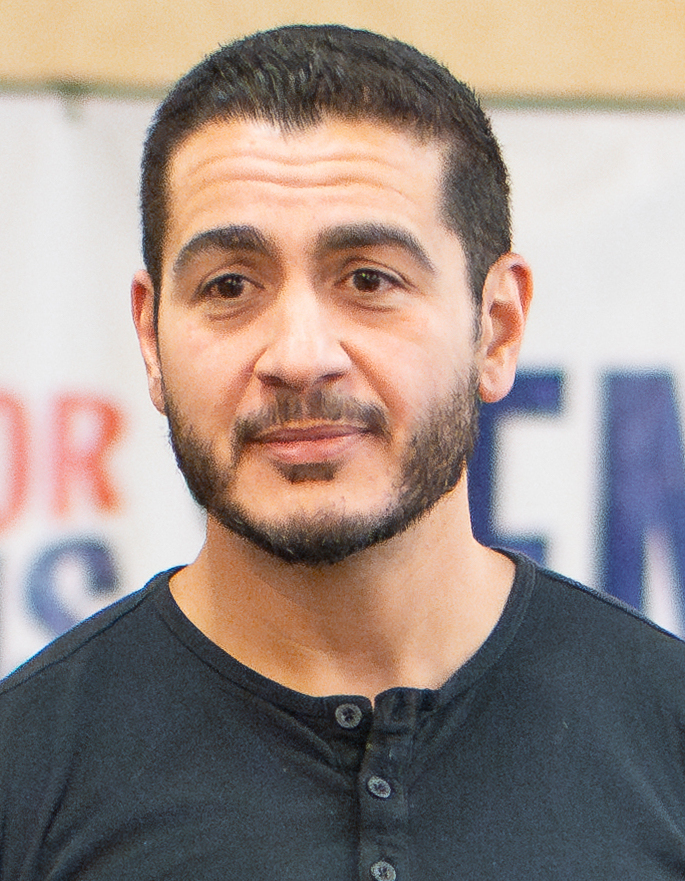
Trump tells voters to send Michigan’s Abdul El-Sayed ‘back to where he came from’
Donald Trump has told voters to send Abdul El-Sayed, the Democratic nominee for the United States Senate in Michigan, “back to where he came from” — even though El-Sayed was born in Michigan. The president made the remark at a campaign rally in Daytona Beach, Florida, on Friday, 30 October, four days before the midterm elections on Tuesday, 3 November.
It was the sharpest line in a week of attacks on El-Sayed’s Muslim faith. In Daytona Beach, Trump also called him a “jihadist” and told Black and Jewish voters they were “not smart” if they supported him. El-Sayed, a physician and former public health director, would be the first Muslim elected to the US Senate if he wins on Tuesday.
The Michigan race is one of a small number that could decide control of the Senate. El-Sayed leads in recent polls, but the race is rated a toss-up, and his opponent, Mike Rogers, insists his own figures show him ahead.
At a glance
What happened: At a rally in Daytona Beach, Florida, on 30 October, President Donald Trump urged voters to send Michigan Democratic Senate nominee Abdul El-Sayed “back to where he came from”, called him a “jihadist”, and said Black and Jewish voters who backed him were “not smart”.
Why it matters: El-Sayed was born in Rochester Hills, Michigan, in 1984. If elected on 3 November, he would be the first Muslim to serve in the US Senate.
What happens next: Michigan votes on Tuesday, 3 November. El-Sayed leads in recent polls, while his opponent, Republican Mike Rogers, claims his own modelling shows him ahead.
What Trump said in Daytona Beach
The rally took place at the Ocean Center in Daytona Beach on Friday, 30 October. Trump was there to support Florida Republicans — Ashley Moody, who is seeking a US Senate seat, and Byron Donalds, who is running for governor — but he spent much of his time talking about races in other states. He spoke for more than 90 minutes to a crowd that nearly filled the venue’s 9,300 seats.
Turning to Michigan, Trump urged the audience to vote for Mike Rogers and made a series of claims about El-Sayed’s views towards Jewish and Black Americans that were not backed by evidence. “Not that other guy, because he doesn’t like Jewish people and he doesn’t like Black people. I’m talking about Abdul. Abdul is not a big fan of Jewish people, and he’s not a big fan of Black people. And I hope you’re going to vote against him and send him back to where he came from,” Trump said.
He returned to the theme while addressing supporters wearing “Blacks for Trump” shirts. “No, if you’re Black or if you’re Jewish, and you vote for Abdul, you’re not smart. I’m being nice. You’re not smart,” he told the audience.
The News-Journal reported that Trump and other speakers at the rally also attacked Representative Ilhan Omar, a Muslim congresswoman from Minnesota. At one point, members of the audience chanted “Send her back!” about Omar — an echo of the chant aimed at Omar by crowds at Trump’s rallies in 2019.
Trump also told the crowd his own name was, in effect, on the ballot. “In the truest sense. I really am on the ballot. We’re all on the ballot together,” he said, urging his supporters to turn out as though he were standing for election himself.
A second night, the same message
A day earlier, at a rally in South Carolina on Thursday, 29 October, Trump had said much the same thing, again singling out Black and Jewish voters who might support El-Sayed.
“If you’re Black, or if you’re Jewish, and you vote for Abdul, you’re crazy. You’re crazy anyway,” Trump said in South Carolina. At the same event, he repeated an allegation linking El-Sayed to the Muslim Brotherhood, saying “they have a guy running now who’s definitely Muslim Brotherhood”. El-Sayed has repeatedly denied any connection with the group.
The attacks began a week earlier in Michigan
The focus on El-Sayed began earlier, at a rally in Port Huron, Michigan, on Sunday, 25 October, where Trump went further than he had before.
He called El-Sayed a “jihadist” and said that, if elected, he would be the only senator who would have to go through a metal detector before entering the Senate. He repeatedly invoked the attacks of 11 September 2001, introducing the father of Todd Beamer, a passenger who fought back against the hijackers aboard United Airlines Flight 93. “Michigan needs to stand up and fight, just like Todd did, to stop a jihadist from walking into the Capitol,” Trump said.
He also warned that an El-Sayed victory would bring violence to the country. “If Abdul and the Democrats win, they will open the floodgates and invite hordes of jihadis to our shores, creating a nightmare of violence and terror until you cannot even have a Christmas,” he said. He also accused El-Sayed of wanting to impose Sharia law and of belonging to the Muslim Brotherhood, claims El-Sayed denies and for which no evidence has been produced.
El-Sayed answered the Port Huron attack the same day, at a rally in Grand Rapids. He turned Trump’s use of his middle name, Mohamed, back on the president. “I don’t even care that he remembers my whole name because he can just go on and call me ‘senator’ after November,” he told supporters. “I will be Senator Mohamed to you, bro.”
A day later, in Detroit, he called the attacks “deflections and deceptions based on no evidence”. On 29 October, in Wyandotte, he pushed back again, five days before the vote.
El-Sayed’s answer: the lie-detector challenge
El-Sayed’s sharpest reply came in response to the metal-detector line from Port Huron. He offered Trump a deal: he would walk through a metal detector every day if the president would sit for a lie detector test just once.
“Here’s the deal, Donald, I’ll go through a metal detector if you’ll sit for a lie detector. Simple, I’ve got nothing to hide; you’ve got so much to hide,” El-Sayed said. “My first question, Epstein. Second question, did you win the 2020 election? So that’s the deal, I’ll go through a metal detector every day if you sit through a lie detector one time.”
The first question referred to Trump’s past friendship with Jeffrey Epstein, the late financier and convicted sex offender. The second referred to Trump’s repeated false claims that he won the 2020 presidential election, which he lost to Joe Biden.
The challenge was widely shared online and reported on 30 October, the same day as the Daytona Beach rally. Trump has not publicly responded to it.
Who is Abdul El-Sayed?
Abdulrahman Mohamed El-Sayed was born on 31 October 1984 in Rochester Hills, Michigan, to Egyptian immigrant parents. He is an epidemiologist and physician who served as health director of Detroit and Wayne County, and since 2019 has hosted a podcast about politics and public health.
He left his public health role in April 2025 to run for the Senate after Senator Gary Peters announced he would not seek a third term. El-Sayed won the Democratic primary on 4 August 2026, taking 50.5 per cent of the vote against Representative Haley Stevens.
If he wins on Tuesday, he will become the first Muslim elected to the United States Senate. Trump and Rogers have repeatedly linked him to the Muslim Brotherhood, an Islamist organisation founded in Egypt. El-Sayed has denied any ties. Asked on NBC’s Meet the Press on 12 October whether he or his family had ties to the group, he replied: “No.” He said Rogers had made about ten references tying him to the group in a debate and in advertisements, only to repeat the word “Muslim”.
Who is Mike Rogers, and why the seat matters
Mike Rogers is the Republican nominee, a former congressman backed by Trump. He has described El-Sayed as a national security risk, and his campaign has leaned on the same Brotherhood claims Trump has repeated at rallies.
The seat is open because Peters is retiring, which makes it one of the most competitive Senate races in the country, and control of the Senate could turn on a handful of races like Michigan’s.
Recent polling points in El-Sayed’s direction, but not by a margin that settles the race. A poll conducted 20–27 October put El-Sayed at 49 per cent and Rogers at 42 per cent among likely voters, with a margin of error of plus or minus 4.7 points. A Mitchell Research poll of 636 likely voters, conducted 26–27 October, put him at 51 per cent to 44 per cent. An average of recent polls put El-Sayed about three points ahead, and one forecaster gives him a 74 per cent chance. The race is rated a toss-up by one forecaster and leaning Democratic by another.
Rogers has claimed the contest is moving his way. He said on 31 October that his campaign was about seven points ahead among voters who had already returned their ballots, citing its own modelling. That cannot be checked against official figures, because Michigan does not register voters by party, so the partisan make-up of early ballots has to be estimated.
Polls are snapshots of opinion, not forecasts. The only number that will settle the race is the vote on Tuesday.
The reaction
Senator Bernie Sanders, who has campaigned alongside El-Sayed, said the attacks were a distraction from the issues voters care about. “The reason they are using Islamophobia against Abdul is because they have nothing to say about the real issues,” Sanders said at the Grand Rapids rally, pointing to health care, housing and income inequality. He also accused Trump and his allies of spending heavily to spread false claims about El-Sayed in Michigan.
The author Stephen King called the president’s remarks “garbage”. El-Sayed has rejected the “jihadist” label and the Brotherhood claims throughout the campaign. His campaign has tried to keep the focus on the cost of living, health care and the war in Iran, which has pushed up petrol prices in Michigan.
H. A. Hellyer, a senior associate fellow at the Royal United Services Institute and an expert on Egypt, said the dispute reflected right-wing Islamophobia in the US more than the Trump administration’s actual policy. Bishara Bahbah, a former Trump supporter, also criticised the remarks.
Why the language matters
The words carried weight because of who they were aimed at. El-Sayed is not an immigrant. He was born in the United States, in the state he is running to represent, to parents who came from Egypt. To tell voters to send a Michigan-born American “back to where he came from” is to treat him as a foreigner because of his name and his faith.
That is why the reaction has been so sharp. The “send her back” chant aimed at Ilhan Omar, a Somali-born American citizen, became one of the most criticised moments of Trump’s first presidency. Hearing the same words return in the closing days of the 2026 campaign, critics argue little has changed in the politics of the president’s rallies.
It also matters because of what the attacks leave out. The Michigan race is being fought over health care, the cost of living, jobs and the war in Iran, which has driven up fuel prices. None of those issues featured in the attacks. Instead, the closing days of the campaign have been dominated by a debate about one candidate’s religion, which El-Sayed has had to answer at almost every stop.
What happens next
Michigan votes on Tuesday, 3 November, in the midterm elections. The result will be one of the first signals of whether the attacks on El-Sayed helped or hurt the Republican campaign — and whether control of the Senate stays with the Republicans or flips.
Watch the margin as well as the winner. A narrow El-Sayed victory would confirm the polls that had him ahead by a few points. A Rogers upset would suggest the closing attacks moved votes in the final days. Either way, the race has already made history: no Muslim has ever served in the United States Senate, and the man who would be the first has spent the final week of his campaign answering for his name and faith.
Frequently asked questions
What exactly did Trump say in Daytona Beach?
At a rally in Daytona Beach, Florida, on 30 October, Trump called El-Sayed a “jihadist”, said Black and Jewish voters who backed him were “not smart”, and told voters to vote against him and “send him back to where he came from”. The rally was held to support Florida Republican candidates.
Was El-Sayed born in the United States?
Yes. El-Sayed was born on 31 October 1984 in Rochester Hills, Michigan, to parents who immigrated from Egypt. If elected, he would be the first Muslim to serve in the US Senate.
What is the lie-detector challenge?
After Trump said El-Sayed would have to pass through a metal detector to enter the Senate, El-Sayed offered to do so every day if Trump would sit for a lie detector test once. His first question would be about Jeffrey Epstein, and his second would be whether Trump won the 2020 election.
Who is Mike Rogers, and who is leading the race?
Mike Rogers is the Republican nominee, a former congressman backed by Trump. Recent polls put El-Sayed ahead — one conducted 20–27 October had him at 49 per cent to Rogers’ 42 per cent, and another conducted 26–27 October had him at 51 per cent to 44 per cent. Rogers claims his own modelling shows him ahead.
What has El-Sayed said about the Muslim Brotherhood claims?
El-Sayed has repeatedly denied any connection with the Muslim Brotherhood. Asked on NBC’s Meet the Press on 12 October whether he or his family had ties to the group, he replied: “No.” At a campaign event in Flint, when a member of the audience asked him to disavow the group, he said he would.
When do Michigan voters decide?
Michigan votes in the midterm elections on Tuesday, 3 November 2026. The seat is open because Senator Gary Peters is not seeking a third term, and the race could help decide which party controls the Senate.
Conclusion
The final week of the Michigan Senate race has been dominated by a single exchange: a president telling voters to send a Michigan-born candidate “back to where he came from”, and the candidate answering with a dare to take a lie detector test. On Tuesday, Michigan voters will decide whether that was a winning argument.
This article is for general information and education only. It is not legal or financial advice.
Sources
- https://news.meaww.com/trump-urges-voters-to-send-abdul-el-sayed-back-to-where-he-came-from (MEAWW, 31 October 2026)
- https://www.coralspringsflnews.com/news/article317859033.html (The Daytona Beach News-Journal, 30 October 2026)
- https://www.thesource.com/2026/10/31/trumps-send-him-back-attack-on-michigan-born-candidate-abdul-el-sayed-newest-racist-outcry/ (The Source, 31 October 2026)
- https://ghanaguardian.com/trump-criticised-for-invoking-9-11-in-attack-on-michigan-senate-candidate-el-sayed/ (Ghana Guardian, October 2026)
- https://inshorts.com:443/en/news/el-sayed-turns-trump-s-insult-into-challenge–says–you-take-lie-detector-test–i-ll-ask-2-questions–1793350803089 (Inshorts, 30 October 2026)
- https://www.thepoke.com/2026/10/30/abdul-el-sayeds-response-to-trump-saying-hed-have-to-go-through-a-metal-detector/ (The Poke, 30 October 2026)
- https://political.org/2026/10/31/mike-rogers-claims-7-point-lead-on-returned-michigan-ballots-by-our-models-as-polls-favor-abdul-el-sayed/ (Political.org, 31 October 2026)
- https://midtermresultslive.com/race/michigan-senate/ (Midterm Results Live, 31 October 2026)
- https://pollingsource.com/senate/MI (PollingSource, October 2026)
- https://beezloop.com/jan-crawford-cbs-apology-abdul-el-sayed-heckler-muslim-brotherhood/ (BeezLoop, October 2026)
- https://magnabureau.space/article-al-jazeera-speaks-el-sayed-religion (Magna Bureau, 29 October 2026)
- https://en.wikipedia.org/wiki/Abdul_El-Sayed (Wikipedia, accessed 1 November 2026)
