
Hubble Finds Dwarf Galaxies Are Missing Most of Their Oxygen — and Scientists Want to Know Where It Went
Small galaxies across our cosmic neighbourhood are missing most of the oxygen their stars ever made, according to a new study using NASA’s Hubble Space Telescope. On average, the dwarf galaxies in the study kept only about 11 percent of the oxygen their stars produced over their lifetimes. The rest — in some cases as much as 96 percent — has gone somewhere else, and scientists are now trying to find out where.
The research, published in The Astrophysical Journal, looked at 37 nearby dwarf galaxies. It is the most careful count yet of oxygen in this type of galaxy, and it shows that the winds blown out by exploding stars are far more powerful at stripping small galaxies of their chemical riches than computer models had predicted.
What did Hubble find?
The numbers are striking. The team compared two things for each galaxy: how much oxygen its stars should have made over their whole lifetime, and how much oxygen is still there today, in the stars, gas and dust of the galaxy.
The answer was the same almost everywhere. The galaxies kept between 4 percent and 25 percent of the oxygen they produced, with an average of about 11 percent. Put simply, for every nine oxygen atoms a dwarf galaxy’s stars forged, about eight are no longer in the galaxy.
“Galactic winds unleashed by supernovae are apparently more effective at removing oxygen from low-mass galaxies than current models predict,” the researchers said. “The findings show that dwarf galaxies can hold onto only a small fraction of the oxygen made by stars.”
The study is part of a project called GLOW — short for Galaxies Losing Oxygen via Winds — funded by NASA and the National Science Foundation. It was led by Kristen Wingfield McQuinn, an astrophysicist at the Space Telescope Science Institute in Baltimore and an associate professor at Rutgers University in the United States.
What are dwarf galaxies?
A dwarf galaxy is a small galaxy. While our Milky Way holds hundreds of billions of stars, a dwarf galaxy may contain only a few thousand to a few hundred million stars. They are the most common type of galaxy in the universe, but because they are faint, they are hard to study in detail.
The 37 galaxies in this study were chosen because they are close enough for Hubble to pick out their individual stars — something that is not possible for most dwarf galaxies, which are too far away. All of them lie within about 22 million light-years of Earth. A light-year is the distance light travels in one year, so these galaxies are practically next door by cosmic standards. Their masses range from about 3 million to 3 billion times the mass of our Sun.
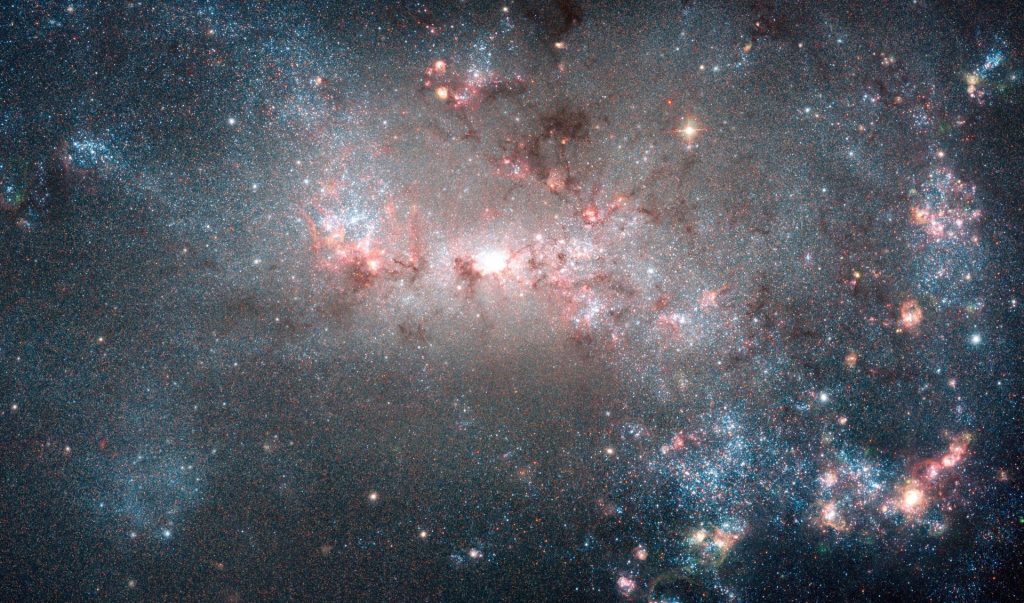
One of the galaxies in the study is NGC 4449, shown in the image above. It sits about 12.5 million light-years away in the constellation Canes Venatici, and it has been forming stars for several billion years.
Why oxygen?
Oxygen might seem like a strange thing to count in a galaxy, but astronomers have a good reason for choosing it. Oxygen is the most abundant element in the universe after hydrogen and helium. It is made inside stars, it is relatively easy to detect and measure, and scientists understand well how it is produced. That makes it a reliable tracer — a way of tracking how all the heavier elements, which astronomers call “metals”, move around inside a galaxy.
“Oxygen is one of the primary elements formed by stars,” said McQuinn, the study’s lead author. “Being able to trace how much oxygen gets made, and then how much is distributed inside and outside of galaxies, helps us understand galaxy evolution. It also helps us learn where and how much galaxies are enriching the space between galaxies, called the intergalactic medium.”
To build the oxygen count, the team used old Hubble images to work out each galaxy’s history — when it formed stars, and how many. They combined that with data from NASA’s retired Spitzer Space Telescope and two radio telescopes on the ground, the Very Large Array in the United States and the Australian Telescope Compact Array. Together, the data let them trace the oxygen in the stars, in the gas between the stars, and in the dust.
How does a galaxy lose its oxygen?
The answer is written in the life and death of stars. Massive stars burn bright and die young, exploding as supernovae. Each explosion releases a huge amount of energy, and together these explosions drive powerful winds of hot gas out of the galaxy. In a big galaxy like the Milky Way, gravity is strong enough to hold on to much of that gas. In a small dwarf galaxy, gravity is weaker, so the winds can blow a large share of the gas — and the oxygen in it — clean out into space.
Scientists had suspected this for a long time. The surprise is how much is lost. Computer simulations of how galaxies form and evolve predicted that dwarf galaxies would keep far more of their oxygen than the Hubble data show. In fact, the models overestimated how much oxygen these galaxies retain by roughly a factor of two to three.
Grace Telford, a co-investigator on the study and an assistant professor of physics and astronomy at the University of Utah, put it plainly: “Oxygen is produced by stars, which are inside of galaxies. We know that the oxygen had to be inside of the galaxies at some point in the past, so the oxygen must have been ejected. And to do that, you need energy from massive stars and supernova explosions to drive material out of the host galaxies and into the space between galaxies.”
Where did the oxygen go?
That is the question the study leaves open. The missing oxygen is probably in one of two places, and it may be split between them.
The first possibility is the halo of thin, hot gas that surrounds a galaxy, known as the circumgalactic medium. Earlier work has found oxygen in these haloes, but the amounts measured so far do not add up to the full missing share. Highly ionised oxygen in the haloes accounts for only about 1 to 7 percent of the total oxygen the galaxies produced, and even after correcting for other forms of oxygen, the haloes may hold only 5 to 35 percent. That leaves a large share unaccounted for.
The second possibility is that the oxygen was blown so far out that it left the galaxy’s surroundings altogether, joining the thin gas that fills the space between galaxies — the intergalactic medium. If that is what happened, then small galaxies have been quietly seeding the universe with the chemical elements that later generations of stars and planets are made from.
The study also found a pattern that may help solve the puzzle. Dwarf galaxies that sit far from any large neighbour — more than about 3.3 million light-years away — consistently kept less than 15 percent of their oxygen. Galaxies with a big neighbour nearby may have their escaping gas slowed, or even pushed back, by the neighbour’s gravity and its own halo of gas. Isolated galaxies have nothing to stop the wind, so they lose more.
This is not the first time astronomers have found missing oxygen
The new result builds on an earlier study from 2014, which looked at larger galaxies more like our Milky Way. That study, led by Molly Peeples, also found that galaxies lose a large share of their oxygen, with some of it turning up in the haloes around them.
The GLOW study extends that work to much smaller galaxies — and finds a more extreme version of the same story. In the smallest galaxies, the share of oxygen kept drops to roughly half of what Milky Way-sized galaxies manage. The smaller the galaxy, the harder it is to hold on to what its stars make.
Why this matters
At first glance, a census of oxygen in 37 faint galaxies might seem like a small detail of astronomy. But it touches on a big question: how did the universe get its chemistry?
Every atom of oxygen you breathe was made inside a star. The oxygen in water, in rocks, in our bodies — all of it was forged in stars and then spread through space when those stars died. If small galaxies are far better at scattering those elements into space than models assume, then our picture of how the universe was enriched with heavy elements needs to be corrected. The models that predict how galaxies grow, form stars and build up their chemistry will have to be updated to match what Hubble actually sees.
The result also matters for understanding the smallest galaxies themselves. Dwarf galaxies are the building blocks of larger galaxies — in the early universe, small galaxies merged to form big ones like the Milky Way. If they were losing most of their metals all along, that changes how astronomers read the history written in their stars.
What happens next?
The team is not finished. McQuinn hopes to study even smaller and fainter galaxies in the nearby universe. She has an approved programme to use NASA’s newly launched Nancy Grace Roman Space Telescope to find these tiny systems across a wide area of sky. Once they are found, she plans to use Hubble and NASA’s James Webb Space Telescope to study their stars in depth and reconstruct how they formed stars across cosmic time.
Telford, meanwhile, plans to use Hubble to zoom in on the individual massive stars that make oxygen and blow it out of their home galaxies, using some of the nearby GLOW galaxies as targets. By studying those stars in detail, the team hopes to learn exactly how the winds work — and why they are stronger than the models suggest.
Hubble itself has now been working for more than three decades. It is a joint project of NASA and the European Space Agency, and it continues to produce discoveries that reshape our understanding of the universe, even as newer telescopes like Webb and Roman take up their own work.
Frequently asked questions
What is a dwarf galaxy?
A dwarf galaxy is a small galaxy with far fewer stars than a large galaxy like the Milky Way. The ones in this study contain between a few thousand and a few hundred million stars, compared with hundreds of billions in the Milky Way. They are the most common galaxies in the universe, but they are faint and hard to study.
How much oxygen did the dwarf galaxies lose?
On average, the 37 galaxies kept only about 11 percent of the oxygen their stars produced. The rest — between 75 and 96 percent, depending on the galaxy — is no longer inside the galaxy.
What is the GLOW project?
GLOW stands for Galaxies Losing Oxygen via Winds. It is a research project funded by NASA and the National Science Foundation that measures how much oxygen stars produce in small galaxies, how much stays, and how much escapes into surrounding space.
Where did the missing oxygen go?
Scientists are not sure yet. Some of it is probably in the halo of gas around each galaxy, but measurements so far cannot account for all of it. A large share may have been blown right out into the space between galaxies. Finding out is the next step for the research team.
Why do computer models disagree with the observations?
The models predicted that dwarf galaxies would keep two to three times more oxygen than Hubble actually found. That suggests the models underestimate how strongly supernova-driven winds blow gas out of small galaxies. The models will need to be revised to match the new data.
Which telescopes were used?
The study used archival optical images from NASA’s Hubble Space Telescope, along with data from NASA’s retired Spitzer Space Telescope and two ground-based radio telescopes, the Very Large Array and the Australian Telescope Compact Array.
Conclusion
Hubble’s census of 37 dwarf galaxies has put a firm number on a long-suspected idea: small galaxies are leaky. Their stars make oxygen, and their supernovae blow most of it away — on average, about nine atoms in every ten. The computer models said they should keep far more, and the models were wrong.
What remains is a mystery with two possible answers. Either the missing oxygen is hiding in the faint haloes around these galaxies, or it has been scattered into the space between galaxies, enriching the universe for future generations of stars. New telescopes, including the Roman Space Telescope and the James Webb Space Telescope, will help find out which it is. For now, the smallest galaxies in our neighbourhood have reminded astronomers of a simple truth: in the universe, what stars make does not always stay where it was made.
Sources
- NASA: https://science.nasa.gov/missions/hubble/nasas-hubble-uncovers-case-of-missing-oxygen-in-nearby-dwarf-galaxies/
- Rutgers University: https://www.rutgers.edu/news/stars-make-oxygen-small-galaxies-they-lose-most-it
- Phys.org: https://phys.org/news/2026-11-stars-oxygen-small-galaxies.html
- Sci.News: https://www.sci.news/astronomy/nearby-dwarf-galaxies-oxygen-hubble-15168.html
- Cerebral Overload: https://cerebral-overload.com/2026/11/nasas-hubble-uncovers-case-of-missing-oxygen-in-nearby-dwarf-galaxies/
This article is for general information and education only. It is not legal or financial advice.
