
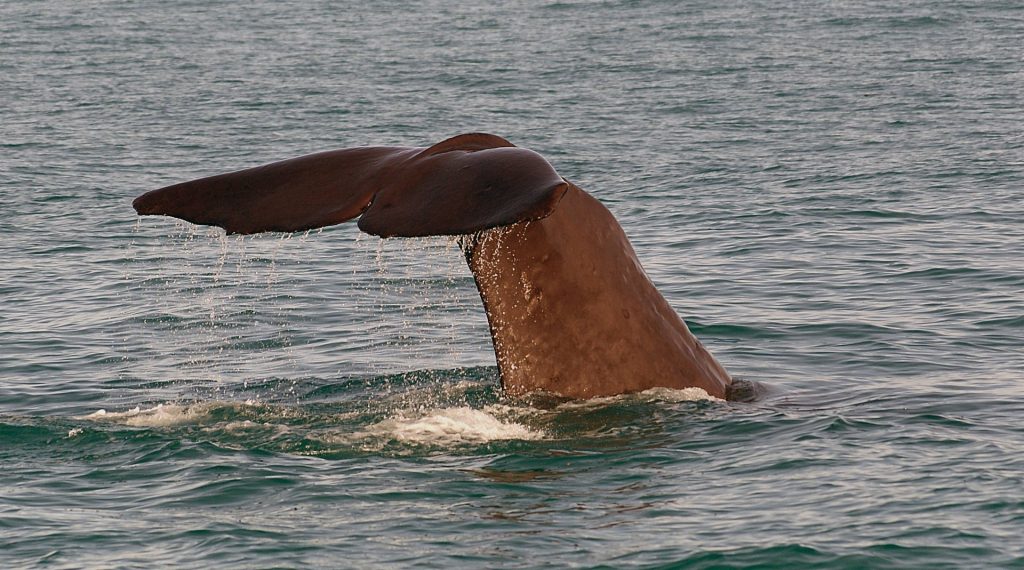
First Sperm Whale Spotted Off Sindh Coast: 45-Foot Giant Surfaces Near Karachi
A sperm whale has been spotted off the coast of Sindh for the first time ever recorded, in a rare and exciting moment for Pakistan’s marine scientists. The giant animal, estimated to be around 45 feet long, surfaced about 40 nautical miles southwest of Karachi, where it was filmed during an expedition by the World Wide Fund for Nature-Pakistan (WWF-Pakistan).
The sighting was announced by WWF-Pakistan on Friday, 6 November 2026. It is the first time the species has been documented in Sindh’s coastal waters, although sperm whales had been seen before off the coast of Balochistan. For a country whose sea life is still largely unexplored, the brief appearance of one of the ocean’s largest animals is a reminder of just how much is living, unseen, in the Arabian Sea.
What happened off Karachi
The whale was encountered during a marine expedition led by Zahid Maker, a board member of WWF-Pakistan. As the animal came to the surface to breathe, Maker managed to capture it on video before it slipped back into the deep.
The footage shows the whale’s most recognisable features: its distinctive blowhole, its wrinkled skin markings and the prominent hump along its back. Sperm whales are among the easiest whales to identify at sea, thanks to their huge, block-shaped head, which can make up around a third of their whole body length.
WWF-Pakistan’s technical adviser, Muhammad Moazzam Khan, described the sighting as an important record, saying it highlighted the extraordinary biodiversity of Pakistan’s marine ecosystem. Until now, sperm whales in Pakistani waters had only been reported off the Balochistan coast. The first live sighting in the country came in September 2017, when fishermen spotted a pair of the animals off Gunz, near Jiwani in Balochistan.
“This is the first recorded observation of a sperm whale along the Sindh coast,” the organisation said in its announcement, adding that the 45-foot animal was seen roughly 74 kilometres from Karachi.
Why this sighting matters
A single whale surfacing for a few minutes might sound like a small event. For marine researchers, it is much more than that. Every confirmed sighting adds a piece to a puzzle that is still mostly blank: what actually lives in Pakistan’s offshore waters?
“Pakistan’s waters support an extraordinary diversity of marine life, much of which remains poorly understood and documented,” said Rab Nawaz, Senior Director at WWF-Pakistan. He said the sighting showed how important Pakistan’s offshore waters are, and called for stronger conservation measures, responsible fishing practices and joint efforts to reduce pressure on marine ecosystems.
WWF-Pakistan says 26 species of whales, dolphins and other cetaceans have now been documented in the country’s waters. That list includes blue whales, the largest animals ever to have lived on Earth, Bryde’s whales, and the Arabian Sea humpback whale, a small and isolated population found only in the northern Indian Ocean. Several species of toothed whales and dolphins have been recorded in Pakistani waters for the first time thanks to WWF-Pakistan’s research and monitoring work.
The organisation has also trained more than 100 fishermen, mostly boat skippers, to record sightings of whales, dolphins and other large marine animals. That network of trained eyes at sea is one reason new records like this one keep appearing. Without it, a whale surfacing 40 nautical miles offshore would simply have gone unnoticed.
The sighting even drew an editorial in The Express Tribune on 8 November, which noted that WWF-Pakistan’s work to introduce subsurface gillnets in tuna fishing has already cut down the number of marine mammals accidentally caught in nets. The editorial argued that the discovery should encourage greater scientific interest in marine ecosystems that have received far too little attention from the authorities.
What is a sperm whale?
The sperm whale, known to scientists as Physeter macrocephalus, is the largest toothed whale in the world and the largest toothed predator on the planet. It is a mammal, not a fish: it gives birth to live young, nurses them with milk and must come to the surface to breathe air, just like the blue whale and other marine mammals.
Here are some of the facts that make this animal so remarkable:
- Size: Adult males average around 16 metres (52 feet) long, and some grow to more than 20 metres (67 feet). At about 45 feet, the whale seen off Karachi was shorter than a fully grown male, which suggests it may have been a female or a younger animal.
- The biggest brain on Earth: A sperm whale’s brain weighs around 7 to 9 kilograms, more than five times heavier than a human brain, and is the largest brain of any animal known, living or extinct.
- A giant head: The whale’s enormous, block-shaped head can account for up to a third of its body length. Inside it sits the spermaceti organ, a large structure filled with a waxy oil that helps the animal focus sound.
- One blowhole: Unlike most whales, which have two blowholes, the sperm whale has just one, set towards the left side of its head. Its spout blows forward and to the left, which is another way experts can recognise the species from a distance.
- Long life: Sperm whales can live for 60 to 70 years or more, spending most of that long life roaming the deep, dark parts of the ocean.
- Famous in literature: The sperm whale is the animal at the centre of Herman Melville’s classic 1851 novel Moby-Dick, in which Captain Ahab hunts a giant white sperm whale across the oceans.
Life in the deep: a hunter that dives two kilometres down
What makes the sperm whale truly extraordinary is where it hunts. While most whales stay near the surface, sperm whales routinely dive to depths of 300 to 800 metres in search of food, and they can plunge as deep as one to two kilometres. The deepest dives ever recorded are around 2,250 metres, more than two kilometres below the surface, where no sunlight can reach. A single dive can last 35 to 45 minutes, and some have lasted up to two hours.
Down in that darkness, the whale hunts almost entirely by sound. It produces clicks that are the loudest sounds made by any animal, measured at around 236 decibels. Those clicks work like a natural sonar system, known as echolocation: the sound waves bounce off objects and prey, and the returning echoes tell the whale the size, shape and distance of what is around it. The sperm whale’s skull is even built unevenly on purpose, which helps it aim and focus this beam of sound.
Its main food is squid. Sperm whales eat giant squid, other squid species, octopuses and deep-sea fish. In Pakistan’s coastal and offshore waters, their prey includes the purpleback flying squid and the diamondback squid, according to WWF-Pakistan. The whale’s huge appetite for squid is one reason it needs such rich, deep feeding grounds — and one reason its presence off Sindh suggests those waters hold more life than most people realise.
Pakistan’s hidden ocean life
Pakistan has a coastline of more than 1,000 kilometres along the Arabian Sea, stretching from Karachi in Sindh to Gwadar and Jiwani in Balochistan. Yet compared with the country’s mountains, deserts and rivers, its sea life has received very little study. The 26 cetacean species recorded so far are probably only part of the picture.
Among the animals already documented are some of the ocean’s most impressive creatures. Blue whales, the largest animals ever known to exist, pass through these waters. Bryde’s whales, which are smaller and live in warm tropical seas, are also found here. And the Arabian Sea humpback whale is special: unlike other humpbacks, which migrate thousands of kilometres between feeding and breeding grounds, this population stays in the northern Indian Ocean all year round.
Dolphins are far more common. Several species of dolphins and smaller toothed whales have been recorded, and fishermen regularly report seeing them around their boats. But because much of this activity happens far offshore, away from cameras and scientists, formal records are rare. That is why WWF-Pakistan’s programme of training fishermen to log sightings matters so much: the people who spend the most time at sea are often the first to spot something unusual.
The same kind of patient, long-term observation is at work in other parts of the world. In the Southern Ocean, for example, talks on protecting krill — the tiny creatures that feed whales, penguins and seals — recently ended without an agreement, leaving a key species unprotected. And the ocean’s wonders continue to draw huge audiences, as the new Blue Planet III series shows, with its remarkable footage of dolphins and other marine life.
The threats these giants face
Sperm whales are listed as Vulnerable on the International Union for Conservation of Nature (IUCN) Red List, which means they face a high risk of extinction in the wild. In the United States they are also listed as endangered under the Endangered Species Act.
The main reason is history. For centuries, sperm whales were hunted in huge numbers for their oil, which was used in lamps, candles and machinery, and for ambergris, a substance used in perfumes. Commercial whaling was largely banned by an international moratorium in 1986, and since then populations have been slowly recovering, growing at roughly 4 per cent a year according to estimates from the US National Oceanic and Atmospheric Administration (NOAA).
But the threats have not disappeared. Today, whales face accidental capture in fishing nets, collisions with ships, underwater noise from shipping and seismic surveys, and plastic and other pollution in the sea. For a slow-breeding animal that can live for 70 years and produces few calves, every loss matters. The subsurface gillnets promoted by WWF-Pakistan in tuna fisheries are one practical answer: by fishing below the surface, they greatly reduce the chance of a whale or dolphin becoming tangled.
What happens next
WWF-Pakistan says the sighting should be a spur to action, not just a moment of wonder. The organisation is calling for sustained research and monitoring, sustainable fishing practices and stronger conservation measures to protect marine life in the Arabian Sea.
That work is already under way. Fishermen trained by WWF-Pakistan continue to report what they see at sea. Research expeditions keep mapping the waters off Sindh and Balochistan. And each new record — a sperm whale here, a blue whale there — builds the case that Pakistan’s offshore waters deserve the same attention and protection as its land.
For the people of Karachi, the news is simpler and more joyful: one of the greatest animals on Earth surfaced just a short journey from their shore, took a breath, and vanished back into the blue. It was there all along. We are only just beginning to notice.
Frequently asked questions
Where was the sperm whale spotted?
About 40 nautical miles (around 74 kilometres) southwest of Karachi, off the Sindh coast, during a WWF-Pakistan marine expedition.
How big was the whale?
It was estimated to be around 45 feet (about 13.7 metres) long, which is shorter than a fully grown male sperm whale, which averages about 52 feet.
Is this the first sperm whale ever seen in Pakistan?
No. Sperm whales were first recorded alive in Pakistani waters in September 2017, when fishermen spotted a pair off Gunz, near Jiwani in Balochistan. But this is the first recorded sighting off the Sindh coast.
How many whale and dolphin species live in Pakistan’s waters?
WWF-Pakistan has documented 26 species of cetaceans — the group that includes whales, dolphins and porpoises — in the country’s waters, including blue whales, Bryde’s whales and Arabian Sea humpback whales.
Why are sperm whales able to dive so deep?
They are built for it. They can hold their breath for up to two hours, and they hunt by echolocation, using the loudest clicks of any animal to find squid in total darkness at depths of up to two kilometres.
Are sperm whales endangered?
They are listed as Vulnerable by the IUCN. Commercial whaling was banned in 1986 and numbers have been slowly recovering, but they still face threats from fishing nets, ship strikes, noise and pollution.
Conclusion
The first sperm whale recorded off Sindh is a small piece of news with a large meaning. It shows that Pakistan’s seas hold giants we are only beginning to document, and it shows that the patient work of researchers and trained fishermen is paying off. If the country protects the waters where this whale was found — through better research, safer fishing and real conservation — there will be more such moments to come. The ocean off Karachi is not empty. It is full of life, and now we have the proof on camera.
Sources
- Dawn: “Sperm whale spotted off Sindh’s coast for first time: WWF-Pakistan” — https://www.dawn.com/news/2042599
- Dawn: “Sperm whale captured on camera off Karachi coast for first time” — https://www.dawn.com/news/2042721/sperm-whale-captured-on-camera-off-karachi-coast-for-first-time
- The Express Tribune: “Giant from the deep makes a splash off Karachi” — https://tribune.com.pk/story/2639068/giant-from-the-deep-makes-a-splash-off-karachi?amp=1
- Geo News: “WATCH: 45-foot sperm whale spotted near Karachi for ‘first time'” — https://www.geo.tv/latest/690000-watch-45-foot-sperm-whale-spotted-near-karachi-for-first-time
- Aaj English: “Giant sperm whale spotted off Sindh coast for first time” — https://english.aaj.tv/news/330479613/giant-sperm-whale-spotted-off-sindh-coast-for-first-time
- Alaska Department of Fish and Game: Sperm Whale species profile — https://www.adfg.alaska.gov/index.cfm?adfg=spermwhale.printerfriendly
- Wikipedia: Sperm whale — https://en.wikipedia.org/wiki/Sperm_whale
This article is for general information and education only. It is not legal or financial advice.
