
China’s Import Expo Closes With Record $85.45 Billion in Deals — What the 9th CIIE Means for World Trade
China’s biggest trade fair for foreign goods has closed with a new record. The ninth China International Import Expo, known as the CIIE, ended in Shanghai on Tuesday, 10 November 2026, with $85.45 billion in one-year intended deals — the highest figure since the event began in 2018.
The result is a small but meaningful rise of 2.3 percent on last year’s total of $83.49 billion, and it comes at a moment when world trade is under strain from tariffs, export controls and geopolitical tension. For China, the message is clear: its giant market is still open for business, and companies from around the world still want in.
Here is what happened in Shanghai, why the numbers matter, and what the record tells us about the state of global trade.
A record year in numbers
The headline figure was announced by Xiao Lu, deputy director of the CIIE Bureau, at a press briefing after the six-day event closed. The expo ran from 5 to 10 November at the National Exhibition and Convention Center in Shanghai.
The key numbers from this year’s expo:
- $85.45 billion in one-year intended deals — a record, up 2.3 percent from the previous edition.
- 162 countries, regions and international organisations took part.
- 4,142 exhibitors filled 370,000 square metres of business exhibition space, with the total showcase spread over 440,000 square metres.
- 485 new products, technologies and services made their debut — up from 461 last year.
- More than 470,000 registered visitors attended, with 931,000 entries in total.
- 51 trading delegations and more than 700 sub-delegations took part, reaching more than 400 cooperation intentions.
Five core measures of the event, including exhibitor numbers and total floor space, reached their highest levels this year, according to the CIIE Bureau.
It is worth understanding what “intended deals” means. These are agreements of intent — promises by Chinese buyers to purchase goods and services from foreign exhibitors over the coming year. They are not the same as money already paid, and some may change as contracts are finalised. But they are the expo’s standard measure, counted the same way every year, so the year-on-year comparison is a fair guide to whether interest is rising or falling.
What is the CIIE?
The China International Import Expo is unusual. Most big trade fairs are about selling a country’s own products to the world. The CIIE works the other way round: it is the world’s first national-level expo dedicated to imports, designed to help foreign companies sell into China.
It was first held in 2018, launched by the Chinese government as a showcase for opening up its market. Each year, companies from around the world set up stalls in Shanghai to display everything from food and wine to medical equipment, cars, industrial machinery and consumer electronics. Chinese buyers — from big state companies to small retailers — walk the halls looking for products to import.
The expo has two parts. The business exhibition is where companies show and sell their products. Alongside it, a country exhibition lets nations present themselves and their industries to Chinese visitors. This year the Shanghai local delegation alone reported $11.2 billion in intended deals, making it the top local delegation for the ninth year in a row.
For many smaller companies, especially from developing countries, the CIIE is one of the few chances to get their products in front of Chinese buyers at scale. A single deal struck in Shanghai can open up a market of more than 1.4 billion people.
What was on show this year?
New products are one of the expo’s main attractions, and this year set a new high: 485 new products, technologies and services were unveiled for the first time, up from 461 at the last edition.
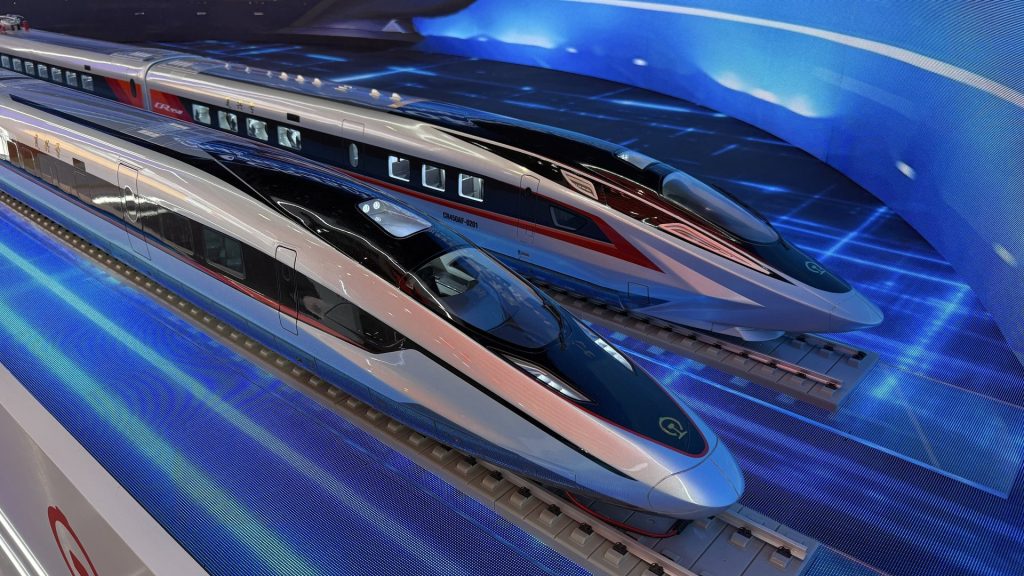
The displays spanned the industries China is most interested in right now. Medical and health technology, green and low-carbon equipment, advanced manufacturing and consumer goods all featured heavily. High-speed rail was among the showpieces: models of China’s CR450 trains, the next generation of its bullet-train fleet, were on display at the expo.
The scale of the event keeps growing. The business exhibition covered 370,000 square metres — filled for the first time — and exhibitors came from 162 countries, regions and international organisations. The total exhibition area, including the country displays, reached 440,000 square metres.
Planning for next year has already begun. Around 143 overseas companies and institutions have already signed up for about 100,000 square metres of exhibition space at the tenth CIIE, due to be held in November 2027.
Why the record matters
A record at a trade fair might sound like a small story. In the current climate, it is not. World trade in 2026 has been shaped by tariffs, export controls and a fragile truce between the world’s two largest economies, China and the United States.
In the past few weeks, both sides have taken steps to lower the temperature. China has suspended part of its export controls on dual-use items — goods that can be used for both civilian and military purposes — for shipments to the United States, with the suspension running until 27 November. It has also extended a pause on rare-earth export controls until 10 January 2027. These are the kinds of measures that decide whether factories can get the materials they need, and whether prices stay stable for consumers.
The CIIE record sits in the middle of that picture. If companies were losing faith in trading with China, they would not be signing up in record numbers or promising to buy more. The $85.45 billion figure suggests that, whatever the politics, businesses still see China’s market as worth investing in.
China’s own trade numbers point the same way. Official customs data released on Tuesday showed China’s total foreign trade in goods grew 20 percent in the first ten months of 2026, reaching 44.81 trillion yuan — about $6.67 trillion. Imports rose 23.6 percent and exports rose 17.6 percent over the same period, with booming demand for artificial intelligence lifting exports of chips, memory components and other electronic products.
In other words, the expo is not an isolated event. It reflects a broader pattern: China’s trade with the world is still growing, and its appetite for imports is growing fastest of all.
What it means for the rest of the world
For countries that export to China, the CIIE is a barometer. A strong expo means Chinese buyers are confident and spending. A weak one would suggest they are pulling back.
The record also matters for a debate that has run for years: whether the world economy is splitting into rival blocs that barely trade with each other. The CIIE’s answer, at least this year, is that trade still flows. Companies from 162 countries and regions showed up in Shanghai, and many of them left with deals.
For developing countries, the expo has a special significance. China has presented the CIIE as a way for smaller economies to reach its market — a chance that would be hard to get through normal trade channels. Whether that promise is fully delivered is a matter of debate, but the attendance figures show that countries keep coming back.
There is also a message for China itself. In its 15th Five-Year Plan, covering 2026 to 2030, China has pledged to keep hosting the CIIE at a high standard, describing it as the world’s premier gateway into the Chinese market. The record result gives that pledge a strong start.
What happens next
The tenth CIIE is already taking shape. With 143 overseas companies signed up for about 100,000 square metres of space, the 2027 edition is on course to be at least as large.
But the real test will be whether the intended deals turn into real orders. Over the next twelve months, the $85.45 billion in promises will be tested against the realities of shipping, payment and demand. If most of them hold, the record will look like a turning point. If many fall through, it will look like a good week in Shanghai and little more.
The wider trade picture will matter too. The current easing between China and the United States is temporary by design — the dual-use suspension expires on 27 November and the rare-earth pause on 10 January. What happens after those dates will shape whether the optimism in Shanghai lasts.
For now, though, the message from the expo floor is simple. After nine years, the world’s biggest import fair is still growing, still breaking records, and still drawing the world to Shanghai.
Frequently asked questions
What is the China International Import Expo?
The CIIE is an annual trade fair in Shanghai dedicated to imports. Foreign companies display their products to Chinese buyers. It was first held in 2018 and is the world’s first national-level expo focused on imports.
How much business was done at the 2026 expo?
The ninth CIIE recorded $85.45 billion in one-year intended deals, a record high and 2.3 percent more than the previous edition’s $83.49 billion.
What are “intended deals”?
They are agreements of intent by Chinese buyers to purchase goods and services from foreign exhibitors over the coming year. They are not the same as money already paid, but they are counted the same way each year, so they show whether interest is rising or falling.
How many countries took part?
A total of 162 countries, regions and international organisations participated, with 4,142 exhibitors and more than 470,000 registered visitors.
When is the next CIIE?
The tenth CIIE is due to be held in November 2027. Around 143 overseas companies and institutions have already booked about 100,000 square metres of exhibition space.
Conclusion
The ninth China International Import Expo closed on Tuesday with a record $85.45 billion in intended deals, more exhibitors, more new products and more visitors than ever before. In a year of tariffs and trade tension, the numbers tell a story that runs against the gloom: companies from 162 countries still want to sell to China, and Chinese buyers still want to buy.
The record does not settle the big questions about world trade. It does not guarantee that the deals will all be honoured, and it does not mean the tensions between China and the United States are over. But it is a reminder that trade is driven by buyers and sellers as much as by governments — and in Shanghai this week, the buyers and sellers were busy.
Sources
This article is for general information and education only. It is not legal or financial advice.
