
Pakistan Blames India’s Diwali Fireworks for Lahore’s Toxic Smog — But the Evidence Is More Complicated
Lahore is choking again. Pakistan’s second-largest city has topped the list of the world’s most polluted major cities for a second day in a row, and the Punjab government says the blame lies across the border — with the fireworks set off during Diwali in India.
But independent air-quality experts in Pakistan say the picture is not that simple. Their assessment found that the available evidence does not prove Diwali fireworks caused Lahore’s pollution spike, and that crop burning, local pollution and still winter weather all played a part.
The row has turned a familiar winter crisis into a cross-border blame game, with each side pointing at the other’s smoke while millions of people breathe some of the dirtiest air on the planet.
What happened in Lahore this week
Lahore topped Swiss air-quality group IQAir’s ranking of the world’s most polluted major cities for a second day on Tuesday, 10 November, with an Air Quality Index (AQI) reading of 263. That level is classed as “very unhealthy”, meaning the air can cause serious health effects for everyone, not just people with breathing problems.
The city’s concentration of PM2.5 — tiny particles small enough to pass deep into the lungs and into the bloodstream — was 37.2 times above the World Health Organization’s annual guideline, according to IQAir.
It was not even the worst of the week. Lahore’s AQI had crossed the 600 mark on Sunday, 8 November, the day of Diwali, when fireworks lit up skies across northern India. Readings at individual monitoring stations in the city were far higher still: Allama Iqbal Town recorded an AQI of 1,063, Punjab University 768, Bedian 746, Upper Mall 621 and the Civil Secretariat 614.
By Monday, the air had improved sharply. Punjab Senior Minister Marriyum Aurangzeb said Lahore’s overall AQI had fallen to 208, with station readings dropping to 155 at the Civil Secretariat, 172 at Bedian, 177 at Upper Mall, 181 at Punjab University and 207 in Allama Iqbal Town. She credited the provincial government’s anti-smog operations, better weather and stronger winds.
The smog has already disrupted daily life beyond the health warnings. The second Test match between Pakistan and Sri Lanka, due to be played in Lahore next week, has been moved to Rawalpindi because of the worsening smog — a decision that underlines how the pollution crisis now reaches into sport, schools, business and transport, not just public health.
What Pakistan’s government says
Punjab’s Environment Protection Minister, Marriyum Aurangzeb, said the pollution had been carried into Pakistan by light winds and air drifting from India in the aftermath of Diwali, when firecrackers set off over the weekend blanketed much of northern India in toxic smog.
In statements posted on X, Aurangzeb named the Indian cities she said the polluted air had come from: Bathinda, Jalandhar, Firozpur, Ludhiana, Khem Karan, Amritsar, Fazilka and Tarn Taran. She said the smoke had entered Lahore through the eastern corridor — the stretch of border closest to the city — and pushed pollution levels up sharply on 8 November.
“However, air pollution is expected to gradually decrease from early afternoon as weather conditions improve and winds shift direction,” she added.
The claim is not new. Pakistan made a similar argument in 2024, when it attributed its toxic air to crop-waste burning in Indian Punjab. At the time, officials from India’s weather department pushed back, saying the wind direction meant the airflow was actually moving from Pakistan into India.
India’s foreign ministry did not immediately respond to a request for comment on the latest claim.
What Delhi’s own numbers show
Across the border, Delhi was the world’s second-most polluted major city on Tuesday, with an AQI of 188. Indian government data showed that firecrackers were responsible for nearly 55 percent of the PM2.5 in the Indian capital a day earlier — a striking figure that shows just how much smoke Diwali fireworks can produce in a single night.
The Delhi government, meanwhile, has blamed stubble burning in Punjab for contributing to the worsening pollution in the national capital. Punjab recorded its sharpest single-day spike in farm fires this season on Diwali itself, with 1,152 fresh stubble-burning incidents reported in a single day.
So both sides are, in effect, blaming each other for the same grey cloud. Pakistan says Indian fireworks poisoned Lahore’s air. India says Pakistani farm fires poisoned Delhi’s air. The truth, as the data suggests, is that both are partly right — and that neither side’s smoke respects a border.
What the evidence actually says
Here is where the story gets more complicated. An assessment by the Pakistan Air Quality Initiative (PAQI), an independent group, released on 10 November, questioned the specific claim that Diwali fireworks caused Lahore’s pollution spike.
PAQI found that while air trajectories did travel from India towards Pakistan, the available evidence did not establish fireworks as the cause of the city’s deteriorating air quality. Telling fireworks smoke apart from agricultural smoke, the group said, would require chemical analysis of the particles in the air — looking for elements such as potassium, strontium and barium, which are markers of firework smoke. Pakistani monitoring stations did not measure those elements, so the distinction could not be made.
What PAQI could measure was the scale of crop burning. The group detected 16,714 likely crop-residue fires in Punjab between 1 October and Monday, 9 November. A separate assessment by Punjab’s own Environment Protection and Climate Change Department had warned on Sunday that Diwali fireworks and crop-residue burning in Indian Punjab could worsen air quality in Lahore and adjoining districts.
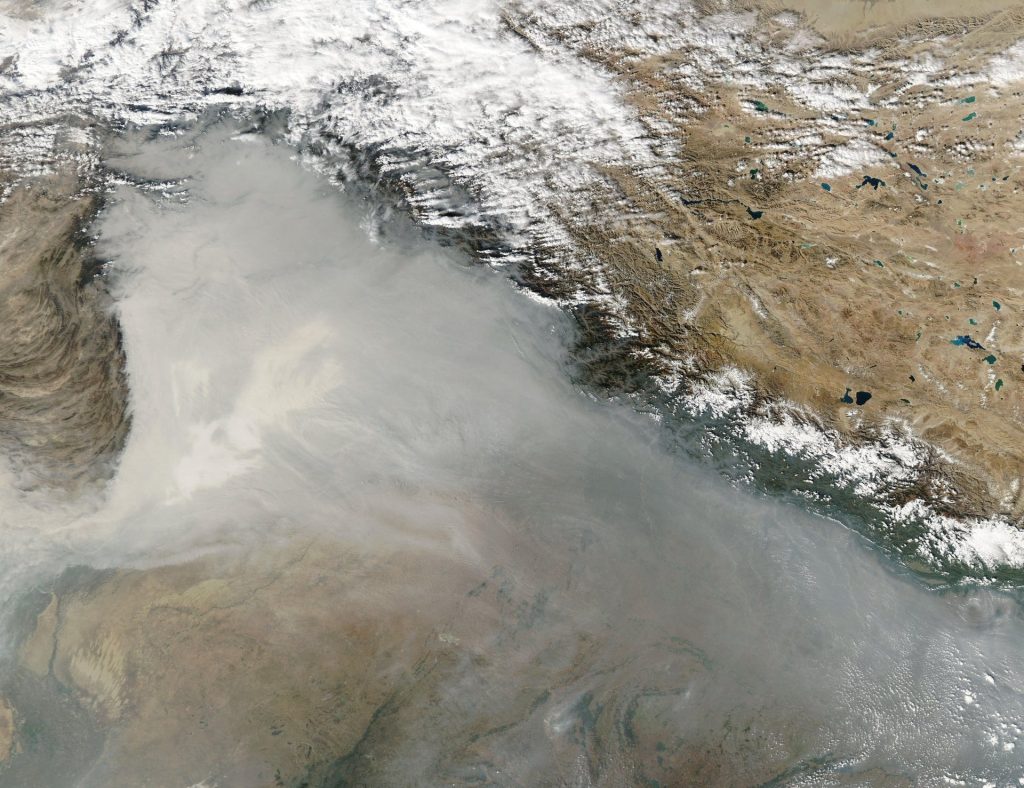
In other words, the smoke over Lahore almost certainly came from a mix of sources: fireworks across the border, stubble burning on both sides of it, vehicle exhaust, factory emissions and dust from construction — all of it trapped close to the ground by the cold, still air of early winter.
Why Lahore’s air turns toxic every winter
Lahore’s smog crisis is not a one-week story. It returns every winter, and the pattern is now painfully familiar to the city’s residents.
As temperatures drop in late October and November, a layer of cold air settles over the Punjab plains. Smoke from vehicles, factories, brick kilns, crop burning and household heating gets trapped beneath it instead of rising and dispersing. The result is a thick grey haze that can last for days or weeks, cutting visibility to a few hundred metres and filling hospitals with patients suffering from coughs, asthma attacks, eye infections and chest problems.
The geography makes it worse. Lahore sits in a flat river plain, only a short distance from the Indian border, and the winter winds often blow from the east — carrying smoke from Indian Punjab’s fields and cities straight towards the city. At the same time, Lahore produces plenty of its own pollution: millions of vehicles, thousands of factories and brick kilns, and open burning of waste.
That is why the annual argument over whose smoke it is misses the point. The air over Lahore and Delhi is shared. Smoke from a fire in Amritsar can reach Lahore in hours, and smoke from a fire in Pakistani Punjab can reach Delhi just as easily. Neither city can clean its air alone.
What the numbers mean for your health
An AQI of 263, as Lahore recorded on Tuesday, falls in the “very unhealthy” band. At that level, health experts advise everyone to avoid outdoor exercise, keep windows closed, and wear a proper face mask — an N95 or equivalent — when going outside. People with heart or lung conditions, older adults and children should stay indoors as much as possible.
A PM2.5 level 37.2 times the WHO annual guideline is far beyond what the human body is built to handle. These particles are less than 2.5 micrometres across — about 30 times smaller than the width of a human hair — and they can pass from the lungs into the bloodstream, raising the risk of heart attacks, strokes and lung disease over time.
The readings above 600 recorded on Sunday fall into the “hazardous” band, the worst category on the scale. At that point, the official advice is simple: stay inside, and if you must go out, do not stay out for long.
What happens next
The immediate outlook offers some relief. Pakistan’s Meteorological Department has forecast rain, wind and thunderstorms, with snowfall over the hills, in the upper parts of the country over the next two to three days, and daytime temperatures are expected to fall by 2 to 4 degrees Celsius. Rain washes particles out of the air, and stronger winds help disperse the haze — which is one reason Lahore’s AQI fell from above 600 on Sunday to 208 on Monday.
But the longer-term picture is unchanged. The smog season in Punjab typically runs from November to January, and without coordinated action on both sides of the border — on crop burning, vehicle emissions, industrial pollution and brick kilns — the same crisis will return next winter, and the winter after that.
For now, the blame game continues. Pakistan’s government says India’s fireworks poisoned Lahore’s air. Independent experts say the evidence does not prove that — and that Lahore’s own fires and fumes did plenty of the damage. What nobody disputes is the number on the monitor: for a second day running, Lahore’s air was among the worst of any major city on Earth.
Frequently asked questions
Why is Lahore’s air so bad right now?
A mix of Diwali fireworks in India, crop-residue burning on both sides of the border, vehicle and factory emissions, and cold, still winter weather that traps smoke close to the ground. Lahore recorded an AQI of 263 on Tuesday, 10 November, and above 600 on Sunday, 8 November.
Did India’s Diwali fireworks cause Lahore’s smog?
The Punjab government says pollutants drifted across the border from India after Diwali. But an assessment by the Pakistan Air Quality Initiative found insufficient evidence to prove fireworks specifically caused the spike, because the chemical markers that would identify firework smoke were not measured. Crop burning and local pollution also contributed.
How bad is an AQI of 263?
It is classed as “very unhealthy”. Everyone may experience serious health effects, and people with heart or lung conditions, older adults and children should avoid going outside. Lahore’s PM2.5 level was 37.2 times the WHO annual guideline.
Is Delhi affected too?
Yes. Delhi was the world’s second-most polluted major city on Tuesday, with an AQI of 188. Indian government data showed firecrackers caused nearly 55 percent of Delhi’s PM2.5 a day earlier. The Delhi government has blamed stubble burning in Punjab for part of its pollution.
Will the smog clear soon?
Rain and stronger winds forecast over the next two to three days should help, and Lahore’s AQI already fell from above 600 on Sunday to 208 on Monday. But the smog season usually lasts until January, so poor air is likely to return.
Conclusion
Lahore’s toxic air this week is a reminder that pollution does not carry a passport. Fireworks in Delhi, stubble fires in Punjab, exhaust fumes in Lahore — the smoke mixes in the same winter air and settles over the same cities, whichever side of the border it started on.
The Punjab government has blamed India’s Diwali fireworks, and Delhi’s own data shows those fireworks produced a huge share of the Indian capital’s pollution. But the independent evidence from Pakistan suggests the story is bigger and messier than a single cause: thousands of crop fires, local emissions and trapped winter air all played their part.
Until both countries tackle the sources of the smoke together, Lahore’s residents will keep waking up to grey skies — and keep arguing about whose smoke it is.
Sources
This article is for general information and education only. It is not legal or financial advice.
