
Pakistan Calls COP31 ‘Theater’ as Climate Minister Demands Grants, Not Loans, for Flood Recovery
Pakistan’s climate minister has called the United Nations climate talks “theater”, accusing the world’s richest countries of forcing disaster-hit nations to rebuild with loans instead of grants — and leaving Pakistan to pay for a crisis it did almost nothing to cause.
Dr Musadik Malik, Pakistan’s Federal Minister for Climate Change, made the blunt remarks at COP31, the UN climate summit taking place in Antalya, Türkiye. His message was simple: when floods destroy homes, schools and hospitals, the world should not hand the victims a bill.
“We took the loans dedicated to health and education and we put them in reconstruction,” Malik said at the summit. “That was the world’s solution.”
It was one of the sharpest attacks on the climate finance system heard at this year’s talks — and it came from a country that has become the symbol of climate injustice: responsible for less than 1 percent of global greenhouse gas emissions, yet repeatedly devastated by floods made worse by a warming planet.
What Pakistan’s climate minister said
Malik was speaking at a session at the Pakistan Pavilion titled “Adapting Under Austerity: Delivering Paris Commitments in Debt-Stressed, Climate-Vulnerable Economies: A Parliamentary Perspective”. The session was organised by the Parliamentary Forum on Energy and Economy together with the Asian Peoples’ Movement on Debt and Development, and brought together lawmakers, policymakers and experts from Pakistan and other climate-vulnerable countries.
His criticism had two targets. The first was the way climate money actually arrives — or does not arrive. The second was the language of the negotiations themselves.
“And we still all of us show up for this theater every year,” Malik said, criticising negotiations over wording that he said allowed governments to avoid binding commitments.
He was equally direct about the financial instruments that rich countries and lenders keep offering. “All these fancy words — green sukuk, blended finance, green bonds — these are debt instruments,” he said. “Our shop is closed for debt.”
The point, he argued, is that a loan is not help when the borrower is already drowning in repayments. Of the roughly Rs16 trillion Pakistan collects in revenue, he noted, about Rs8 trillion — half of everything the state takes in — goes on servicing debt. That leaves little room for building flood defences, repairing schools or preparing for the next disaster.
The floods that left Pakistan paying twice
Malik’s anger is rooted in what Pakistan has lived through in the past four years. The numbers explain why.
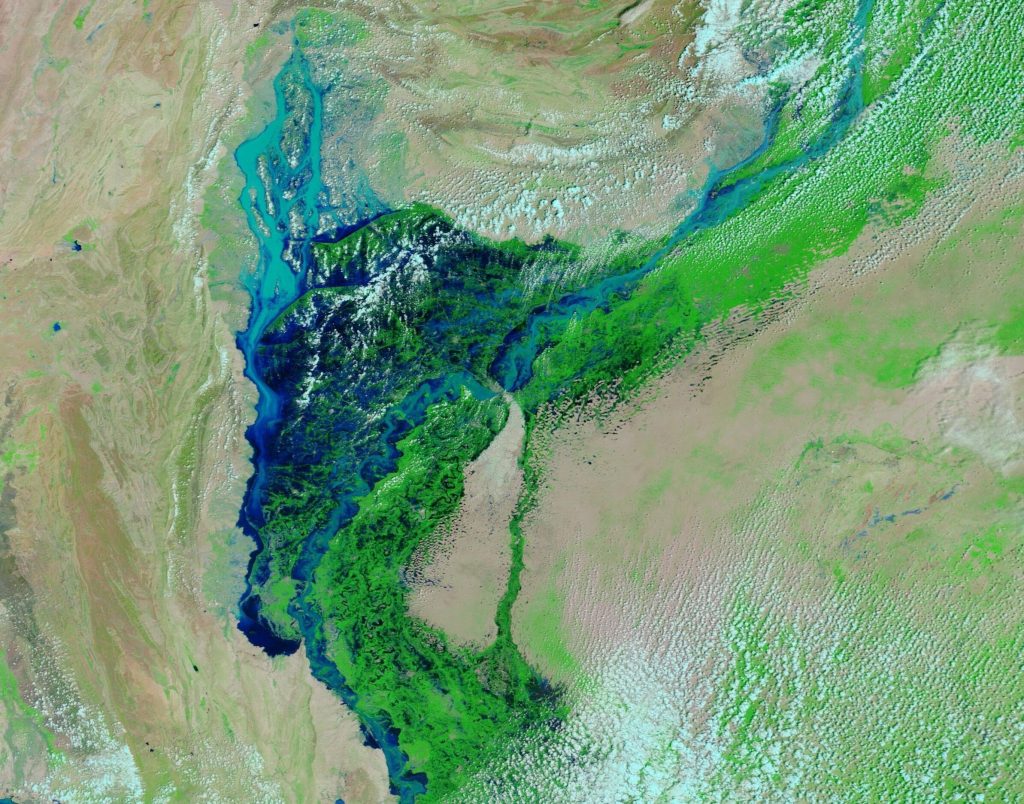
The floods of 2022 affected 33 million people, killed more than 1,730 and caused more than $30 billion in damage and economic losses, according to a government-led assessment that put recovery and reconstruction needs at $16.3 billion.
Then the floods struck again in 2025, killing more than 1,000 people, displacing more than 4 million and causing an estimated $2.9 billion in damage, according to Pakistan’s latest Economic Survey.
Over the past five floods, Malik said, 6,000 people have died, 20,000 have been injured or disabled and 40 million have been affected or displaced.
And the 2022 floods alone cost about 9 percent of the country’s gross domestic product to rebuild, he said. The world’s answer, in his words, was $8 billion to $10 billion in repurposed loans — money originally meant for health and education in a country ranked around 165th in human development.
The Asian Development Bank said in December 2022 that it had repurposed $71 million from existing loans as part of a $554 million flood assistance package. The bank’s announcement did not specify whether the reallocated money came from health or education projects, and Malik did not identify the loans or say how much was redirected. But the wider point stands: much of the money Pakistan received after its worst disaster in living memory was not new money. It was old money, moved from one purpose to another.
Separately, international partners pledged more than $9 billion for Pakistan’s recovery at a UN co-hosted conference in Geneva in January 2023, with commitments from the Islamic Development Bank, the World Bank and Saudi Arabia among the largest. Pledges, however, are not the same as money in hand — a theme that ran through everything Malik said in Antalya.
The Loss and Damage Fund: promised, pledged — but not delivered
At the heart of Pakistan’s complaint is the Loss and Damage Fund, agreed at COP27 in 2022 to help vulnerable developing countries cope with climate losses that cannot be avoided — the homes, farms and lives already lost, not just the damage that can be prevented.
By the end of March 2026, donors had pledged about $826 million to the fund, of which about $456 million had been paid in, according to UN climate records. Italy and France pledged the equivalent of about $116 million and $111 million respectively, while the United Arab Emirates pledged $100 million and Germany about $98 million.
But Malik told the COP31 session that the fund had collected $422 million and that “not one dime” had reached affected communities. The difference between money paid into a fund and money reaching a flooded village is the gap Pakistan is protesting.
Malik also criticised the pace of funding for other countries, citing Nepal. The Loss and Damage Fund said in October that it had provisionally set aside $21.6 million for Nepal after flash floods in the Bhote Khosi area and opened an expedited route for the country to submit a funding request. The announcement did not report a payment.
For Pakistan, the fund’s slow start is not an administrative detail. It is the difference between rebuilding a school with a grant and rebuilding it with a loan that must be repaid with interest — while the next flood is already on its way.
“Financing is chasing emissions, not vulnerability”
Malik’s second charge was about where climate money goes. “Ten countries produce 70 percent of greenhouse gas emissions. Those same ten countries receive 80 percent of green finance,” he said. “Financing is chasing emissions, not vulnerability.”
In other words, the countries that caused the problem are also the ones receiving most of the money meant to fix it, while the countries suffering the worst consequences get the least.
The squeeze is getting worse, not better. Malik told the session that international assistance to developing countries had fallen by 23 percent in a single year, taking it back to 2015 levels, while negotiators argued over pledges to triple it. Overall official development assistance fell 23.1 percent in real terms in 2025 compared with 2024, according to preliminary OECD figures.
Against that background, the climate finance agreement reached at COP29 looks thin. It set a goal of at least $300 billion a year for developing countries by 2035, with developed countries taking the lead, and called for public and private financing from all sources to rise to at least $1.3 trillion a year by then. Those goals cover climate action more broadly and are separate from pledges to the Loss and Damage Fund — but for countries like Pakistan, the question is the same: will the money actually arrive, and will it arrive as help rather than debt?
The climate-debt trap — and the alternatives
Opening the session, Dr Nafisa Shah, a member of the National Assembly and co-convenor of the Parliamentary Forum on Energy and Economy, said parliaments must be at the centre of the climate and budget debate because they pass budgets, oversee spending and voice public concerns.
She described the cycle Pakistan is caught in as a “climate-debt trap”. “Communities that contributed almost nothing to the climate crisis are being asked to rebuild their lives through additional debt,” she said.
Her list of alternatives was concrete: grants instead of loans, concessional finance, climate-resilient debt clauses that pause repayments when disaster strikes, debt swaps, rechanneling of Special Drawing Rights, guarantees, and effective access to the Loss and Damage Fund.
Danyal Chaudhry, a member of the National Assembly, parliamentary secretary for information and broadcasting and secretary of the forum, said legislators must ensure that international climate commitments are reflected in national laws and budgets. “Climate finance should not create additional debt vulnerabilities for countries that are already facing significant fiscal pressures,” he said.
The message from the whole Pakistani delegation was consistent: the problem is not a lack of promises. It is that the promises arrive as debt, late, or not at all.
What Pakistan is doing with its own money
Malik was keen to stress that Pakistan is not simply waiting for help. Citizens and farmers have installed an estimated 33 to 37 gigawatts of rooftop solar, he said, and clean sources now make up 55 percent of the country’s energy mix. The target is 70 to 75 percent in the next few years.
On adaptation, Minister of State for Climate Change Dr Shezra Mansab Ali Khan Kharal pointed to results already on the ground. With United Nations Development Programme support, 284 early-warning stations now protect about 700,000 people in Gilgit-Baltistan and Khyber Pakhtunkhwa. In Sindh, more than one million climate-resilient homes have been completed for flood-affected families, with ownership rights granted to women.
She said the federal Climate Budget Statement had already mapped more than 5,000 cost centres for climate-related spending. “Parliament should now be able to follow each programme from allocation through to measurable results,” she said. Grant-based finance, she added, was especially important for adaptation and for loss and damage.
Separately at COP31, Pakistan’s National Disaster Management Authority called for more predictable and accessible climate finance to help vulnerable countries prepare for disasters. It said international funding and technology sharing were needed to improve early warnings, strengthen infrastructure and help local authorities act before hazards strike. Its National Emergencies Operations Center combines satellite observations, weather forecasts and ground data with artificial intelligence tools to identify communities and infrastructure at risk, and sends alerts to provincial and district authorities — but, it said, acting on those warnings requires local agencies to have the resources and plans in place to respond.
What happens next at COP31
COP31 runs from November 9 to 20 at the Antalya EXPO Center in Türkiye, and the final week is where the hardest decisions are taken. A draft deal circulated in Antalya calls for a faster phase-out of fossil fuels, but governments remain divided over coal, oil, gas and climate finance.
Malik’s intervention adds to pressure that was already building. Last week, Prime Minister Shehbaz Sharif also called for grant-based climate financing and a significant increase in funds for resilience and adaptation, telling a high-level session in Antalya that vulnerable countries needed timely financial assistance that did not add to their debt burden.
“When climate disasters strike, vulnerable countries need timely assistance and financing that does not deepen their debt. We call for grant-based finance, including public-private partnerships, alongside a significant increase in resilience and adaptation funds, which are essential for the survival of struggling economies,” the prime minister said.
Whether the final COP31 agreement reflects that demand will be decided in the coming days, as negotiators work toward the Friday deadline. For Pakistan, the test is not the wording of the final text. It is whether the money that follows is a grant or another loan — and whether it reaches the people still rebuilding from the floods of 2022 and 2025.
Why it matters
Pakistan’s outburst matters because it is not only Pakistan’s complaint. Dozens of developing countries face the same arithmetic: climate disasters are getting more frequent and more expensive, aid is falling, and the finance on offer mostly arrives as debt. If the world’s answer to a flood is a loan, then every disaster makes the next one harder to survive.
The “theater” remark will be remembered because it was undiplomatic — and because it was true to the experience of the countries in the room. Negotiators can argue about wording for another year. The families in Sindh who lost their homes in 2022 and again in 2025 cannot wait for the next round of talks.
Frequently asked questions
What is COP31?
COP31 is the 31st United Nations Climate Change Conference, held from November 9 to 20, 2026, at the Antalya EXPO Center in Antalya, Türkiye. Nearly 200 governments are negotiating action on cutting emissions, adapting to climate change and financing the response.
What did Pakistan’s climate minister say at COP31?
Climate Minister Dr Musadik Malik called the UN climate talks “theater” and said Pakistan had been forced to redirect loans meant for health and education into flood reconstruction. He said Pakistan’s “shop is closed for debt” and demanded grant-based climate finance instead of loans.
What is the Loss and Damage Fund?
It is a fund agreed at COP27 in 2022 to help vulnerable developing countries cope with climate losses that cannot be avoided. By the end of March 2026, donors had pledged about $826 million, of which about $456 million had been paid in, according to UN climate records. Pakistan argues the money is not reaching affected communities fast enough.
Why does Pakistan say climate finance is unfair?
Pakistan contributes less than 1 percent of global greenhouse gas emissions but is among the countries worst hit by climate disasters. Its minister told COP31 that the ten countries producing 70 percent of emissions receive 80 percent of green finance, while half of Pakistan’s revenue goes on debt servicing.
What does Pakistan want instead of loans?
Grants, concessional finance, climate-resilient debt clauses that pause repayments after disasters, debt swaps, rechanneling of Special Drawing Rights, guarantees, and faster, effective access to the Loss and Damage Fund.
Conclusion
Pakistan went to COP31 with a simple demand: when a country that did almost nothing to cause climate change loses homes, schools and lives to floods, the world should help it rebuild — not lend it the money and charge interest.
Dr Musadik Malik’s word for the current system was “theater”. The test of whether he was right will come in the final days of the Antalya talks, when governments must decide whether climate finance for the world’s most vulnerable countries arrives as grants or as more debt. For the 33 million Pakistanis affected by the 2022 floods, and the millions more hit again in 2025, that is not a diplomatic question. It is the difference between recovery and a debt trap that never ends.
Sources
- Arab News — “Pakistan climate minister calls COP31 ‘theater,’ criticizes reliance on loans”: https://www.arabnews.pk/pakistan/pakistan-climate-minister-calls-cop31-theater-criticizes-reliance-on-loans-3007272
- Business Recorder — “No loans, only grants for climate recovery, Pakistani lawmakers urge”: https://www.brecorder.com/news/40449202/no-loans-only-grants-for-climate-recovery-pakistani-lawmakers-urge
- UrduPoint — “Pakistan calls for grants over debt to fund climate recovery at COP31”: https://www.urdupoint.com/en/pakistan/pakistan-rejects-debt-funded-climate-recovery-2291608.html
This article is for general information and education only. It is not legal or financial advice.

Pingback: COP31: Fossil Fuels Vanish from New Draft Deal as Climate Talks Enter Final Day - Findivoza