
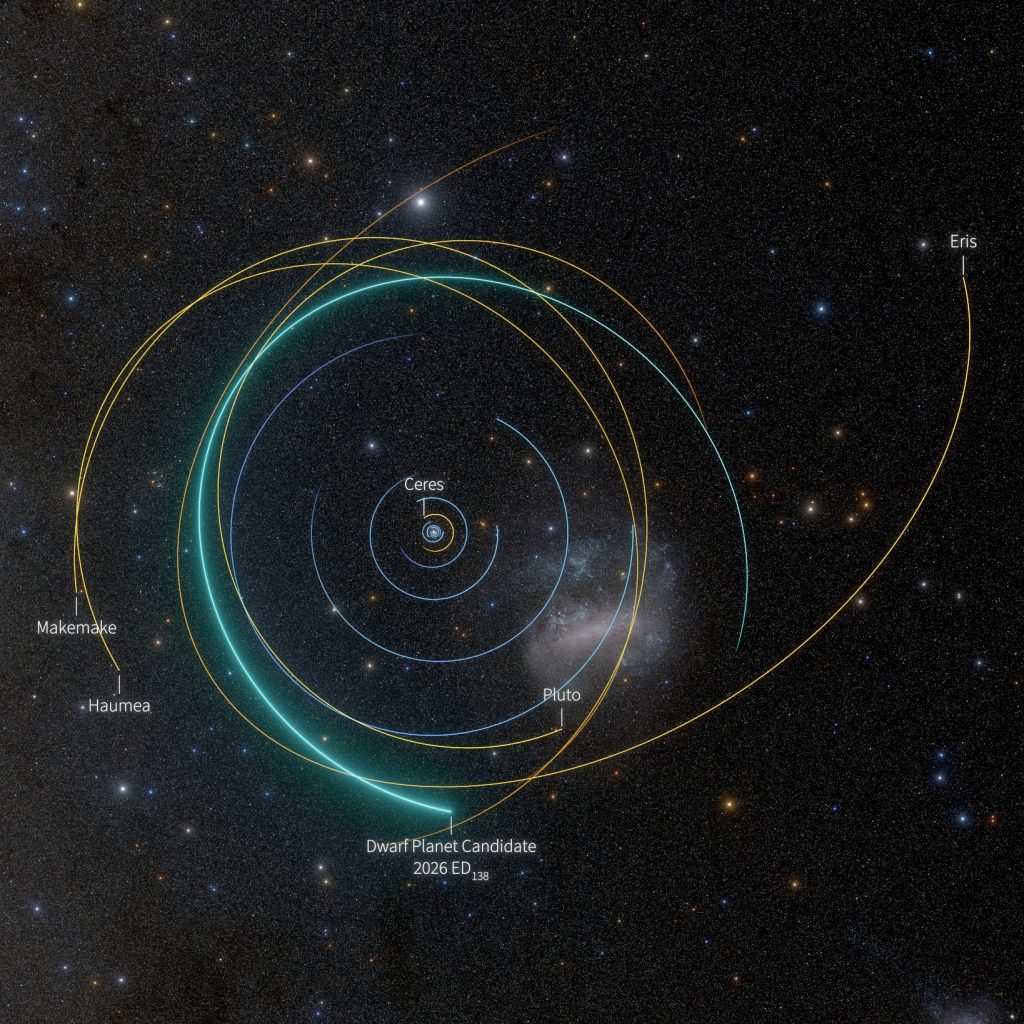
A possible new dwarf planet is hiding beyond Pluto
Astronomers may have found a new dwarf planet beyond Pluto: a large, icy world that had been hiding against the crowded star field of the Milky Way. The object, named 2026 ED138, was announced on 27 October 2026 at a meeting of planetary scientists in Spokane, Washington, after it turned up in data from the Vera C. Rubin Observatory in Chile.
It sits about 46 times farther from the Sun than Earth is, beyond Pluto, which orbits at an average of 40 times Earth’s distance. From its brightness and distance, astronomers estimate it is between 600 and 1,500 kilometres (370 to 930 miles) wide — smaller than Pluto, at about 2,370 kilometres, but still the largest object found beyond Neptune in about 20 years.
The discovery was made on 13 October by Matthew Holman of the Center for Astrophysics | Harvard & Smithsonian, who ran Rubin data through search software he built with colleague Kevin Napier. Rubin had photographed the object 30 times on 20 nights between 4 March and 11 July 2026, and older images from another Chilean telescope traced it back to 2016. Its orbit is tilted by almost 25 degrees from the flat plane of the Solar System, one reason earlier surveys missed it.
For now, 2026 ED138 is a candidate, not a confirmed dwarf planet. A dwarf planet must be massive enough for its own gravity to pull it into a round shape, but not so dominant that it clears other objects from its orbit. Astronomers still need infrared observations to pin down its true size and shape.
Why it matters
Only five dwarf planets are officially recognised: Pluto, Ceres, Eris, Haumea and Makemake. A sixth would be the first addition to that small family — and a sign of what Rubin can do. With the world’s largest digital camera, Rubin is scanning the whole southern sky every few nights over a ten-year survey, and it found this object early in its survey. Astronomers expect more distant worlds to turn up in the same data.
What happens next
Follow-up observations are being planned, including infrared measurements that should settle the object’s size. If they confirm it is large and round enough, the International Astronomical Union would decide whether to add it to the official list. Either way, Rubin will keep imaging the southern sky for a decade.
This article is for general information and education only. It is not legal or financial advice.
Sources
- https://physics.aps.org/articles/v19/147 (Physics, 30 October 2026)
- https://earthsky.org/space/new-dwarf-planet-candidate-ed138/ (EarthSky, 30 October 2026)
- https://kwsn.com/2026/10/28/possible-new-dwarf-planet-identified-orbiting-beyond-pluto/ (Reuters via KWSN, 28 October 2026)
