
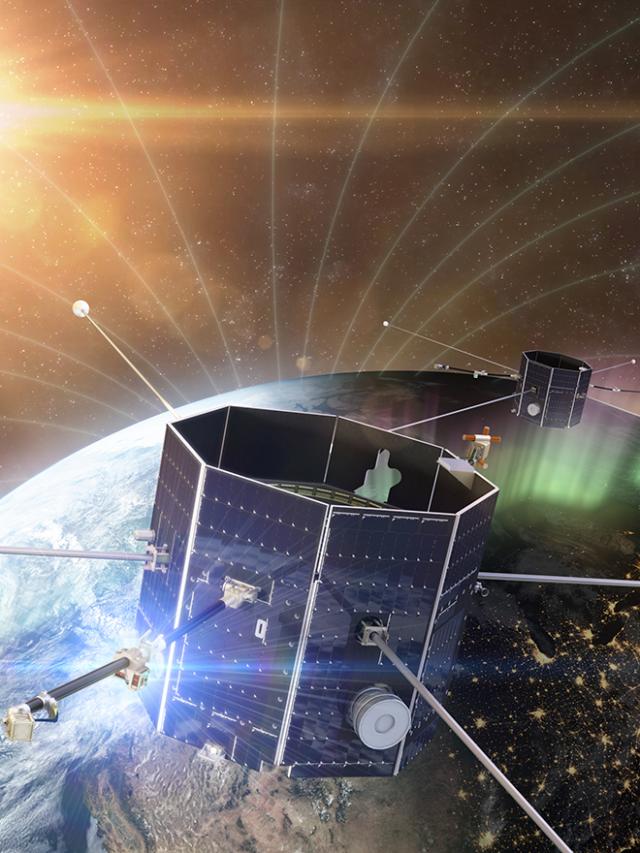
NASA’s twin TRACERS satellites find space weather’s violent spark moves around more than it changes
High above Earth, where our planet’s magnetic shield meets the wind blowing from the Sun, magnetic field lines snap apart and rejoin in violent bursts of energy. It is one of the most important processes in space weather, and for years scientists have argued over a simple question about it: does it change mainly because time passes, or mainly because the place where it happens moves?
NASA’s twin TRACERS satellites have now given the first clear answer: place over time. In results published on 29 October 2026, researchers found that magnetic reconnection — the snapping and rejoining of magnetic field lines — is largely a spatial process: where it is happening moves around more than the process changes from one moment to the next.
That may sound like a small detail, but it matters for anyone who depends on satellites, power grids, radio communications or GPS. Reconnection is the main way energy from the solar wind gets into Earth’s magnetic environment, and the starting point for geomagnetic storms. Knowing whether that energy arrives through a shifting location or through rapid changes over time helps scientists build better forecasts of space weather — the storms from space that can disrupt everyday technology.
What happened: NASA published the first results from its twin TRACERS satellites on 29 October 2026, showing that magnetic reconnection at Earth’s magnetic boundary is largely a spatial process, based on 207 paired observations of the southern polar cusp.
Why it matters: Reconnection is the main link between the solar wind and Earth’s space environment, and it drives geomagnetic storms that can affect astronauts, power grids and communication systems.
What happens next: NASA extended the mission in September 2026, so the satellites will keep observing reconnection events into spring 2027, and future measurements will test whether the first finding holds up.
What magnetic reconnection actually is
Earth is surrounded by an invisible shield called the magnetosphere, the region controlled by our planet’s magnetic field, which deflects much of the solar wind — the continuous stream of electrically charged particles blowing out from the Sun.
But the shield is not solid. The Sun’s magnetic field is carried along in the solar wind, and when it meets Earth’s magnetic field at the magnetosphere’s outer edge, called the magnetopause, the two fields can become tangled. Energy builds up, and then the field lines snap and reconnect into new shapes, flinging nearby particles away at high speed and down into our atmosphere.
NASA describes this as an explosive process. In an animation produced by NASA’s Goddard Space Flight Center, the solar wind is shown travelling at speeds of more than one million miles per hour, pushing the Sun’s magnetic field towards Earth’s until the two collide and the field lines snap. The energy released can send solar wind particles that would normally be diverted around our planet directly into the upper atmosphere.
The visible result is one we know well: the aurora, the northern and southern lights. The same process can also create hazardous conditions for astronauts and satellites, and the geomagnetic storms it helps to trigger can disturb power grids and communication systems on the ground.
Scientists have long understood the basic idea of magnetic reconnection. What they have not understood is how the energy transfer works in detail — in particular, how the edge of Earth’s magnetic field reacts, and whether the location of reconnection matters more than how fast it changes.
Why two satellites were needed
TRACERS stands for Tandem Reconnection and Cusp Electrodynamics Reconnaissance Satellites. The mission uses two identical satellites flying one behind the other in a Sun-synchronous orbit, about 360 miles above Earth, passing repeatedly through the polar cusps.
The polar cusps are funnel-shaped regions over the north and south magnetic poles, where Earth’s magnetic field lines converge and open up. Solar wind particles are funnelled through these narrow openings into a small region of the upper atmosphere, which makes the cusps the ideal place to watch reconnection at work. TRACERS was designed to take more than 3,000 cusp crossings in its one-year primary mission.
The twin-satellite design is the key to the whole mission. A single satellite flying through the cusp cannot easily tell the difference between two things: conditions changing because the satellite has moved to a different place, and conditions changing because time has passed. The two look the same in a single set of measurements. Two satellites solve that problem: the second follows the first through the same region a short time later, so scientists can compare the two records. If both see the same pattern at the same place, the pattern is spatial. If it has changed between passes, it is temporal.
The mission launched on 23 July 2025 aboard a SpaceX Falcon 9 rocket from Vandenberg Space Force Base in California. It is led by David Miles at the University of Iowa, with support from the Southwest Research Institute in San Antonio, and managed by NASA’s Heliophysics Explorers Program Office at the Goddard Space Flight Center in Greenbelt, Maryland. The University of Iowa, the Southwest Research Institute, the University of California, Los Angeles, and the University of California, Berkeley, all lead instruments on board.
What the first results found
A year after launch, the TRACERS team analysed its first set of observations and published the results in the Journal of Geophysical Research: Space Physics. The paper, led by Stephen Fuselier, is titled “Is Magnetic Reconnection Dominantly Spatially or Temporally Variable: First Results From TRACERS”.
The researchers looked at 207 paired encounters with the southern polar cusp between 7 November 2025 and 28 February 2026, using data from the Analyzers for Cusp Ions instruments on the two spacecraft, which measure the incoming charged particles. The patterns in those particles reveal how reconnection was behaving.
Of the 207 encounters, 129 were dominated by spatial variability, 48 by temporal variability, and 30 were ambiguous. In other words, in about 62 per cent of cases the pattern depended mainly on where the satellites were looking, in about 23 per cent it depended mainly on when they looked, and in about 14 per cent the researchers could not tell. Counting only the encounters that could be classified, spatial cases outnumbered temporal ones by almost 2.7 to one. The finding was consistent across the different conditions examined, including different magnetic field orientations and solar wind pressures, which suggests it is not an accident of one particular set of conditions.
There is an important nuance. Almost all of the spatially dominated encounters also contained changes over time within their larger spatial structures. The finding is not that reconnection never changes with time — only that the bigger pattern, where it is happening, matters more than the moment-to-moment changes. Think of it like a river: the water is always moving, but the course of the river decides where it goes.
“Analyzing the data TRACERS collected gave our team a clearer view of solar wind particle behavior and how it connects to reconnection events,” said Stephen Fuselier, TRACERS deputy principal investigator and instrument lead at the Southwest Research Institute. “This is an important first step in understanding how magnetic reconnection works and how these processes can affect Earth.”
David Miles, the mission’s principal investigator, said: “The TRACERS team has demonstrated exceptional collaboration and resolve to gather and evaluate this data. I am excited to see what is revealed by future measurements.”
This is a first result, not a final answer. NASA’s own announcement says that future measurements will help confirm the results, and the paper is based on an early sample from the first months of science observations.
A mission that nearly did not work
The first results are also a story of recovery, because TRACERS almost lost one of its two satellites soon after launch.
After launch, Space Vehicle 1 suffered a problem with its power subsystem that caused intermittent contact with the spacecraft. The team worked to re-establish contact, then turned the spacecraft towards the Sun so its solar panels could generate more power. All the data indicated that its battery was no longer working properly, so it would always need enough sunlight to power its systems while collecting science data.
That changed the mission’s plan. Instead of studying the northern polar cusp as originally intended, the team re-targeted science collection to the southern polar cusp. That route lets Space Vehicle 1 collect sunlight and power up its systems on Earth’s dayside before it reaches its target area. Space Vehicle 2, by contrast, completed commissioning and is fully operational.
By December 2025, both spacecraft were collecting limited, routine tandem measurements at the southern cusp — the observations behind the first paper. Because the two spacecraft are identical and carry the same instruments, the team could adapt the plan without losing the paired measurements that make TRACERS special. The satellites now observe the southern cusp routinely several times a day.
Why it matters for life on Earth
Space weather can sound remote, but its effects reach into everyday life. When reconnection lets large amounts of solar wind energy into Earth’s magnetic environment, the result can be a geomagnetic storm — a disturbance in Earth’s magnetic field that can last for hours or days.
During a strong storm, satellites can be damaged or pushed off course, GPS signals can become less accurate, high-frequency radio communications can fade, and electric currents induced in the ground can stress power grids. Astronauts near Earth face higher radiation exposure. Power grid operators, satellite companies and airlines all watch space weather forecasts, and strong storms have disrupted all three in the past.
That is why NASA says understanding how reconnection varies helps scientists better predict geomagnetic storms. Reconnection provides the fundamental link between the solar wind and Earth’s space environment, so a better model of reconnection should mean a better forecast. The TRACERS result — that the location of reconnection matters more than its rate of change — gives forecasters a clearer idea of what to watch.
TRACERS does not work alone. NASA’s Magnetospheric Multiscale mission, which uses four spacecraft, studies reconnection in fine detail on very small scales, and the THEMIS mission studies how energy is transferred and how auroral substorms develop. TRACERS adds repeated paired passages through the cusp, showing how reconnection is organised across a wider region. Together with newer missions such as PUNCH, which studies the solar wind, and EZIE, which studies the currents linking auroras to the magnetosphere, the aim is a complete picture of energy flowing from the Sun into our atmosphere.
For readers in Pakistan, the lesson is the same as anywhere else: the satellites carrying television, internet, navigation and weather data all fly through the space environment TRACERS is studying, and the power grids that keep cities running are exposed to the same storms. Space weather does not respect borders.
What happens next
The mission is not stopping at its first paper. In September 2026, NASA approved a prime mission extension that will keep the spacecraft studying reconnection events into spring 2027, giving the team more time to test whether the spatial pattern seen in the first 207 encounters holds up in a larger sample and under different solar wind conditions.
The next steps are straightforward but demanding. The team needs more encounters, across more of the year, to see whether the balance between spatial and temporal variability changes with the seasons or with the Sun’s activity. It also needs to connect the cusp measurements to what is happening at the magnetopause itself, where reconnection begins, and to work out how the moving reconnection site affects the energy reaching Earth. The team is still working within the limits of Space Vehicle 1’s battery problem, planning every observation around the need for sunlight.
For now, the message is clear and modest at the same time. A long-standing question about magnetic reconnection has its first solid answer: where it happens matters more than when it happens. The answer is preliminary and needs more data to confirm — but it is the kind of first step a mission is built for, a small, well-measured fact about a violent process high above our heads, with consequences for the technology we rely on down here.
Frequently asked questions
What is magnetic reconnection?
Magnetic reconnection is what happens when magnetic field lines from the Sun and from Earth become tangled, snap apart, and rejoin in new shapes. The snapping releases stored energy and flings charged particles away at high speed. Near Earth, it is the main way energy from the solar wind enters our magnetic environment.
What is the magnetopause?
The magnetopause is the outer boundary of the magnetosphere, the region around Earth controlled by our planet’s magnetic field. It is where the solar wind first meets Earth’s magnetic shield, and where much of the reconnection that affects Earth takes place.
What are the polar cusps?
The polar cusps are funnel-shaped regions over the north and south magnetic poles where Earth’s magnetic field lines converge and open up. Solar wind particles are funnelled through these narrow openings into the upper atmosphere, which makes the cusps a good place to observe reconnection.
Why did NASA need two satellites for this?
A single satellite cannot easily tell whether its measurements are changing because it has moved to a different place or because time has passed. Two satellites flying the same path one behind the other can compare their records: if both see the same pattern at the same place, the pattern is spatial, and if it has changed between passes, it is temporal.
What did TRACERS actually find?
In 207 paired encounters with the southern polar cusp between 7 November 2025 and 28 February 2026, 129 were dominated by spatial variability, 48 by temporal variability, and 30 were ambiguous. The researchers concluded that magnetic reconnection is largely a spatial process — where it is happening moves around more than the process changes over time — while noting that almost all spatial cases also contained changes over time.
Does this mean space weather can now be predicted?
No. This is a first result about how reconnection is organised, not a new forecast system. NASA says the finding will help scientists better understand space weather and improve predictions of geomagnetic storms, but more measurements are needed to confirm it.
What went wrong with one of the satellites?
After launch, Space Vehicle 1 had a power subsystem problem that interrupted contact. Its battery no longer works properly, so it needs sunlight to power its systems during science collection. The team switched observations from the northern cusp to the southern cusp so the spacecraft could charge in sunlight on Earth’s dayside before reaching its target.
How long will TRACERS keep working?
NASA approved a prime mission extension in September 2026, so the spacecraft will continue studying reconnection events into spring 2027. The satellites now observe the southern cusp routinely several times a day.
This article is for general information and education only. It is not legal or financial advice.
Sources
- https://science.nasa.gov/blogs/tracers/2026/10/29/nasas-tracers-first-results-offers-peek-into-violent-magnetic-process/ (NASA Science, 29 October 2026)
- https://phys.org/news/2026-10-nasa-tracers-results-peek-violent.html (Phys.org, 30 October 2026)
- https://newspaceeconomy.ca/2026/10/30/nasas-tracers-finds-spatial-patterns-dominate-early-reconnection-observations/ (New Space Economy, 30 October 2026)
- https://science.nasa.gov/blogs/tracers/2025/12/12/nasas-tracers-spacecraft-begin-preliminary-science-data-collection/ (NASA Science, 12 December 2025)
