
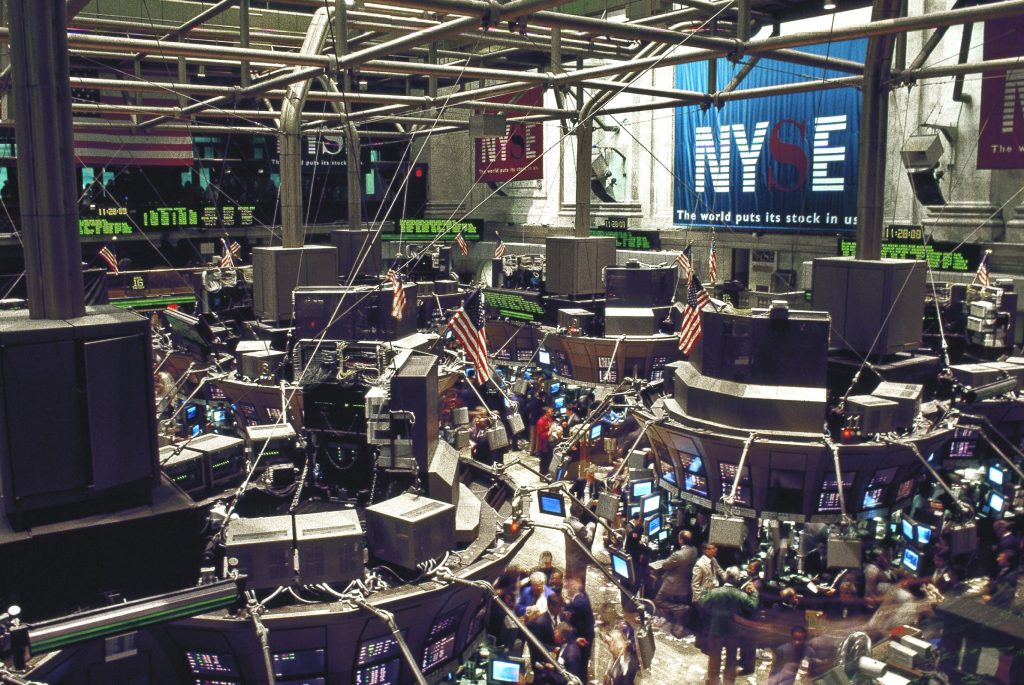
Wall Street Sell-Off Wipes Out Post-Election Rally as Nasdaq Falls Into Correction
Wall Street went from celebration to panic in the space of a day. On Thursday, 5 November 2026, American stocks suffered one of their worst falls of the year, wiping out all of the gains from the post-election rally the day before — and pushing the Nasdaq, the index packed with technology companies, into what traders call a correction.
The sell-off was led by the makers of artificial intelligence chips and the firms building the giant data centres that use them. Nvidia fell 8 percent and Advanced Micro Devices tumbled 14 percent. Behind the falls lay a simple question: companies are spending hundreds of billions of dollars on AI, but when will that spending start paying off?
At a glance
- What happened: On Thursday, 5 November 2026, the S&P 500 fell 3.6 percent, the Dow Jones Industrial Average dropped 1,533 points, and the Nasdaq Composite fell 4.5 percent, according to the Associated Press.
- Why it matters: The falls erased Wednesday’s post-election rally entirely. The Nasdaq has now dropped more than 10 percent from its record high — what traders call a correction, its second of the year.
- What caused it: Investors sold AI and chip stocks on worries about the huge cost of building AI data centres, the returns on that spending, and the prospect of tighter rules on data-centre construction after the Democrats’ sweeping midterm wins.
- What happens next: Investors will watch Friday’s October jobs report and the next round of big technology results for signs of whether the AI boom is slowing down or just taking a breather.
The numbers: a brutal day on Wall Street
The scale of Thursday’s fall was striking. The S&P 500, the index that tracks 500 of the largest American companies, fell 3.6 percent and was on track for its worst day since President Donald Trump shook markets around the world in April 2025 with his “Liberation Day” tariffs, the Associated Press reported.
The Dow Jones Industrial Average, which tracks 30 large American companies, was down 1,533 points, or 2.9 percent, with an hour of trading still to go. The Nasdaq Composite, which is full of technology and AI-related stocks, was 4.5 percent lower at the same point.
On Wednesday, the first full trading day after the midterm elections, the Dow had jumped more than 1,500 points for its best day since April 2025, while the S&P 500 rose 1.6 percent and the Nasdaq gained 1.4 percent. Investors had initially read the election results as reducing political uncertainty. By Thursday, that mood had completely reversed.
This was not the first sharp fall in recent weeks. Wall Street had already suffered its worst day since June on 30 October, when the Nasdaq fell 2.9 percent and the S&P 500 dropped 1.8 percent on the same worries about AI spending. Thursday’s fall was considerably worse.
The Nasdaq is now in a correction
The Nasdaq’s fall took it more than 10 percent below its all-time high, which traders call a correction. The index sank 11 percent below its record, the Associated Press reported.
A correction is a fall of 10 percent or more from a recent high. It is a warning sign, not a crash. Markets fall by 10 percent from time to time, and they often recover. But it is a clear signal that confidence has been shaken.
The numbers behind it are large. The Nasdaq’s record closing high was 27,599.89, reached on 6 October, Reuters reported. By Thursday morning it had fallen to 24,712.60 — more than 10 percent below that peak. The narrower Nasdaq-100 index, which tracks the 100 largest non-financial companies on the Nasdaq exchange, had already confirmed a correction on Monday.
It would be the Nasdaq’s second correction this year. And the losses have been building for weeks: Reuters reported that the Nasdaq shed more than $2.5 trillion in market value during October alone.
Why AI stocks fell: three reasons
There was no single event that caused Thursday’s sell-off. Instead, three worries that have been building for weeks came together at once.
1. The AI spending question
The biggest worry is the simplest one. The world’s largest technology companies are spending enormous sums of money building data centres and buying the chips that power them. Investors want to know when that spending will turn into revenue and profit. The latest results have suggested the answer is: not yet, and not soon.
This is the same doubt that drove the sell-off on 30 October, when Intel plunged almost 29 percent in a day and Amazon reported it had burned through $42.4 billion of cash over the previous 12 months.
The concern is not that demand for AI is falling. It is that the companies building it are spending so much, and borrowing so much to do it, that investors are no longer sure the returns will justify the cost. As one analyst put it after the October sell-off, the market is moving out of the “hopes and dreams” phase of the AI trade and into the “show me” phase.
That doubt was underlined again on Thursday. OpenAI recently cut the target for its latest funding round by $10 billion, to about $20 billion, after the sell-off in technology shares — a sign that even the most closely watched company in AI is finding it harder to raise money on the terms it wanted.
2. The election result and data centres
Tuesday’s midterm elections added a new worry. Democrats won sweeping victories, taking control of both houses of Congress, and investors began to worry that the new political landscape could slow the construction of AI data centres.
The fear is that governments — federal, state and local — could impose pauses, or moratoriums, on building new data centres. Voters across political parties say they are wary about AI and do not like the increases in their power bills caused by data centres, which consume huge amounts of electricity.
Any slowdown in data-centre construction would mean fewer purchases of AI chips, and less demand for the electricity and other products and services that are being swept up in the AI boom. That boom is driving much of the US economy’s growth, so a slowdown would matter far beyond the technology sector.
Reuters reported that UBS strategists believe about 30 percent of expected US data-centre capacity additions in 2028 could face delays.
3. Company results added fuel
Individual company news made things worse. Qualcomm, which makes chips for smartphones, fell sharply after saying fourth-quarter smartphone chip sales had fallen short of expectations, citing weak demand and less business from Apple.
Nvidia fell 8 percent, a day after dropping 3.2 percent, and was by far the heaviest weight pulling the S&P 500 down, the Associated Press reported. That matters because Nvidia is so large that a 1 percent move in its share price has more effect on the S&P 500 than a 1 percent move in nearly any other American stock.
Advanced Micro Devices tumbled 14 percent, even though it had recently reported record revenue from its data-centre business. CoreWeave, a company that rents access to AI chips to customers over the internet, fell 8.9 percent. GE Vernova, which has been helping to power data centres, sank 6.9 percent.
The Philadelphia Semiconductor Index, which tracks chipmakers, dropped nearly 11 percent at its lowest point during the day, Yahoo Finance reported.
Not everything fell
AppLovin, a marketing technology company, jumped 29.4 percent after reporting revenue and profit that beat analysts’ expectations. The company also approved a programme to return up to $3.2 billion to its investors by buying back its own shares, bringing the programme’s total value to $3.6 billion.
Tapestry, the company behind the Coach and Kate Spade fashion brands, rallied 7.4 percent after delivering a stronger profit than expected and raising its forecasts for the year.
Beyond stocks: oil, bonds and the Bank of England
The selling spread beyond the stock market, and the moves in other markets told their own story.
In the oil market, the price of a barrel of Brent crude oil rose 3.9 percent to $98.29, recovering part of its nearly 9 percent drop the day before. Uncertainty still hangs over the war with Iran and when the global energy industry can return to normal.
In the bond market, the yield on the 10-year US Treasury bond fell to 4.83 percent, from 4.90 percent late on Wednesday. It had been at 4.95 percent on election night and above 5.30 percent last month. When bond yields fall, it usually means investors are buying government bonds in search of something safer than stocks.
In Britain, the Bank of England increased its main interest rate for the first time in three years to help limit high inflation. London’s FTSE 100 share index dipped 0.4 percent after the decision. The bank said its next moves on interest rates largely depend on what happens with the Iran war, which has sent oil prices and inflation higher around the world.
The drop came despite some encouraging news about the US economy itself. Fewer American workers applied for unemployment benefits last week than expected, and a separate report suggested worker productivity improved by more during the summer than economists had expected.
The sell-off went global
The worry about AI was not limited to the United States. Stock markets around the world felt the pressure.
In South Korea, the Kospi index tumbled 5.3 percent as the AI worries hit its technology-heavy market. In Japan, the Nikkei 225 sank 1.8 percent. Stock markets in Europe were mixed, with London’s FTSE 100 down 0.4 percent.
What this means for ordinary readers
It is easy to see a 3.6 percent fall in an American stock index as distant news. But there are a few reasons it matters to people who never buy a share.
First, many people’s savings are connected to these markets, even if they do not realise it. Pension funds, retirement accounts and investment funds around the world hold American technology stocks. When those stocks fall sharply, the value of those savings falls too — at least on paper.
Second, the AI boom has become one of the main engines of the American economy, the largest in the world. The data centres being built across the United States use steel, concrete, cables, cooling systems and electricity on a vast scale. If that building slows down, the effects reach construction workers, suppliers and power companies.
Third, the market is sending a message about a question that affects everyone: how fast should the world rush to build artificial intelligence, and who pays for it? Data centres use enormous amounts of electricity and water, and their neighbours are increasingly asking whether the benefits are worth the higher power bills. That debate is now moving from town hall meetings into the stock market — and into politics.
None of this means the AI boom is over. The technology is real, the demand for it is real, and the companies involved are still making large profits. What Thursday showed is that investors are no longer willing to pay any price for a share of it. They want proof that the spending will pay off, and they want it soon.
What happens next
Several things will decide whether Thursday was a sharp but short-lived fright, or the start of a longer reset in technology stocks.
The first is Friday’s jobs report. The US government is due to publish its October employment report on Friday, 6 November, and it will be the next big test for the economy. A strong report could calm nerves. A weak one could add to them.
The second is the next round of company results. Investors will be watching closely for signs of whether the big technology companies are slowing their spending, and whether the chipmakers’ order books are still growing. Nvidia’s results, in particular, are now seen as a key signal for the whole AI trade.
The third is politics. The new Congress does not take office until January, and it is not yet clear what, if anything, it will do about data centres. But the debate about where data centres are built, how much electricity they use, and who pays for the power grid upgrades they need is now a national political issue in the United States — and it will not go away quickly. Interest rates matter too: if borrowing stays expensive, building data centres gets more expensive, and the sums involved are so large that even small changes matter.
For now, the market’s message is clear enough. On Wednesday, investors celebrated the election result. On Thursday, they looked at the price of the AI boom — and decided, at least for one day, that it was too high.
Frequently asked questions
What is a correction?
A correction is a fall of 10 percent or more in a stock market index from a recent high. The Nasdaq has now fallen more than 10 percent from its record closing high of 27,599.89, reached on 6 October. Corrections are common and do not necessarily mean a crash is coming, but they are a sign that confidence has been shaken.
Did the Democrats’ election win cause the sell-off?
It was one factor, but not the only one. The election results raised the prospect of tighter rules on data-centre construction. But the deeper worry — whether AI spending will pay off — had been building for weeks, and it had already caused a sharp sell-off on 30 October, before the election.
Is this the end of the AI boom?
It is too early to say. The technology is real and demand for it is real. What has changed is that investors are no longer willing to pay any price for AI stocks. They want evidence that the huge spending on chips and data centres will produce profits, and the next round of company results will be an important test.
What should investors watch next?
Friday’s October jobs report, the next results from the big technology companies — especially Nvidia — and any signals from the new Congress about data-centre rules. Interest rates also matter: if borrowing stays expensive, building data centres gets more expensive too.
Sources
- Associated Press, “A wipeout for AI stocks sends Wall Street reeling, and the S&P 500 tumbles more than 3.5%”, 5 November 2026: https://apnews.com/article/stocks-markets-ai-midterm-oil-trump-7ee9c212805aa5e70cf34d25aab7a36e
- Reuters, “Nasdaq set to confirm correction as AI stocks tumble”, 5 November 2026 (via SRN News): https://srnnews.com/sp-500-futures-steady-after-midterm-rally-nasdaq-lags-on-chip-weakness/
- Reuters, “Nasdaq set to confirm correction as AI spending worries mount”, 5 November 2026 (via SRN News): https://srnnews.com/nasdaq-set-to-confirm-correction-as-ai-spending-worries-mount/
- Associated Press, “Stock Market Erases Post-Election Rally As Nasdaq Drops 5%” (via Artvoice), 5 November 2026: https://artvoice.com/stock-market-erases-post-election-rally-as-nasdaq-drops-5
- Reuters, “AI data center stocks slip; Democratic sweep clouds expansion plans”, 5 November 2026 (via Investment Watch Blog): https://www.investmentwatchblog.com/nvidia-and-amd-plunge-wiping-out-wall-streets-post-election-rally/
This article is for general information and education only. It is not legal or financial advice.

Pingback: Bitcoin Falls Below $76,000 as Tech Stock Sell-Off Spreads to Crypto Markets - Findivoza
Pingback: Isomorphic Labs in Talks to Raise $5 Billion at a $50 Billion Valuation, Bloomberg Reports - Findivoza
Pingback: Anthropic IPO: Claude Maker Files for a $1.5 Trillion Listing as AI Spending Faces Its First Real Test - Findivoza
Pingback: Tesla to Wind Down Cybertruck Production by Mid-2027 as Musk Bets the Texas Factory on the Cybercab - Findivoza
Pingback: 600,000 Nvidia H200 AI Chips Stuck in Hong Kong as China Holds Back Import Approval - Findivoza
Pingback: Wall Street Rebounds: Nasdaq Jumps 1.8% as Nvidia Surges 6.5% After Brutal AI Sell-Off - Findivoza
Pingback: Microsoft Is Switching Off Oracle's AI Cloud Capacity as the AI Spending Boom Faces Its First Reality Check - Findivoza