
Alien Throne Collapses: Two of New Mexico’s Most Famous Rock Formations Fall Within Weeks
Two of the most photographed rock formations in the American desert are gone. The Alien Throne and the King of Wings, two strange and beautiful stone towers in the badlands of northwestern New Mexico, have both collapsed within weeks of each other after heavy rain soaked the region.
For photographers and hikers, the loss feels personal. These were not just rocks. They were landmarks that people travelled from around the world to see, and they had stood for millions of years. Now, in a single wet autumn, both have fallen.
What happened in the Valley of Dreams
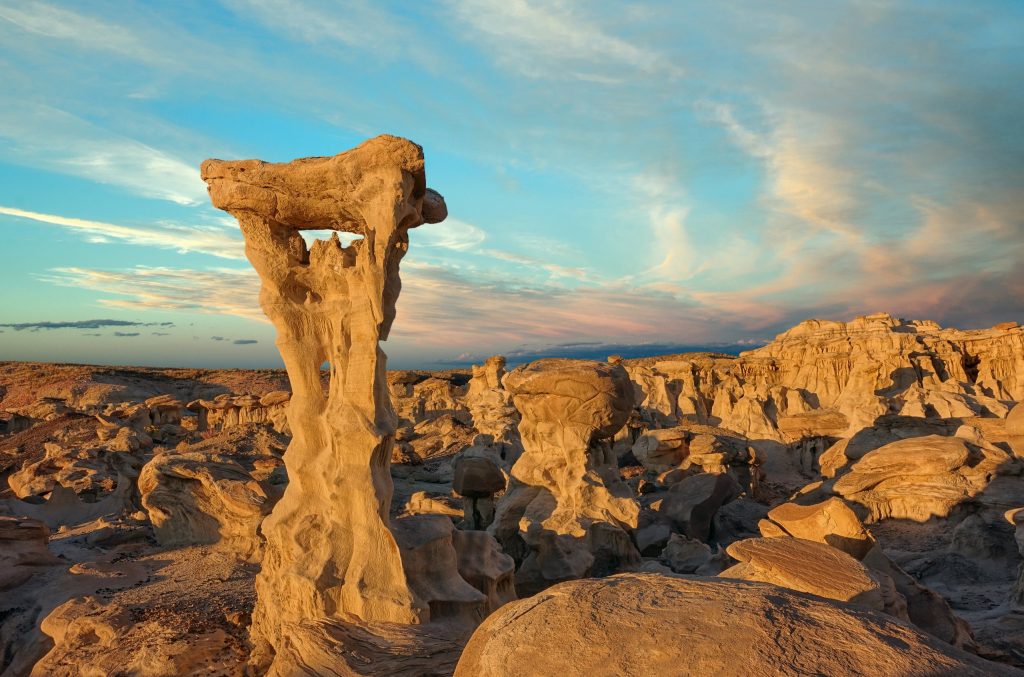
The Alien Throne was the most famous rock formation in the Valley of Dreams, a remote stretch of badlands in the Ah-Shi-Sle-Pah Wilderness in northwestern New Mexico. It was a tall, thin tower of sandstone with a flat, throne-like top, full of holes and strange curves carved by wind and water over millions of years.
On 30 October 2026, Kialo Winters, the founder of Navajo Tours USA, rounded a bend in the valley and found the Alien Throne in pieces. The great tower had toppled.
Because poor road conditions had kept Winters away from the area for a couple of weeks, nobody knows the exact day it fell. What is clear is that it came down some time in late October, after weeks of heavy rain.
The King of Wings, a second famous formation about a mile and a half away, had already fallen. Pictures of its toppled slab began circulating in early October. So within a single month, the Valley of Dreams lost its two biggest stars.
The news was first reported by the Associated Press on 5 November 2026, and local television station KRQE in Albuquerque also covered the collapse, carrying the message: “Let the site rest.”
The Alien Throne: more than 75 million years in the making
The Alien Throne was not a young rock. Estimates say it may be more than 75 million years old. To put that in simple terms, the stone began to take shape when dinosaurs still walked the Earth, long before humans existed.
In the Navajo language, the formation is called Tsé Bináká Níyol. The Valley of Dreams sits on Navajo Nation land, and Navajo guides lead most visitors through it, because there are no marked trails, roads or signs in the area.
The formation stood about 10 feet tall. That does not sound huge, but its shape made it special. A wide, flat slab of hard rock sat on top of a tall, narrow pedestal, like a chair balanced on a single leg. Holes had been carved clean through the stone, so sunlight shone through it at sunset. Photographers loved it because no two visits looked the same: the light, the shadows and the colours changed with the hour and the season.
The whole Valley of Dreams is part of the Ah-Shi-Sle-Pah Wilderness, which covers more than 6,500 acres of badlands. Its name is no accident. The landscape looks like something from another planet, with mushroom-shaped rocks, striped hills and towers that seem to defy gravity.
The King of Wings fell first
The King of Wings was the Alien Throne’s near neighbour, and in some ways it was even more dramatic. It was a huge, flat slab of rock that stretched out from a narrow base like a wing, reaching far into empty air. It was the biggest formation of its kind in the area.
Visitors had noticed for some time that it was changing. Alan Studt, a photographer from Parma, Ohio, first visited in 2019 and returned in April 2026. His photographs from the two visits show the slow damage: new holes forming in the Alien Throne, and cracks opening along the base of the King of Wings.
Then, in early October, pictures began to appear online showing the King of Wings lying in pieces. Its great slab had come off its base and fallen to the ground.
At the time, some people hoped it was a one-off. A few weeks later, the Alien Throne followed it down.
Why did they fall? Heavy rain on soaked ground
The short answer is rain — a lot of it, falling on ground that was already wet.
The southwestern United States has endured major rounds of storms in recent weeks. Rain has been falling on ground already soaked from an especially wet autumn. Experts estimate that more than 20 trillion gallons of rain fell across the Four Corners states — Arizona, Colorado, New Mexico and Utah — and Nevada in late October and early November.
That is hard to picture, so think of it this way: the desert around the Valley of Dreams is made of soft clay and sandstone. In dry weather it is hard and stable. But when it gets soaked through, it turns soft, like wet sand on a beach. The tall, thin pedestals that hold up formations like the Alien Throne are the weakest part. Once the base softens and cracks, the heavy rock on top has nothing to hold it up.
The storms were part of a wider pattern of wild weather this autumn. Typhoons have battered East Asia as the Pacific warms, and the polar vortex has weakened at a record-early date, raising the chance of a cold, snowy winter in parts of Europe. Climate scientists will gather next week at COP31 in Antalya to discuss how a warming world is changing weather patterns — and the fall of the Alien Throne is a small, visible example of what that can mean on the ground.
It is important to be clear about one thing: nobody pushed these rocks over, and nobody broke them. There is no sign of vandalism or human damage. They died a natural death, exactly the way they were made — by the slow work of wind and water, finished off quickly by a very wet few weeks.
What is a hoodoo?
The Alien Throne and the King of Wings were both hoodoos. A hoodoo is a tall, thin tower of rock formed by erosion — the slow wearing away of stone by wind, rain and ice.
Here is how one forms, in simple steps:
- Layers of rock are laid down. Over millions of years, sand and mud settle in layers. Some layers are hard, some are soft.
- The soft rock wears away first. Rain and wind eat away the soft layers much faster than the hard ones.
- A hard cap protects what is underneath. A slab of tough rock on top acts like an umbrella, shielding the softer rock below it from the rain. The rock around it washes away, but the column under the cap survives.
- A tower is left standing. What remains is a tall, thin pillar with a flat top — a hoodoo.
The catch is that the same process that builds a hoodoo also destroys it. The pedestal keeps getting thinner. Cracks open. Holes appear. And one day, after a heavy rain, the whole thing gives way. Every hoodoo is temporary. The Alien Throne simply reached the end of its life sooner than anyone expected.
The badlands of New Mexico are full of hoodoos in every stage of life. Some are just starting to form. Some, like the Alien Throne was, are at their most beautiful — and their most fragile. Others have already fallen, and their rubble is slowly turning back into desert sand.
Why these two rocks mattered so much
It is fair to ask: why should anyone care about two fallen rocks in a remote desert?
First, they were rare. Formations as strange and perfect as the Alien Throne and the King of Wings do not exist everywhere. They drew photographers, hikers and travellers from around the world to a quiet corner of New Mexico that few people would otherwise visit. For the Navajo guides who lead tours there, they were a source of work and pride.
Second, they were old in a way that is hard to grasp. Seventy-five million years is almost impossible to imagine. The Alien Throne had survived ice ages, droughts, floods and the rise and fall of whole species. That it fell in a single rainy month is a reminder of how quickly even the oldest things can change.
Third, they were a warning of sorts. The same wet weather that brought down the Alien Throne has caused flooding across the southwestern United States, closing roads and tunnels and damaging homes. Rocks falling in the desert are the least serious part of that story — but they are the most visible. A tower that stood for millions of years is gone, and everyone can see the empty space where it was.
What happens next
The Valley of Dreams is still open, and it is still worth visiting. The Ah-Shi-Sle-Pah Wilderness covers thousands of acres, and it is full of other strange and beautiful formations: mushroom rocks, striped hills, fossil beds and towers with names like the Red Dinosaur Egg, the Petrified Wood Turtle and the Chocolate Penguin King.
But local guides have a simple request: let the site rest. The message carried by KRQE’s coverage was clear — visitors should not rush in to see the rubble, climb on the fallen rocks or disturb the fragile ground around them. The desert is soft after the rain, and footsteps can do real damage to formations that are still standing.
If you do visit, go with a Navajo guide. The area has no official trails, the roads are rough, and a guide knows both the land and its history. That is how most people reached the Alien Throne when it stood, and it is still the best way to see what remains.
Scientists and photographers will keep watching the valley. The fallen rocks will be studied, photographed and remembered. And the other hoodoos will keep changing, a little bit every year, until their turn comes too. That is the nature of the desert: it builds wonders slowly, and it takes them away without asking.
Frequently asked questions
What is the Alien Throne?
The Alien Throne was a famous hoodoo — a tall, thin rock tower formed by erosion — in the Valley of Dreams in northwestern New Mexico. It was about 10 feet tall, with a flat, throne-like top, and it was one of the most photographed rock formations in the American Southwest.
When did the Alien Throne collapse?
It was found in pieces on 30 October 2026 by Kialo Winters, founder of Navajo Tours USA. Because bad road conditions had kept him away for a couple of weeks, the exact day it fell is not known. It collapsed some time in late October 2026 after heavy rain.
What is the King of Wings?
The King of Wings was another famous formation about a mile and a half from the Alien Throne. It was a huge, flat slab of rock stretching out from a narrow base like a wing. It fell earlier, in early October 2026, when pictures of its toppled slab began circulating online.
Why did the two formations collapse?
Heavy rain. The southwestern United States had an unusually wet autumn, and experts estimate more than 20 trillion gallons of rain fell across the Four Corners states and Nevada in late October and early November. The rain soaked the soft clay and sandstone at the base of the formations until they could no longer hold up the heavy rock on top.
Can I still visit the Valley of Dreams?
Yes. The Valley of Dreams is part of the Ah-Shi-Sle-Pah Wilderness, which covers more than 6,500 acres and is full of other hoodoos and rock formations. There are no official trails, so visitors should go with a Navajo guide. Local guides have asked people to let the collapsed site rest and not to climb on the rubble or disturb the fragile ground.
How old was the Alien Throne?
Estimates say it may have been more than 75 million years old. The rock began forming when dinosaurs still walked the Earth.
Conclusion
The Alien Throne stood for more than 75 million years and fell in a single rainy month. Its neighbour, the King of Wings, went first, and within weeks both of the Valley of Dreams’ two great icons were gone.
There is something sad about that, and something strangely fitting too. Hoodoos are born from erosion, and erosion is what kills them. The same wind and rain that carved these towers into shapes that looked like thrones and wings eventually brought them down. No one broke them. Nature simply finished what it started.
What remains is the valley itself — thousands of acres of strange, beautiful desert, still changing, still worth seeing, and still best visited with respect and a good guide. The Alien Throne is gone, but the desert that made it is still there.
Sources
- Associated Press (Susan Montoya Bryan), “Desert icons collapse as southwestern US gets pummeled with rain and flooding”, 5 November 2026: https://www.ottumwacourier.com/news/national_news/desert-icons-collapse-as-southwestern-us-gets-pummeled-with-rain-and-flooding/article_409c0a5f-4c0c-5aa4-ba4a-a0e8badfe134.html
- Rest of the World Report, “November 6, 2026 — Morning Edition”: https://www.restoftheworldreport.com/p/the-rest-of-the-world-report-november-c7e
- KRQE News 13, “‘Let the site rest’: Photos show collapse of northwest New Mexico rock formation”: https://www.youtube.com/watch?v=BX3UhPmF4mM
- Sailing Stone Travel, “The Valley of Dreams: Hiking to The Alien Throne”: https://sailingstonetravel.com/valley-of-dreams-alien-throne/
- Explore.com, “The Valley Of Dreams Is Home To Some Of The Most Out Of This World Hiking Trails”: https://www.explore.com/1689460/new-mexico-valley-of-dreams-hiking-trails-alien-throne/
This article is for general information and education only. It is not legal or financial advice.
