
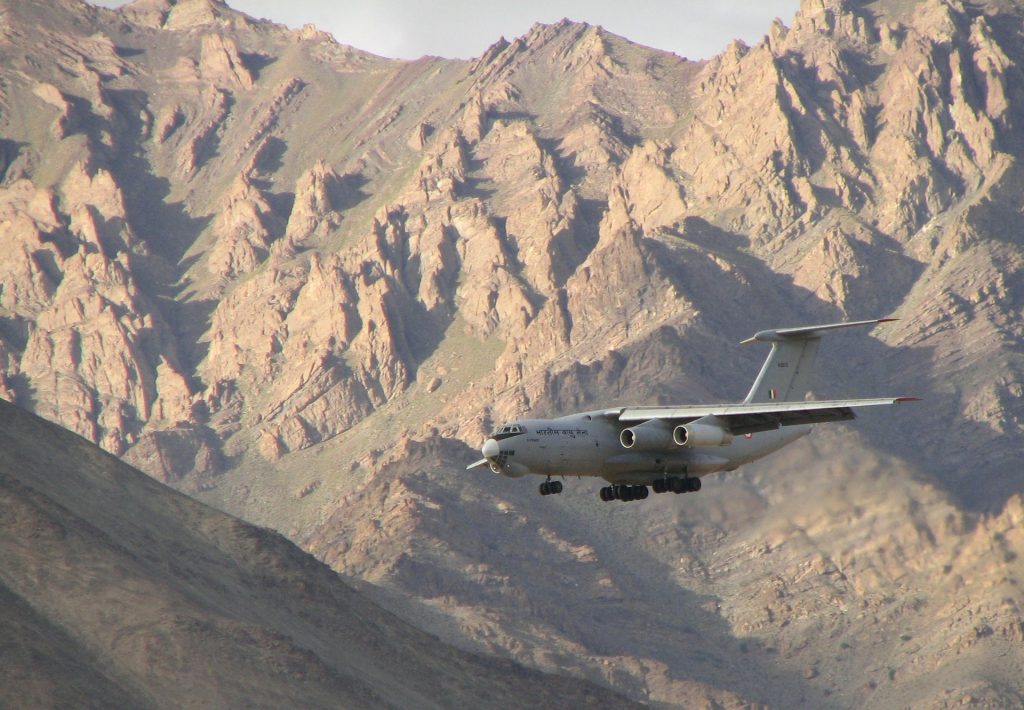
IAF’s IL-76 ‘Gajraj’ Lands at Nyoma at 13,629 Feet — the Highest Ever for the Aircraft
The Indian Air Force has landed one of its biggest transport planes at one of the highest airbases on Earth — and set a world record in the process.
An IL-76MD heavy-lift aircraft, known in Indian service as the “Gajraj”, touched down at the Mudh-Nyoma airbase in eastern Ladakh on Friday, 6 November, at an altitude of 13,629 feet (about 4,150 metres). The Air Force says it is the highest-altitude landing ever made by an IL-76 anywhere in the world.
The Air Force announced the feat on Saturday in a post on X, writing in capital letters: “13,629 FEET. A NEW HEIGHT IN AVIATION HISTORY.”
For most people, the numbers alone tell the story. Nyoma sits higher than almost any runway on the planet, in thin, freezing air, about 25 kilometres from the Line of Actual Control — the disputed border between India and China. Landing a four-engine heavy transport plane there, fully loaded with troops or cargo, is one of the hardest things a military pilot can do.
This article explains what happened, why the landing was so difficult, what the Gajraj is, and why Nyoma matters far beyond the record books.
What happened at Nyoma
The Indian Air Force (IAF) said the IL-76MD landed at Nyoma on Friday and later took off again safely. It shared photographs and a video of the aircraft taking off from the high-altitude runway.
“An Indian Air Force IL-76MD has scripted history with a successful landing at Nyoma, marking the highest-altitude landing ever achieved by the aircraft anywhere in the world,” the Air Force said.
In a second post, it added: “Pushing boundaries. Redefining limits. Making history. A remarkable demonstration of the aircraft’s enduring capability, backed by the exceptional skill, precision, and professionalism of its crew.”
The record is specific to the aircraft type. Lighter planes have landed higher — and India itself holds one of those records too, as we explain below. But no IL-76, a plane roughly the size of a small airliner, has ever landed this high before.
The landing was first reported by Indian media on Saturday, 7 November, after the Air Force posted about it. It quickly became one of the most talked-about defence stories of the weekend.
Why landing at 13,629 feet is so hard
To understand why this landing matters, it helps to understand what thin air does to an aeroplane.
At sea level, the air is thick. Wings get plenty of lift, engines get plenty of oxygen, and brakes work well on a long runway. At 13,629 feet, the air is roughly 40 percent thinner. That changes everything:
Less lift. Wings need speed to generate lift, and thin air gives them less to work with. A plane must come in faster, which means it needs more runway to stop.
Less engine power. Jet engines burn fuel with oxygen from the air. With less oxygen, they produce less thrust — exactly when the plane needs more power to climb away from a mountain runway.
Less margin for error. At high altitude, a plane that is slightly too heavy, or slightly too fast, or caught by a sudden gust of wind has far less room to recover. Mountain weather can also change in minutes, with strong winds and sudden drops in visibility.
Cold and ice. Temperatures at Nyoma can fall far below freezing. Ice on wings and runways makes every part of flying harder, from starting the engines to braking after touchdown.
That is why very few airbases in the world sit above 13,000 feet, and why even fewer can handle a heavy transport plane. Pilots who fly there train for it specially, and every landing is carefully planned around the aircraft’s weight, the weather, and the length of the runway.
Landing the Gajraj at Nyoma was therefore not just a stunt. It was proof that the Air Force can deliver heavy cargo to one of its most remote and strategically important bases — and do it safely.
Meet the Gajraj: the IL-76MD
The plane at the centre of the story is a workhorse. The IL-76MD is a Russian-origin, four-engine heavy-lift military transport aircraft. In Indian service it is called the “Gajraj”, which means “King Elephant” — a fitting name for a plane built to carry heavy loads over long distances.
India has flown the IL-76MD since 1985. It bought 17 of the aircraft in the 1980s, and they have served without a single loss in 40 years, according to the aircraft’s service record. The planes fly alongside India’s newer American-built C-17 Globemaster and C-130J transport aircraft, and together they form the backbone of the Air Force’s strategic airlift fleet.
The Gajraj is designed to carry troops, military vehicles and heavy cargo. It can carry around 40 to 45 tonnes in a single trip, and it has been airlifting T-72 tanks and BMP-2 infantry vehicles to Ladakh since the early 1990s. It has also flown relief supplies after earthquakes and other disasters across the region.
The aircraft is getting old — the design dates back to the Soviet era — but the Air Force has kept it flying with upgrades, and in 2024 it asked Russia for a life-extension programme to modernise the fleet with new engines and a modern cockpit. The Nyoma landing is a reminder that, even after four decades, the old plane can still do things no other aircraft of its type has done.
For readers in Pakistan, the Gajraj is a familiar sight in a different context: IL-76s have flown humanitarian cargo around the region for decades, and the type is one of the most widely used military transport planes in the world.
Why Nyoma matters
Nyoma is not just a high runway. It is one of the most strategically placed airbases in South Asia.
The base sits in eastern Ladakh, about 25 kilometres from the Line of Actual Control (LAC), the disputed boundary between India and China. It is close to the Demchok sector and the southern bank of Pangong Tso, a high-altitude lake that has been at the centre of India-China border tensions.
Nyoma’s history goes back a long way. The airfield was first built in 1962 as a simple mud-paved landing ground, during the India-China war of that year. It then lay largely unused for decades. India began rebuilding it in earnest after the military standoff with China in eastern Ladakh in 2020, when both sides rushed troops and equipment to the border and realised how much they depended on air supply lines.
The upgraded base was formally inaugurated on 12 November 2025, when the then chief of the Air Force, Air Chief Marshal A. P. Singh, landed a C-130J transport plane there. The upgrade cost about ₹218 crore (roughly $24 million) and turned Nyoma into a full airbase — the fourth major Air Force base in Ladakh, alongside Leh, Kargil and Thoise.
The Air Force describes Nyoma as the highest fighter-capable airbase in the world. That means it is built to operate fighter jets as well as transport planes, at an altitude where most air forces cannot fly at all.
The IL-76 landing now proves the base can also receive heavy cargo aircraft. That matters because in a crisis, the speed at which an army can move tanks, artillery, fuel and supplies to the border can decide the outcome. A base that can take a Gajraj can be supplied far faster than one that depends on trucks climbing mountain roads.
The record books: Daulat Beg Oldie and the C-130J
India’s new record at Nyoma is not its first in high-altitude flying. The country already holds a remarkable record a little further north.
On 20 August 2013, an Indian Air Force C-130J Super Hercules landed at Daulat Beg Oldie (DBO), an airstrip in eastern Ladakh at 16,614 feet — nearly 3,000 feet higher than Nyoma. That was a world record for the highest landing by an aircraft of its class, and DBO remains the world’s highest airstrip.
DBO sits about 250 kilometres north of Nyoma, close to the Karakoram Pass. But there is an important difference: the C-130J is a lighter, tactical transport plane, and DBO is a small airstrip that cannot handle heavy-lift aircraft like the IL-76 or the C-17.
So the two records sit side by side. DBO holds the record for the highest landing by any transport aircraft, and Nyoma now holds the record for the heaviest aircraft type to land at such an altitude. Together, they show the range of India’s high-altitude airlift: light planes at the very top of the world, and heavy planes at bases that can actually sustain a large military deployment.
What this means for the region
The Nyoma landing is a technical achievement, but it also sends a message.
India and China have been locked in a tense military standoff along their border in Ladakh since 2020. Both sides have built roads, airbases, barracks and surveillance posts at a rapid pace. The ability to land a heavy transport plane at Nyoma tells Beijing — and the wider region — that India can reinforce its border positions quickly, even in the harshest conditions.
The IL-76 played an important role during the 2020 standoff itself, when the Air Force used its heavy-lift fleet to rush military equipment and supplies to Ladakh. The Nyoma landing shows that capability has grown stronger, not weaker, in the years since.
For Pakistan, which shares its own long and sensitive border with India in Ladakh and Kashmir, the development is worth watching. Ladakh sits at the junction of three countries — India, China and Pakistan — and military infrastructure built for one frontier can be relevant to another. The region around Kargil, which saw a war in 1999, is served by the same network of high-altitude airbases.
At the same time, the landing is not a step towards war. High-altitude airlift is also what makes it possible to supply troops through the winter, when mountain passes close and roads become impassable. In that sense, better airlift can make a border more stable, not less, because both sides know the other can hold its positions through the hardest months of the year.
What happens next
The Nyoma landing is likely to be followed by more activity at the base. Once a runway is proven for a heavy aircraft, air forces typically use it more often — for training, for supply runs, and for exercises that test how quickly troops and equipment can be moved.
Watch for three things in the coming months:
More heavy aircraft at Nyoma. The C-17 Globemaster, India’s largest transport plane, is the obvious next test. If it can land at Nyoma too, the base’s supply capacity would grow again.
Fighter operations. Nyoma is described as fighter-capable. Fighter jets operating from 13,629 feet would be a further step, and one that China would watch closely.
China’s response. Beijing has been building its own airbases and infrastructure on its side of the border. Each side’s construction tends to be answered by the other, and the competition in infrastructure along the LAC has been running for years.
For now, though, the story is a simple one: a big old plane, a skilled crew, and a runway in the sky. At 13,629 feet, the Indian Air Force has shown it can put heavy cargo where very few air forces in the world can reach.
Frequently asked questions
What is the IL-76MD “Gajraj”?
It is a Russian-origin, four-engine heavy-lift military transport aircraft flown by the Indian Air Force since 1985. India calls it the Gajraj, meaning “King Elephant”. It carries troops, vehicles and heavy cargo, including tanks, over long distances.
How high is Nyoma airbase?
Nyoma sits at 13,629 feet (about 4,150 metres) above sea level in eastern Ladakh, India. The Air Force describes it as the highest fighter-capable airbase in the world.
Why is this landing a world record?
No IL-76 has ever landed at such a high altitude before. The record is for the aircraft type — lighter planes, like India’s C-130J, have landed higher, at Daulat Beg Oldie (16,614 feet).
Where is Nyoma, and why is it important?
Nyoma is in eastern Ladakh, about 25 kilometres from the Line of Actual Control, the disputed border between India and China. It is close to the Demchok sector and Pangong Tso lake. It became a full airbase in November 2025 and is India’s fourth major airbase in Ladakh.
When did the landing happen?
The IL-76MD landed on Friday, 6 November 2026. The Indian Air Force announced it on X on Saturday, 7 November.
How much can the IL-76MD carry?
About 40 to 45 tonnes of cargo, including military vehicles such as T-72 tanks and BMP-2 infantry vehicles, which it has been airlifting to Ladakh since the early 1990s.
Conclusion
A world record in aviation is usually about speed or distance. This one was about height — and about what height makes possible.
By landing the Gajraj at Nyoma, the Indian Air Force proved it can deliver heavy cargo to a base at 13,629 feet, just 25 kilometres from the border with China. It is a feat of flying skill, a payoff for years of investment in Ladakh’s airbases, and a signal to the region that India’s ability to supply its mountain frontiers is growing.
The mountains of Ladakh have always decided what armies can and cannot do. With this landing, India has shown that its reach in those mountains now extends further than ever before.
Sources
- The Indian Express, “IL-76 scripts history: heavy-lift aircraft lands at Nyoma airbase”, 7 November 2026
- The Times of India, “Aviation history: At 13,629 ft, IAF lands heavy-lifter ‘Gajraj’ near LAC in Ladakh in record high-altitude touchdown”, 7 November 2026
- Gulf News, “Indian Air Force Sets World Record with Highest IL-76 Landing at Nyoma Airbase Near China Border”, 7 November 2026
- The Week, “World record for IAF: IL-76MD heavy-lift aircraft makes historic touchdown at Ladakh’s Nyoma airbase”, 7 November 2026
- The New Indian Express, “IAF lands heavy-lifter Gajraj near LAC in record high-altitude touchdown”, 7 November 2026
This article is for general information and education only. It is not legal or financial advice.
