
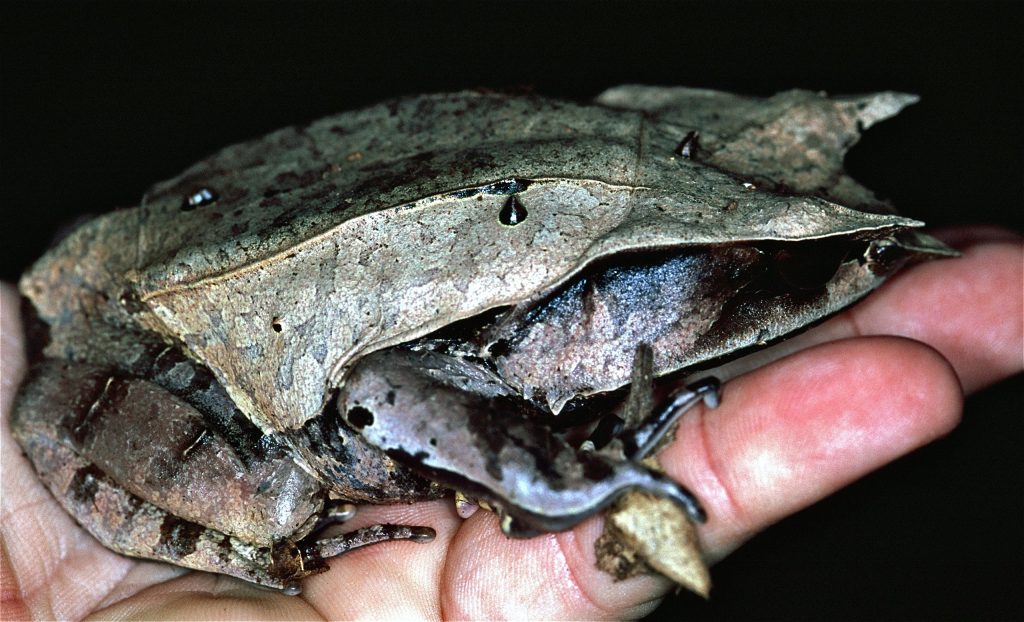
Five New Tiny Horned Frog Species Found in India’s Eastern Himalayas — Including the First Snail-Eating Frog in India
Scientists have discovered five new species of tiny horned frogs hiding in the forests of India’s eastern Himalayas, including one frog that eats snails — the first snail-eating frog ever recorded in India.
The discovery, made after five years of fieldwork in Arunachal Pradesh, more than doubles the number of known species in the frog group, called Jingophrys. The findings were published on 11 November in the journal Royal Society Open Science, and they show that one of the world’s most famous mountain ranges still holds secrets that science has barely begun to uncover.
For the people who study frogs, this is a big moment. For everyone else, it is a reminder that new species are not only found in remote oceans or deep jungles — they can be sitting quietly on a forest floor, just a few centimetres long, waiting for someone to look closely enough.
Five New Frogs, Five Years of Searching
The discovery was made by a team of scientists from the University of Delhi and Harvard University in the United States. The research was led by Dr Sonali Garg, a biodiversity researcher at Harvard’s Museum of Comparative Zoology, working with her colleague James Hanken and Delhi University researchers S D Biju, Tage Tajo and Radhakrishna Upadhyaya K.
The team spent five years exploring the forests of Arunachal Pradesh, a state in north-east India that sits in the eastern Himalayas. It is one of the least-studied parts of the Himalayas, even though the mountain range is one of the richest places on Earth for wildlife.
The work was not easy. The researchers trekked through remote, mountainous terrain and worked in temperatures as low as minus 4 degrees Celsius. Many of the frogs are active only during a short breeding season, and they are experts at hiding. Their mottled brown skin looks almost exactly like dead leaves on the forest floor, which makes them very hard to spot — even when you know they are there.
Back in the laboratory, the team used DNA analysis to confirm that the frogs they had found were genuinely new species, and not just unusual-looking members of species that were already known.
Meet the Five New Species
All five new frogs belong to the group Jingophrys, known as diminutive horned frogs. They are called “horned” frogs because of the small, pointed flaps of skin above their eyes, which look a little like horns. They are called “diminutive” because they are tiny — small enough to sit comfortably on a leaf.
The five new species are:
- Jingophrys taniitatii — the Tanii horned frog. Named after the Tanii tribe of the Ziro Valley region, combined with the local Apatani word for frog.
- Jingophrys tanogogo — the snail-eating horned frog. Named after the Apatani word for snails.
- Jingophrys siangensis — the Siang horned frog. Named after the Siang region of Arunachal Pradesh.
- Jingophrys hrdy — Hrdy’s horned frog. Named after anthropologist Sarah Blaffer Hrdy and medical professor Daniel Bruce Hrdy.
- Jingophrys wularsoni — Wu-Larson’s horned frog. Named after herpetologists Barbara Wu and Eric Larson of Harvard University, in recognition of their support for frog research and conservation.
Three of the five species were named after local communities, languages and places — a decision the researchers say reflects how much the discovery depended on the people who live in the region.
The Snail-Eating Frog: A First for India
The most surprising of the five is Jingophrys tanogogo, the snail-eating horned frog. It is the first frog known in India to feed on snails, and the first member of its whole family — the Asian horned frogs — ever recorded with such a diet.
The researchers found out what it eats in an unusual way. Using 3D micro-CT imaging, a kind of detailed X-ray scan, they looked inside the frog’s gut and found whole land-snail shells.
That is a remarkable detail. Most frogs eat insects, spiders, worms and other small creatures they can catch with a flick of the tongue. Snails are a very different kind of meal: they come in a hard shell, they move slowly, and they are not the kind of prey most frogs bother with. Finding snail shells inside a frog tells scientists that this species has a feeding habit nobody had seen before in its family.
Why would a frog eat snails? Scientists do not yet know for sure. Snails are rich in calcium, which frogs need for strong bones, and in a damp forest where snails are common, a frog that can crack them open has a food source all to itself. What is clear is that this little frog has found a way of living that sets it apart from its relatives — and that scientists only discovered it because they looked inside.
How the Himalayas Shaped These Frogs
The study does more than add five names to the list of known frogs. It also tells a story about how the Himalayas themselves helped create them.
DNA analysis showed that the horned frogs diversified rapidly into many different species in the eastern Himalayas as the mountain range rose and the Asian monsoon took shape over millions of years. As the mountains grew taller, they created new valleys, new forests and new climates — and the frogs in each separated valley slowly evolved into different species.
This means the Himalayas played a much larger role in frog evolution than scientists previously thought. The mountains did not just provide a home for these frogs; they actively shaped how the frogs evolved.
Dr Garg, who led the study, said the research “highlights how significant evolutionary changes can go unnoticed in little-studied species”. In other words, big stories in evolution can be hiding in small animals in places that researchers have not yet explored properly.
The Himalayas stretch from tropical forests at their base to alpine meadows high above, and they are among the world’s richest regions for biodiversity. Yet many parts of the range have never been fully explored. Arunachal Pradesh, where all five new species were found, is one of the least-studied corners of all.
Why So Many Species Went Unnoticed
If five new frog species were living in Arunachal Pradesh all along, why did it take until 2026 to find them?
There are a few reasons. First, the frogs are tiny and very well camouflaged. Their skin looks like dead leaves, and they spend much of their lives hidden in leaf litter on the forest floor. Second, some of them are extremely secretive. As S D Biju, one of the researchers, explained: “Some of the new species are extremely secretive and found in remote forests only during a short breeding season.” If you visit at the wrong time of year, you simply will not find them.
Third, the region itself is hard to reach. Arunachal Pradesh is mountainous, heavily forested and sparsely populated. Roads are few, and many of the valleys where the frogs live can only be reached on foot.
And fourth, until recently, scientists could not easily tell these frogs apart. Several species can look almost identical to the human eye, and only DNA analysis can show that they are, in fact, different species that have been evolving separately for millions of years. The study’s title captures this idea: “Two-fold hidden diversity of diminutive horned frogs” — the diversity was hidden twice over, by the frogs’ camouflage and by how similar they look to each other.
Local Tribes Helped Make the Discovery
The discovery also depended on the people who live in Arunachal Pradesh. The researchers said in a statement that local tribes gave them essential field support and knowledge that helped make the discoveries possible.
Local guides know the forests, the seasons and the animals in ways that visiting scientists cannot match. They know where frogs call during the breeding season, which streams run in which months, and which valleys are worth searching. Naming three of the five new species after local communities, languages and places is the team’s way of recognising that contribution.
This kind of partnership is becoming more common in field science. Researchers bring laboratory tools like DNA analysis and CT scanning; local communities bring knowledge built up over generations of living in the same forests. Together, they can find things that neither could find alone.
Why This Discovery Matters
Five tiny frogs might not sound like world-changing news. But discoveries like this matter for several reasons.
First, they show how much biodiversity is still unknown. If five new species can be found in a single frog group in a single Indian state, there are almost certainly many more species waiting to be discovered in the Himalayas — frogs, but also insects, plants, fungi and other animals that have never been described by science.
Second, you cannot protect a species you do not know exists. Frogs are sensitive to changes in their environment: pollution, deforestation, climate change and disease can all hit them hard. Scientists say further studies will be needed to understand the biology and conservation needs of the new species. Knowing they exist is the first step towards making sure they survive.
Third, frogs are useful indicators of the health of an ecosystem. Because they live both in water and on land, and because their skin absorbs chemicals from their surroundings, frogs often show the effects of environmental damage before other animals do. A forest with a rich variety of frogs is usually a healthy forest.
And finally, discoveries like this remind us that science still has frontiers close to home. The Himalayas are one of the most studied mountain ranges in the world, yet they still surprise researchers. As Dr Garg’s comment suggests, significant evolutionary stories can go unnoticed for a long time — until someone takes the trouble to look.
What Happens Next
The researchers say more studies will be needed to understand the new species properly. That includes learning more about where exactly each species lives, how large their populations are, what they eat, how they breed, and what threats they face.
For the snail-eating frog in particular, scientists will want to understand how it manages to eat snails — whether it crushes the shells, swallows them whole, or has some other trick — and whether other frogs in its family share the habit.
Conservation is the other open question. None of the five species has yet been assessed for how endangered it might be, and that work will take time. What is known is that they live in remote forests in a region that is still largely intact — which is good news, as long as those forests stay that way.
For now, the discovery stands as a small but vivid reminder: in a world that can feel fully mapped and fully known, a frog the size of a coin can still rewrite what scientists thought they knew.
Frequently asked questions
How many new frog species were discovered?
Five. All of them are tiny horned frogs in the group Jingophrys, found in Arunachal Pradesh in India’s eastern Himalayas. The discovery more than doubles the number of known species in the group.
What is special about the snail-eating frog?
Jingophrys tanogogo is the first frog known in India to feed on snails, and the first member of its family ever recorded with such a diet. Researchers found whole land-snail shells inside its gut using 3D micro-CT imaging.
Who discovered the new frogs?
A team from the University of Delhi and Harvard University, led by Dr Sonali Garg of Harvard’s Museum of Comparative Zoology, with James Hanken, S D Biju, Tage Tajo and Radhakrishna Upadhyaya K. The work took five years of fieldwork.
Where were the frogs found?
All five species were found in Arunachal Pradesh, a state in north-east India in the eastern Himalayas. It is one of the least-studied parts of the Himalayan region.
When was the study published?
The study, titled “Two-fold hidden diversity of diminutive horned frogs (Megophryinae: Jingophrys) highlights overlooked in situ diversification in the Himalayas”, was published on 11 November 2026 in the journal Royal Society Open Science.
Are the new frogs endangered?
That is not yet known. Researchers say further studies are needed to understand the biology and conservation needs of the new species, including where they live and how large their populations are.
Conclusion
Five new horned frog species, found after five years of searching in one of the least-explored corners of the Himalayas, tell a story much bigger than their size. They show how mountains and monsoons shaped evolution over millions of years, how local knowledge and modern science can work together, and how much of the natural world is still waiting to be discovered.
The snail-eating frog is the star of the find — a tiny animal with a diet nobody expected. But the real message of the discovery is broader: the Himalayas are not just a backdrop for wildlife. They are an engine of evolution, still producing surprises, and still rewarding the people patient enough to look closely at the forest floor.
Sources
- BBC News — “Five new miniature frog species found in eastern Himalayas” (Rachita Prasad, BBC News, Mumbai), 12 November 2026
- Harvard University, Museum of Comparative Zoology — “Five New Miniature Frog Species Found in Eastern Himalayas”
- The Hindu — “Five new diminutive horned frog species discovered in Arunachal Pradesh”, 13 November 2026
- NDTV Profit — “India’s First Known Snail-Eating Frog Among 5 New Species Found In Himalayas”
- The New Indian Express — “New frog species found in Arunachal, Keralam scientist part of team”, 14 November 2026
- Garg S, Biju SD, Tajo T, Upadhyaya KR, Hanken J (2026) “Two-fold hidden diversity of diminutive horned frogs (Megophryinae: Jingophrys) highlights overlooked in situ diversification in the Himalayas.” Royal Society Open Science 13:261030. DOI: 10.1098/rsos.261030
This article is for general information and education only. It is not legal or financial advice.
