
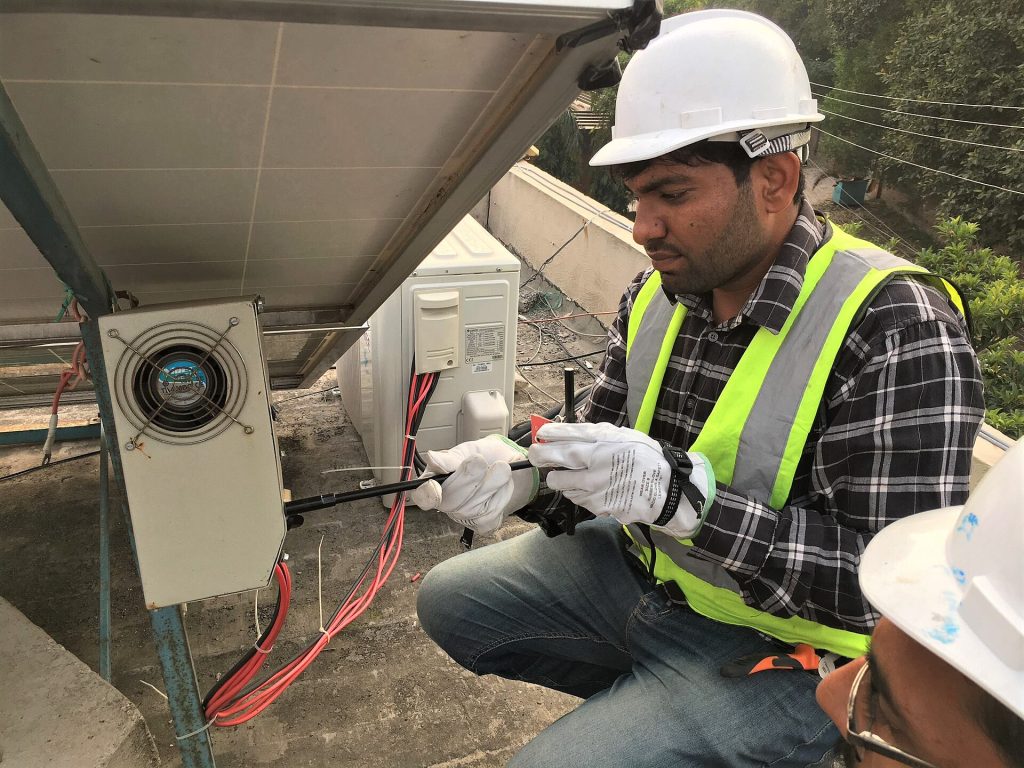
Pakistan’s LNG Import Bill Falls 36% as Solar Power Cuts Demand for Imported Gas
Pakistan spent about $1.25 billion less on imported liquefied natural gas (LNG) in the year to June 2026, as cheaper electricity — above all from rooftop solar panels — cut the need to burn imported gas in power plants. The country’s LNG import bill fell 36.1 percent to $2.22 billion in fiscal year 2026, down from $3.48 billion a year earlier, according to figures from the State Bank of Pakistan.
The numbers come from the central bank’s Governor’s Annual Report, which was submitted to parliament on Tuesday, 17 November, and reported by Arab News on Wednesday. They are the clearest sign yet of how fast Pakistan’s solar boom is changing the country’s energy bills — and its relationship with the world’s gas exporters.
The fall is good news for Pakistan’s foreign exchange reserves and for the cost of keeping the lights on. But the same report carries a warning: the country is still exposed when it needs gas most, in winter, and a supply disruption can quickly turn a saving into a shortage.
The numbers: a $1.25 billion saving
The headline figure is simple. In fiscal year 2026 — the year that ran from July 2025 to June 2026 — Pakistan paid $2.22 billion for LNG imports. A year earlier, the bill was $3.48 billion. That is a drop of 36.1 percent, or roughly $1.25 billion.
The State Bank said the fall was driven by “greater availability of lower-cost generation sources — such as decentralized solar — [which] had reduced reliance on imported gas to run power plants.” Decentralised solar means solar panels installed on rooftops and at homes, businesses and farms, rather than in large power stations connected to the national grid.
The bank also pointed to two other reasons for the fall: weaker demand for gas from industry, and the deferral of surplus LNG cargoes that Pakistan had already agreed to buy under long-term contracts. It did not say how much of the decline was down to solar alone, so the saving cannot be credited to solar panels by themselves.
There is one more detail worth noting. LNG was the exception, not the rule. In the final four months of the fiscal year, higher international prices pushed up Pakistan’s overall energy import bill. Gas got cheaper for Pakistan because the country used less of it — not because world prices fell.
Why solar is cutting gas demand
To understand why the LNG bill fell, it helps to understand how Pakistan’s power system works. When demand for electricity rises, the national grid turns on power plants in order of cost, cheapest first. Gas-fired plants that run on imported LNG are expensive, so they sit near the back of the queue. If cheaper electricity is available, the gas plants stay switched off.
That is exactly what rooftop solar has done. Millions of households and businesses have installed panels on their roofs, mainly to escape high electricity bills and power cuts. During the day, those panels supply their own power, so they draw far less electricity from the grid. With less demand on the grid, the expensive gas plants are needed less often — and Pakistan needs to import less LNG to feed them.
Rooftops, not power plants
The striking part of this change is that it was not planned by the government. It was driven by ordinary people and businesses buying panels themselves. A separate report, the Pakistan Energy Market Review 2026 by the think tank Renewables First, found that the home sector is leading the shift, with an electrification rate of 48 percent — meaning nearly half of household energy demand is now met by electricity, much of it from their own solar panels.
Businesses are following. Industrial electrification rose from 20 percent to 25 percent between fiscal years 2023 and 2025, driven by growing solar use among industrial consumers. In farming, where rising electricity tariffs pushed farmers towards solar-powered tube wells, solar electrification jumped 80 percent in a single year in fiscal 2025.
The same report shows how far the shift has gone. Demand for natural gas in the power sector fell 17 percent in fiscal 2025, and consumption of imported regasified LNG (RLNG) by power plants plunged 24 percent. Use of oil in the power sector fell even more sharply, by 77 percent, as expensive oil plants were retired and solar power grew.
The numbers behind the shift
Renewables First estimates that Pakistan has spent $8.9 billion importing solar panels and inverters up to fiscal 2026, and that those panels have helped the country avoid nearly $14.7 billion in fossil fuel imports. Its headline estimate is that distributed solar helped Pakistan avoid around $15 billion in fossil fuel imports by fiscal 2026 — though the think tank itself stresses this is an estimate, not an officially verified government saving.
Looked at over the long term, the report estimates cumulative savings of about $124 billion between fiscal 2017 and fiscal 2050 — roughly $9.23 in avoided fossil fuel imports for every dollar spent on solar panels and inverters. A one-off import of panels is replacing repeated imports of fuel, year after year.
The trend is also visible in the import data. Pakistan’s LNG imports fell 4 percent in fiscal 2025 to 8.7 million tonnes of oil equivalent, slightly below the five-year average of 9 million tonnes. The Institute for Energy Economics and Financial Analysis (IEEFA) found in a March 2026 briefing that LNG consumption fell by 1.21 million tonnes in 2025 as solar power spread.
What it means for Qatar
The fall in Pakistan’s LNG bill matters well beyond Pakistan — most of all for Qatar, the country’s main supplier. Of the 36 LNG cargoes Pakistan imported last winter, 35 came from Qatar, according to official figures previously reported by Arab News.
Pakistan buys most of its LNG under long-term contracts with Qatar, which guarantee supply but also commit Pakistan to taking cargoes whether it needs them or not. When solar power cuts demand, those fixed contracts become a problem: Pakistan ends up with gas it does not need, and must either defer deliveries, divert cargoes to other buyers, or find somewhere to store the fuel.
That is what happened. Reduced demand from power plants left Pakistan with surplus contracted LNG, prompting cargo deferrals and diversions to international markets, according to Renewables First. The State Bank’s report also cited the deferral of surplus cargoes as one reason the import bill fell.
Qatar has felt the disruption from the other side too. Supplies from Qatar were interrupted during the Middle East conflict this year. According to IEEFA, Qatar shipped just six cargoes to Pakistan through the Strait of Hormuz during the disruption, after damage at Qatar’s Ras Laffan facility and problems around the strait. The narrow waterway between Iran and Oman is the only sea route out of the Gulf for Qatari gas, and shipping through it has been repeatedly attacked in recent weeks.
The other side of the story: too much gas, then too little
Pakistan’s gas story in 2026 has a strange twist: the country has swung between having too much LNG and having too little, sometimes within months.
The surplus came first. As solar power spread and demand from power plants fell, contracted cargoes piled up. Gas held in pipelines rose by 23 percent, raising pressure in the system and forcing the curtailment of Pakistan’s own domestic gas production, which fell 8 percent in fiscal 2025. Domestic gas fields are depleting and exploration has been limited, but the immediate cause of the cut was simple: there was too much imported gas in the system and nowhere to put it. Pakistan began importing LNG in 2015 as its own gas output became insufficient, and it still has almost no dedicated onshore storage to manage short-term imbalances.
Then came the shortage. In October, officials warned of a possible winter shortage after QatarEnergy extended its suspension of supplies to 29 December. With LNG deliveries disrupted, Pakistan turned to furnace oil to generate electricity during evening peaks — exactly the expensive, polluting fuel that solar power had helped it avoid.
The price of emergency supply showed how costly the gap can be. In July, Pakistan LNG Limited paid TotalEnergies $21.88 per million British thermal units (mmBtu) for a single spot cargo of 140,000 cubic metres — the highest price Pakistan has paid for a spot cargo since the conflict began, and its seventh spot purchase since QatarEnergy declared force majeure in March.
The episode has revived a long-running debate about storage. A United States consortium led by Global Vision Energy Partners and Khanjee Holdings has proposed a $4.4 billion LNG storage project at Port Qasim, with four storage tanks and a pipeline to carry gas upcountry. The proposal came after an earlier venture, Energas — a partnership between the Lucky Group and QatarEnergy — walked away from a similar scheme, blaming shifts in energy policy and fiscal issues that stayed unresolved for years. A government energy study from March 2025 found that Pakistan would need no new LNG terminals for five years, a finding that underlines how uncertain the country’s gas future has become.
What it means for households and businesses
For ordinary Pakistanis, the LNG saving matters in two ways: the country’s foreign exchange and the price of electricity.
Pakistan imports almost all of its oil and gas, so every dollar saved on fuel imports is a dollar that stays in the country’s foreign exchange reserves. Imported fossil fuels still accounted for around 41 percent of Pakistan’s primary energy supply in fiscal 2025, up from 37 percent the year before, so the country remains heavily exposed to world prices and supply shocks. Cutting the LNG bill by more than a third in a single year is a real step towards easing that exposure.
The effect on electricity prices is less direct. For everyone else, the benefit is less direct: the power system also carries heavy debts and fixed costs, including payments to power plants that sit idle.
There is also a divide opening up. Homes and businesses that can afford solar panels are escaping the grid and its costs, while those that cannot — including many poorer households — remain dependent on grid electricity and gas. Domestic-sector gas consumption fell 10 percent in fiscal 2025 to its lowest level in the review period, amid supply cuts and higher tariffs, a sign that many households are simply using less gas because it costs more. How the costs of the power system are shared as more people leave the grid is becoming one of the biggest questions in Pakistan’s energy policy.
What happens next
Three things will decide whether the LNG saving lasts.
First, winter. The immediate test is the cold season, when demand for gas rises and solar output falls. If QatarEnergy’s suspension runs to 29 December as announced, and if shipping through the Strait of Hormuz remains disrupted, Pakistan could face another tight winter — and more expensive emergency purchases on the spot market.
Second, solar growth. If rooftop solar keeps spreading at its current pace, demand for gas-fired power will keep falling, and the surplus-cargo problem will get worse before it gets better. Pakistan will need to decide what to do with long-term contracts signed for a world in which gas demand only grew. Renegotiating, diverting or storing the surplus all cost money; doing nothing means paying for gas the country does not burn.
Third, storage and planning. The $4.4 billion storage proposal at Port Qasim is one answer, but it is only a proposal, and an earlier attempt failed. Without storage, Pakistan cannot smooth out the swings between surplus and shortage — and the swings are getting bigger, not smaller.
For now, the numbers tell a hopeful story with a warning attached. Solar power has done what years of energy policy could not: it has cut Pakistan’s gas import bill by more than a third. But until the country can store gas, manage its contracts and get through winter without emergency purchases, the saving will remain fragile.
Frequently Asked Questions
How much did Pakistan’s LNG import bill fall?
Pakistan’s LNG import bill fell 36.1 percent to $2.22 billion in fiscal year 2026 (the year to June 2026), down from $3.48 billion a year earlier, according to State Bank of Pakistan figures. That is a saving of about $1.25 billion.
Why did the LNG bill fall?
The State Bank said cheaper electricity sources, including decentralised solar power, reduced the need to burn imported gas in power plants. Weaker industrial demand and the deferral of surplus LNG cargoes also played a part. The bank did not say how much of the fall was due to solar alone.
Where does Pakistan buy its LNG?
Mostly from Qatar. Of the 36 LNG cargoes Pakistan imported last winter, 35 came from Qatar, according to official figures previously reported by Arab News. Pakistan buys under long-term contracts, which commit it to taking cargoes even when demand falls.
How much has solar power saved Pakistan?
The think tank Renewables First estimates that distributed solar helped Pakistan avoid around $15 billion in fossil fuel imports by fiscal 2026, after $8.9 billion was spent importing solar panels and inverters. This is the think tank’s estimate, not an officially verified government figure.
Is Pakistan still at risk of a gas shortage?
Yes. In October, officials warned of a possible winter shortage after QatarEnergy extended its suspension of supplies to 29 December. Pakistan has almost no dedicated onshore LNG storage, so it struggles to manage the swings between surplus gas in summer and shortages in winter.
What is RLNG?
RLNG stands for regasified liquefied natural gas. LNG is natural gas cooled to a liquid so it can be shipped by sea. When it arrives at a port terminal, it is warmed back into gas — regasified — and then sent through pipelines to power plants, industry and homes.
Conclusion
Pakistan’s LNG import bill fell by more than a third in a single year, and the reason is sitting on rooftops across the country. Solar panels have cut the need for expensive imported gas in power plants, saving about $1.25 billion in fiscal 2026 and easing pressure on the country’s foreign exchange reserves. It is one of the clearest examples yet of how clean energy can change a country’s bills, not just its emissions.
But the saving comes with a warning. Pakistan still buys most of its gas under fixed contracts from Qatar, still has almost nowhere to store it, and still faces winter shortages when supplies are disrupted. Until storage, contracts and winter planning catch up with the solar boom, the country will keep swinging between too much gas and too little. The panels on the roof have done their part; the system around them now needs to catch up.
Sources
- Arab News Pakistan — “Pakistan’s LNG import bill falls 36 percent as solar curbs power sector demand”
- Energy Update — “Pakistan’s Indigenous Gas Output Falls 8%, RLNG Use in Power Sector Drops 24%”
- Focus Pakistan — “US Consortium Proposes $4.4 Billion Pakistan LNG Storage Project”
- Pakistan Matters — “Pakistan’s Solar Boom Saves $15 Billion, but Official Data Misses the Bigger Picture: Report”
This article is for general information and education only. It is not legal or financial advice.

Pingback: Punjab Solar Panel Scheme Expanded to 100,000 Households as Maryam Nawaz Approves Phase Two - Findivoza
Pingback: Pakistan's Solar Revolution: Rooftop Panels Now Supply 28% of the Country's Electricity — and the National Grid Is Feeling the Strain - Findivoza