
UK to Host 2035 Women’s World Cup as FIFA Confirms England, Scotland, Wales and Northern Ireland
The 2035 Women’s World Cup is coming to the United Kingdom. FIFA confirmed on Monday, 23 November 2026, that England, Northern Ireland, Scotland and Wales will jointly host the tournament, the biggest event in women’s football. It will be the first Women’s World Cup ever held in the UK, and the first senior World Cup of any kind staged in the country since England hosted — and won — the men’s tournament in 1966.
The decision was made at an Extraordinary FIFA Congress held virtually in Zurich. Both the 2035 bid and the bid for the 2031 tournament were unopposed, and FIFA’s member associations approved them by acclamation — a round of applause rather than a formal vote. The 2031 Women’s World Cup will be hosted by the United States, Mexico, Costa Rica and Jamaica.
For the UK, the announcement ends years of waiting. The four home nations had been the only bidders for 2035 since FIFA declared their bid the sole valid candidacy in April 2025. Now it is official: in the summer of 2035, the biggest tournament in women’s sport will be played in stadiums across England, Scotland, Wales and Northern Ireland.
What FIFA announced
FIFA’s member associations met online for the Extraordinary Congress on Monday, 23 November, and confirmed the hosts of the next two Women’s World Cups in one session.
The United States, Mexico, Costa Rica and Jamaica will stage the 2031 tournament, the first Women’s World Cup to feature 48 teams and the first to be co-hosted by four nations. It will be the third Women’s World Cup held in North America, after the United States hosted in 1999 and 2003 and Canada in 2015.
England, Northern Ireland, Scotland and Wales were then confirmed as the hosts of the 2035 tournament, the 12th edition of the Women’s World Cup. FIFA said the appointments followed thorough bidding processes that began when the FIFA Council opened the race in March 2025.
FIFA President Gianni Infantino said the two tournaments should reach far beyond the pitch. Infantino is seeking a fourth term as FIFA president, and faces a challenge from Japan’s Kozo Tashima ahead of the March election. “Our objective, of course, is making women’s football truly global, and (to) build the future together with all Member Associations and with all stakeholders,” he said ahead of the vote. “Today, we decide here on the hosts of the FIFA Women’s World Cup 2031 and 2035. This is a proud moment for you, this is a proud moment for us, for all of us.”
He added: “But 2031 and 2035 should reach far beyond the pitch. More women player(s), more girls inspired, more women coaches, more women referees, more women administrators, more women leaders.”
What the 2035 tournament will look like
The 2035 Women’s World Cup will be a much bigger event than any before it in the UK. Like the 2031 edition, it will feature 48 teams — up from the 32 teams that played at the last two tournaments. The teams will be split into 12 groups of four, followed by a knockout stage that begins with the round of 32.
In total, the tournament will involve 104 matches played over 39 days, according to UK Sport. The proposed dates are 21 June to 29 July 2035, although the final schedule will be confirmed by FIFA.
All four host nations — England, Scotland, Wales and Northern Ireland — will qualify automatically, as hosts always do. That means all four home nations will be guaranteed a place at the finals on home soil.
The tournament will be the largest single-sport event ever staged in the UK, according to UK Sport. It will also be only the fourth Women’s World Cup held in Europe, after Sweden in 1995, Germany in 2011 and France in 2019.
The announcement comes almost exactly 35 years after the opening match of the very first Women’s World Cup, which was played in China in 1991 with just 12 teams. The growth since then — from 12 teams to 48 — tells the story of how far the women’s game has travelled.
The stadiums and the cities
The UK bid proposed 19 stadiums in 15 cities across the four nations: 14 in England, two in Scotland, two in Wales and one in Northern Ireland. The final list of venues will be confirmed by FIFA in due course, and the number is expected to be cut to 16.
The ten proposed English host cities are London, Manchester, Liverpool, Newcastle, Birmingham, Sunderland, Leeds, Bristol, Nottingham and Brighton. The FA estimates that 63 million people live within two hours of at least one of them — a sign of how compact the tournament will be for travelling fans.
The proposed English venues include Wembley, Old Trafford, the Emirates Stadium, the Tottenham Hotspur Stadium, the Etihad Stadium, St James’ Park, Villa Park, the Stadium of Light, Elland Road, Ashton Gate, the City Ground, Selhurst Park, the Amex Stadium and the Hill Dickinson Stadium in Liverpool. Four more venues — planned stadiums for Manchester United, Chelsea, Birmingham City and Wrexham — could be added if they are built in time.
Wales would host matches at the Principality Stadium and Cardiff City Stadium in Cardiff, with Wrexham’s redeveloped Racecourse Ground a possible third venue. Scotland’s two proposed venues are Hampden Park in Glasgow and Easter Road in Edinburgh. In Northern Ireland, Windsor Park in Belfast is set to host matches after a small upgrade to reach FIFA’s minimum capacity of 20,000.
Wembley is expected to host the final, as it is the only venue in the bid that meets all of FIFA’s technical requirements for the showpiece match. The bid scored 4.3 out of five in FIFA’s technical evaluation — higher than any of the past five Women’s World Cup bids.
A first for the UK — and a long wait since 1966
The 2035 tournament will be the first Women’s World Cup staged in the United Kingdom. It will also be the first senior men’s or women’s World Cup hosted in the country since England hosted the men’s World Cup in 1966 — the year Bobby Moore lifted the trophy at Wembley after England beat West Germany 4-2 in the final.
That is a wait of 69 years. In the meantime, the UK has hosted major tournaments — Euro 1996, the 2012 London Olympics, the 2022 Women’s Euros and the 2028 men’s Euros, which England, Scotland, Wales, Northern Ireland and Ireland will host together — but never a senior World Cup.
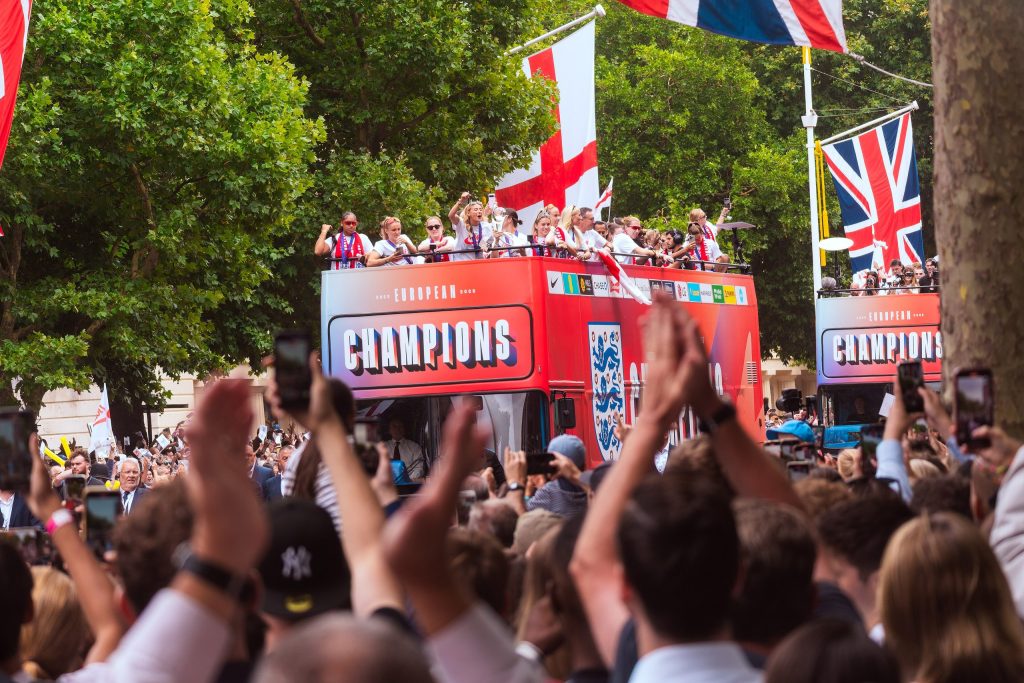
The women’s game has changed beyond recognition in that time. When England’s Lionesses won the Women’s Euros on home soil in 2022, the final against Germany at Wembley drew a crowd of 87,192 — a record for a women’s European Championship final. Three years later, England retained the European title in Switzerland, and hundreds of thousands of fans lined The Mall in London for the team’s open-top bus parade.
Debbie Hewitt, the chair of the English Football Association, said the bid was built around the fans. “As we said throughout our bid, we want this to be your Women’s World Cup, a World Cup for everyone,” she said. “Together, we will celebrate the power of women’s football, inspire the next generation, and unite fans from every corner of the world.”
The bid was built on the vision of “All Together” — a promise to unite people through football, give women and girls a bigger platform, and leave a lasting change in the game long after the final whistle in 2035. The chief executives of the four host associations — Mark Bullingham of The FA, Patrick Nelson of the Irish FA, Ian Maxwell of the Scottish FA and Noel Mooney of the FA of Wales — said in a joint statement that hosting the tournament was “a landmark moment” for all four nations.
Prime Minister Andy Burnham said: “The world is coming to the United Kingdom. In 2035 the biggest tournament in women’s sport will be played in cities across England, Scotland, Wales and Northern Ireland, bringing visitors, investment and jobs to every part of the country.”
Why FIFA picked the UK
The UK bid had several strengths. First, it was the only bid. FIFA declared it the sole valid candidacy for 2035 in April 2025, after the home nations moved their bid from 2031 to 2035 when FIFA limited 2031 hosting to Africa and CONCACAF, the confederation covering North and Central America and the Caribbean.
Second, the stadiums are ready. The bid was judged to have high-quality stadiums, considerable hosting experience and a relatively compact tournament footprint. England alone has more large football stadiums than most countries could offer for a whole tournament.
Third, women’s football in the UK is booming. England are the reigning European champions, the Women’s Super League is one of the strongest leagues in the world, and crowds for women’s matches have grown year after year. FIFA’s technical report gave the bid 4.3 out of five — the best score of any recent Women’s World Cup bid.
There are still questions to answer. The final list of stadiums will not be decided until 2029, and the planned new grounds at Manchester United, Chelsea, Birmingham City and Wrexham must be built on time to be included. Relations between the FA and FIFA have also been tense at times, and the cost of staging a 48-team tournament across four nations will be closely watched.
But for now, the mood is celebration. The UK government and the football authorities have spent years building the case, and the prize is the biggest event in women’s sport.
What it means for women’s football
The 2035 World Cup is about more than six weeks of football. FIFA says the tournament should inspire more girls to play, produce more women coaches, referees and administrators, and close the gaps that still exist in the women’s game around the world.
The numbers show how fast the women’s game is growing. The 2023 Women’s World Cup in Australia and New Zealand drew almost two million fans to stadiums. Nigeria’s Flamingos won the FIFA U-17 Women’s World Cup earlier this month, the first African team to win a FIFA women’s world title at any age level. The next edition, in Brazil in 2027, will be the first Women’s World Cup held in South America. By 2031 the tournament will have grown to 48 teams, and by 2035 it will arrive in the UK at its biggest ever size.
For the host nations, the tournament is also a chance to grow the game at home. The FA, the Scottish FA, the FA of Wales and the Irish FA have all said they want the World Cup to leave a legacy — better facilities, more girls playing football in schools and clubs, and more women in coaching and leadership roles.
The impact will not be limited to football. UK Sport says the tournament will bring visitors, investment and jobs to every part of the country, with matches spread across 15 cities in all four nations. For Scotland, Wales and Northern Ireland, hosting World Cup matches is a rare chance to be part of football’s biggest stage.
Women’s football has already produced some of the most memorable moments in recent British sport — from the Lionesses’ win at Wembley in 2022 to their victory parade through London in 2025. The 2035 World Cup gives the next generation of players something even bigger to aim for: a World Cup on home soil.
What happens next
FIFA will now work with the four host associations to confirm the final list of host cities and stadiums. That decision is expected by 2029, giving the planned new grounds time to be completed.
The four host nations will qualify automatically, and the remaining 44 places will be decided through qualifying matches around the world. The draw for the tournament, the match schedule and ticket sales are all still years away.
Before then, the football world will turn to Brazil, which hosts the 10th Women’s World Cup from 24 June to 25 July 2027, and then to the United States, Mexico, Costa Rica and Jamaica for the first 48-team edition in 2031. The UK will be watching both — and preparing for its own turn in 2035.
Frequently asked questions
When will the 2035 Women’s World Cup be held?
The tournament is scheduled for the summer of 2035. The proposed dates are 21 June to 29 July 2035, with 104 matches played over 39 days. FIFA will confirm the final schedule closer to the time.
Which countries are hosting the 2035 Women’s World Cup?
England, Northern Ireland, Scotland and Wales are hosting the tournament together. It is the first Women’s World Cup ever held in the United Kingdom.
How many teams will play at the 2035 Women’s World Cup?
48 teams will take part, split into 12 groups of four. The knockout stage will begin with the round of 32. The 2031 tournament will be the first Women’s World Cup with 48 teams, and 2035 will keep the same format.
Where will the 2035 Women’s World Cup final be played?
Wembley Stadium in London is expected to host the final, as it is the only proposed venue that meets all of FIFA’s technical requirements for the final. FIFA will make the final decision.
Has the UK hosted a World Cup before?
England hosted the men’s World Cup in 1966 and won it, beating West Germany 4-2 in the final at Wembley. The 2035 Women’s World Cup will be the first senior World Cup of any kind in the UK since then — a gap of 69 years.
Who is hosting the next Women’s World Cups before 2035?
Brazil hosts the 2027 Women’s World Cup from 24 June to 25 July 2027, the first edition held in South America. The United States, Mexico, Costa Rica and Jamaica will jointly host the 2031 tournament, the first with 48 teams.
Conclusion
The confirmation of the UK as host of the 2035 Women’s World Cup is a landmark moment for British sport. Sixty-nine years after England hosted — and won — the men’s World Cup, the women’s game will take centre stage in stadiums from Wembley to Hampden Park, from Cardiff to Belfast.
The tournament will be the biggest the women’s game has ever seen in this country: 48 teams, 104 matches, 15 cities and millions of fans. For the Lionesses and the other home nations, it is a once-in-a-generation chance to play a World Cup on home soil. For the millions of girls who will be watching, it is a chance to see what is possible.
There is a decade of preparation ahead, and plenty of decisions still to make — on stadiums, tickets, transport and legacy. But the biggest question has now been answered. In 2035, the Women’s World Cup is coming home.
Sources
• Reuters: “US, Mexico, Costa Rica, Jamaica awarded 2031 Women’s World Cup, UK to host 2035 edition”
• FIFA: “2031 and 2035 FIFA Women’s World Cup hosts appointed”
• UK Sport: “UK Awarded hosting rights for FIFA Women’s World Cup 2035”
• The Times: “Football’s coming home: UK confirmed as 2035 Women’s World Cup host”
• Korea Herald: “US, Mexico, Costa Rica and Jamaica to co-host 2031 Women’s World Cup; UK gets 2035”
• Bangkok Post: “USA joint bid and UK confirmed as 2031 and 2035 Women’s World Cup hosts”
• Wikipedia — 2035 FIFA Women’s World Cup: “2035 FIFA Women’s World Cup”
