
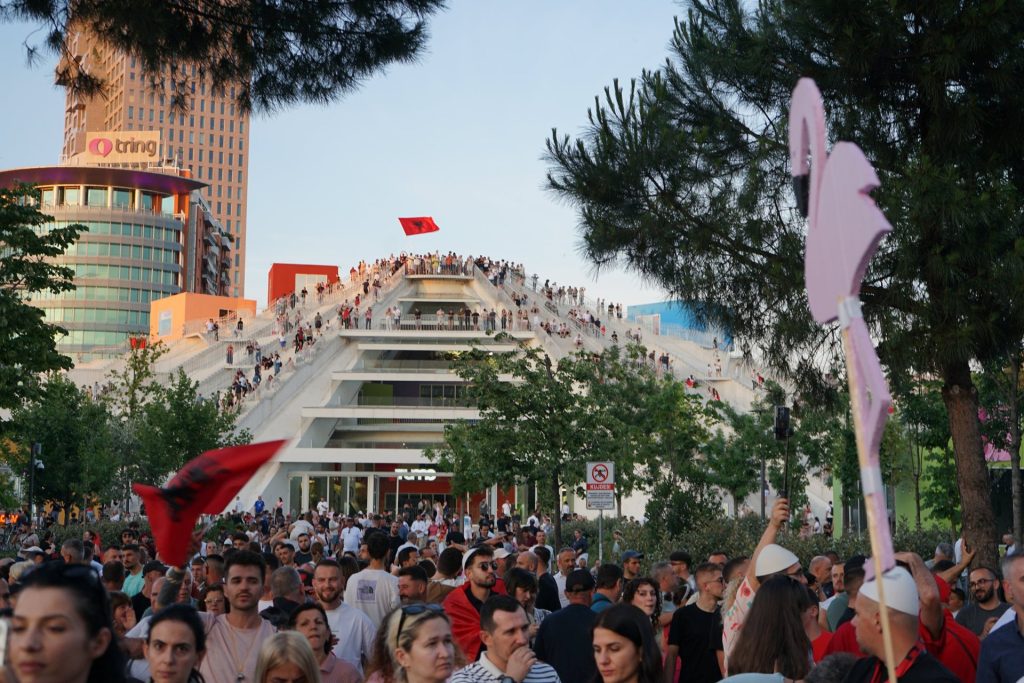
Albania Protests Hit Day 161 as Students Defy Fines and Clashes Return to Tirana
Thousands of people took to the streets of Tirana again on Saturday, 7 November, as Albania’s anti-government protests reached their 161st day. Police used water cannons and tear gas to disperse crowds near the Ministry of Education, while some protesters threw stones and firecrackers and set rubbish bins on fire.
The march began peacefully. Students and other citizens gathered outside the Ministry of Education in the afternoon, then walked to the Prime Minister’s Office on the capital’s main boulevard. But as on several recent Saturdays, the rally ended in clashes with riot police.
Four people were arrested and seven more face criminal proceedings after the protest, police said on Sunday. The government has also begun fining demonstrators heavily under a new law — including a 500,000 lek penalty, about 5,500 euros, for one masked protester who threw stones at police and at the Prime Minister’s Office building.
What started in the summer as a protest against a luxury resort project has now become the biggest challenge yet to Prime Minister Edi Rama, who has led Albania since 2013 and won a fourth term in office last year. Here is what happened on Saturday, how the movement grew, and what could happen next.
What happened on Saturday in Tirana
Saturday’s protest followed a pattern that has become familiar in the Albanian capital over the past few weeks. Students and citizens gathered outside the Ministry of Education at around 2 p.m., voicing their complaints about universities, tuition fees and the state of education. They then marched along the main boulevard towards the Prime Minister’s Office.
During the march and the rally that followed, the crowd chanted slogans against both Prime Minister Edi Rama and Sali Berisha, the leader of the opposition Democratic Party. “Rama in prison, Berisha in prison!” was one of the chants heard on the boulevard, as protesters said they opposed the whole political class, not just the government.
Tensions rose near the Ministry of Education, where police used water cannons to disperse a group of protesters, some of whom were masked. Footage from the protest showed demonstrators throwing objects at a police cordon, red smoke from flares hanging over the street, and a rubbish container set on fire next to a police vehicle. Protesters pushed another container towards the vehicle as officers moved in.
According to the police, protesters confronted officers, attacked them with hard objects and fireworks, blocked traffic and set waste bins alight. The clashes spread from the Education Ministry to the area around the Prime Minister’s Office, where police again used water cannons to clear the crowd.
By Sunday morning, the police had announced four arrests. Those arrested were named as Kevin Ndrevataj, 24, Muhamet Karaj, 19, Blerdjan Murati, 19, and Zef Nika, 34. Criminal proceedings have also been started against seven other people. Police said they found a quantity of suspected cannabis and a sharp metal object on one of those arrested, and that a later search of his home turned up an imitation firearm and 50 metal pellets. They also said they had seized devices they believe were used to launch stones.
The protests did not stop on Saturday. On Sunday, demonstrators gathered again in front of the Prime Minister’s Office, continuing their rally even in the rain.
The fines: a new weapon against the protests
Alongside the arrests, the government is now using fines to try to push protesters off the streets. Under Normative Act No. 5, a law dated 28 October 2026, the authorities imposed 12 administrative penalties for violations during Saturday’s demonstration.
The largest was a fine of 500,000 Albanian lek — about 5,500 euros — given to a person who wore a hood to hide his identity and threw stones at police officers and at the Prime Minister’s Office building. Police said officers had repeatedly told him to stop and disperse, but he did not follow their orders.
This is part of a wider fines campaign that began earlier in the week. On Thursday, 5 November, police announced they had issued 31 fines of 5,000 lek, about 55 euros each, to protesters for blocking roads and holding up traffic in Tirana during the previous day’s protest. Two more people were prosecuted for disobeying police orders.
The fines have not stopped the protests. On Saturday, thousands marched despite the government’s warnings of heavy penalties for anyone involved in violent acts. As one local report put it, the warnings “do not appear to have dampened the anger of young people and other citizens”.
The government has also introduced legislation imposing heavy fines on protesters who hide their faces with masks or refuse to leave violent crowds. The message from the authorities is clear: the protests are now treated not just as a political problem, but as a public order problem with a price attached.
How a resort protest became a national movement
To understand why students are on the streets, it helps to go back to the summer. The movement began as a largely peaceful environmental protest against a proposed luxury resort on Sazan, a former military island at the entrance to the Bay of Vlore. The project is linked to Jared Kushner, the son-in-law of US President Donald Trump, and his wife Ivanka Trump.
Protesters said the resort would damage a protected coastal area. They called their campaign the “Flamingo Revolution”, after the flamingos that live in the lagoons along Albania’s coast. For months, the demonstrations were mostly about the environment and about corruption in the way the project was approved.
By mid-October, the movement had changed. Students began leading protests of their own, starting on 13 October, over poor conditions at universities, high tuition fees, too little financial support for students and limited job prospects after graduation. The student protests spread from Tirana to other cities across Albania.
From there, the demands widened again. The students’ complaints about education joined the older anger about corruption, poor public services and unemployment. The result is a movement that now challenges the government itself, with the resignation of Prime Minister Rama as its central demand.
The protests entered their third week as a student-led movement in early November, and the wider movement passed 160 days on Saturday. The 161st day was counted from the start of the summer demonstrations, while the student phase is measured in weeks.
The scale of the unrest is now large. Al Jazeera reported on 7 November that roughly 300 people have been injured in the clashes so far, more than half of them police officers. Protesters have blocked roads, set off firecrackers and thrown stones and petrol bombs, while police have answered with tear gas, water cannons and, in some cases, rubber bullets.
Rama’s answer: dialogue, not resignation
Prime Minister Rama has refused to step down. His position, repeated several times, is that governments change through democratic elections, not through street protests. Albania held elections last year, in which Rama won his fourth term, and he argues that the result should stand.
Instead of resigning, Rama has offered talks. On Tuesday, 3 November, he renewed his call for dialogue with students and university lecturers, setting up a stone table outside his office and placing invitations marked “Dialogue” beside it. He said he was willing to consider any proposals from students and lecturers, and pointed to measures for families, public services and students in the 2027 state budget.
So far, the offer has not worked. The demonstrators have rejected the invitation to talk and insist on Rama’s resignation. There are also divisions among the students themselves: some have returned to classes, ending a boycott that lasted around two weeks, while others continue to disrupt teaching and rally support for the protests.
The opposition has tried to join the movement, but not always welcome. Democratic Party lawmakers and supporters, mobilised by party leader Sali Berisha, have joined some demonstrations — but many students have made clear they do not accept Berisha’s presence, insisting their cause is not his. That is why the crowds on Saturday chanted against both men.
The government, meanwhile, has hardened its tone. Deputy Prime Minister Albana Koçiu has condemned the violence, and the authorities have warned of tough measures against anyone involved in violent acts.
Why this matters
Albania is a small country of about 2.7 million people, but these protests matter well beyond its borders for three reasons.
First, they are the biggest challenge Rama has faced in 13 years in power. He has won four elections and built a reputation as a stable leader in a region that has often been unstable. A protest movement that has lasted more than five months, and that keeps growing despite arrests and fines, tests that reputation.
Second, Albania is a candidate to join the European Union, and how a government handles protests is one of the things Brussels watches closely. A long-running confrontation between students and riot police, with hundreds injured and heavy fines for demonstrators, is not the picture any government seeking EU membership wants to present.
Third, the protests show how a local environmental dispute can grow into something much bigger. The Flamingo Revolution began with a single resort project on a single island. It is now a movement about corruption, education, jobs and the future of a whole generation — the same issues that drive young people to protest in many countries.
What happens next
Neither side looks ready to give way. The students have shown they will keep marching despite fines, arrests and bad weather. The government has shown it will keep using police and penalties to try to end the protests. The prime minister has offered dialogue, but the students have refused it while resignation remains off the table.
A few things are worth watching in the coming days. The first is whether the protests stay student-led or become a wider opposition movement — and whether the students can keep Berisha’s party at arm’s length. The second is whether the fines work: if fewer people turn out, the government will say its approach is working; if the crowds stay large, the fines will look like a failed threat. The third is whether the clashes get worse. With roughly 300 people already injured, each Saturday carries a risk that someone is seriously hurt.
For now, the pattern is set. Every few days, students gather outside the Ministry of Education, march to the Prime Minister’s Office, and demand that Rama goes. And every few days, the police answer with water cannons, tear gas and fines. After 161 days, neither side has blinked.
Frequently asked questions
What are the Albania protests about?
They began in the summer of 2026 as an environmental protest, called the Flamingo Revolution, against a luxury resort project linked to Jared Kushner on the island of Sazan. In mid-October, students took the lead with demands about university conditions, tuition fees and jobs. The movement has since widened into a broader protest against government corruption and poor public services, with the resignation of Prime Minister Edi Rama as its central demand.
How long have the protests been going on?
The wider movement reached its 161st day on Saturday, 7 November 2026, counting from the summer demonstrations. The student-led phase began in mid-October and entered its third week in early November.
What happened on 7 November in Tirana?
Thousands of people marched from the Ministry of Education to the Prime Minister’s Office. Police used water cannons and tear gas after some protesters threw stones and firecrackers and set rubbish bins on fire. Four people were arrested and seven more face criminal proceedings. Protesters also gathered again on Sunday, despite rain.
What fines are protesters facing?
Under Normative Act No. 5, dated 28 October 2026, police imposed 12 administrative penalties after Saturday’s protest, including a 500,000 lek fine — about 5,500 euros — for a masked protester who threw stones at police and the Prime Minister’s Office. Earlier, 31 protesters were fined 5,000 lek each for blocking roads.
Has Prime Minister Rama agreed to resign?
No. Rama says governments change through democratic elections, not street protests, and he won a fourth term in elections last year. He has offered dialogue with students instead, including a public invitation on 3 November, but the protesters have rejected it and insist on his resignation.
How many people have been injured?
Al Jazeera reported on 7 November that roughly 300 people have been injured in the clashes so far, more than half of them police officers.
Conclusion
Albania’s protests have now lasted 161 days, and Saturday’s clashes in Tirana showed no sign that either side is backing down. Students who began by demanding better universities are now leading the biggest challenge to Edi Rama’s 13 years in power, while the government answers with arrests, water cannons and fines of up to 500,000 lek.
The movement started with flamingos and a luxury resort. It has become a test of whether a government can outlast a generation of young Albanians who say they want change — and whether those young people can keep a peaceful protest going when the streets keep turning violent.
Sources
- Euronews Albania, “Tirana Protest: Four Arrested, Seven Others Under Investigation Following Violent Clashes”, 8 November 2026: https://www.euronews.al/en/tirana-protest-four-arrested-seven-others-under-investigation-following-violent-clashes/
- Koha.net, “Police use water to disperse protesters in Tirana”, 7 November 2026: https://www.koha.net/en/arberi/policia-perdor-uje-per-ti-shperndare-protestuesit-ne-tirane
- Albeu, “Thousands of protesters take to Tirana’s streets for the 161st day despite warnings of fines”, 7 November 2026: https://albeu.com/english/thousands-of-protesters-take-to-tiranas-streets-for-the-161st-day-despite-warnings-of-fines/1092311/
- Albanian Telegraphic Agency (ATA), “PM Rama renews call for talks with protesting students as divisions emerge over boycott”, 3 November 2026: https://en.ata.gov.al/2026/11/03/pm-rama-renews-call-for-talks-with-protesting-students-as-divisions-emerge-over-boycott/
- EconoTimes, reporting Al Jazeera, “Albania Protests Enter Third Week as Police Disperse Masked Crowds”, 8 November 2026: https://econotimes.com/Albania-Protests-Enter-Third-Week-as-Police-Disperse-Masked-Crowds-1772986
- DTT-net, “Albania’s Prime Minister Edi Rama hits student-led protesters with massive fines as unrest spirals”, 5 November 2026: https://dtt-net.com/albanias-prime-minister-edi-rama-rama-hits-student-led-protesters-with-massive-fines-as-unrest-spirals/
This article is for general information and education only. It is not legal or financial advice.
