
Beavers Return to Loch Ness After 500 Years: The First Family Is Back in the Water
Beavers are back in the waters around Loch Ness — 500 years after they were last seen there. A family of six beavers was released into a small loch in the Scottish Highlands on Wednesday, 4 November 2026, in the first step of a project that will bring at least 15 beaver families back to the famous loch over the next three years.
The release is a small moment with a big meaning. Beavers were hunted to extinction in Scotland centuries ago. Now, exactly five centuries after the last widely recorded sighting of a beaver at Loch Ness, the animals are coming home — this time with a licence, a health check, and a team of conservationists watching over them.
Loch Ness is one of the most famous lakes in the world, known everywhere for the legend of the Loch Ness Monster. This week, it gained something better than a monster story: a real animal, back in the water at last.
What happened on Wednesday
The first family of beavers was set free at a lochan — a small lake — on Trees for Life’s Dundreggan rewilding estate in Glenmoriston, in the Scottish Highlands. Dundreggan is a 10,000-acre estate where the charity is restoring native woodland and wildlife.
The release was the first step of the Ness Beaver Project, a joint project by two conservation charities, Trees for Life and the Beaver Trust. The charities described the release as a “major milestone for nature recovery in Britain”.
Steve Micklewright, the chief executive of Trees for Life, was there to watch the animals swim away. He called it a “very beautiful thing to see” the creatures back in their natural environment.
The exact release sites are being kept secret for now. The charities say they will only announce the locations once the beavers have settled in safely, so the animals can get used to their new home without being disturbed.
The family that came home
The six beavers are a family: a mother, two juveniles about two years old, and three young beavers — known as kits — born earlier this year.
They did not come from far away. The family was caught on Tayside, in eastern Scotland, where beavers had been causing problems for local farmers. Instead of being removed and lost to the wild, they were given a new home.
Before the release, the beavers were taken to Five Sisters Zoo near West Calder, where they had health checks. Only after the vets were happy were they moved to the Highlands and set free.
This is how the project will work from now on. Beavers will be moved from places in Scotland where they are in conflict with farming, and released in the Loch Ness area, where there is plenty of water and woodland for them.
Why 500 years?
Beavers once lived all over Scotland. Then people hunted them for their fur, their meat, and a substance from their scent glands called castoreum, which was once believed to have medicinal uses. By the 16th century, they were gone.
The last widely cited record of beavers in Scotland comes from 1526–27 — and it places them around Loch Ness. The record appears in Hector Boece’s History and Chronicles of Scotland, one of the earliest histories of the country. That is where the “500 years” figure comes from: 2026 is almost exactly five centuries after the last beavers were written down at the loch.
Beavers stayed away for a very long time. They were only officially brought back to Scotland in 2009, in a trial release at Knapdale in Argyll, on the west coast. Since then, they have spread to other rivers and lochs, and in 2019 they became a protected species in Scotland. That means it is now against the law to kill or harm them without a licence.
But Loch Ness itself had to wait. It took until 30 October 2026 for Scotland’s nature agency, NatureScot, to grant a licence for the Ness Beaver Project. The licence allows Trees for Life and the Beaver Trust to release at least 15 beaver family groups around Loch Ness over three years.
The River Ness catchment — the network of rivers, lochs and streams that feed into and out of Loch Ness — was identified by NatureScot in 2022 as one of the most suitable places in Scotland for beavers. It has plenty of water, plenty of trees, and plenty of space.
The Ness Beaver Project
The project is part of Scotland’s Beaver Strategy 2022–2045, the national plan to expand where beavers live and help nature recover.
Under the plan, the first seven family groups are expected to be released between autumn 2026 and spring 2027. The rest will follow over the next three years, until at least 15 families are living around Loch Ness.
Before the licence was granted, the charities talked to local people, landowners and farmers. Trees for Life says the community discussions showed strong public support for bringing the beavers back.
The project is paid for by Trees for Life’s supporters and its Missing Species Appeal, along with the Fred Foundation, the Forest Peace Foundation, and Rewilding Britain’s Rewilding Innovation Fund.
Alan McDonnell, Trees for Life’s head of nature restoration, said: “Hunted to extinction centuries ago, beavers are reclaiming their place in our rivers and wetlands.”
Why beavers matter
Beavers are sometimes called “ecosystem engineers” — animals that change the landscape around them, and in doing so help many other species.
A beaver builds dams from sticks and mud, and lodges — dome-shaped homes — in the water. The dams slow rivers down and create ponds and wetlands. Those wetlands become homes for fish, frogs, dragonflies, birds and water plants. The ponds also hold water during dry spells and slow floodwater after heavy rain. Beaver dams can even help clean water, because the still ponds trap soil and pollution.
NatureScot, which assessed the project before granting the licence, said beavers could “significantly improve” the variety of wildlife in the River Ness catchment. It also judged that the landscape was at low risk of harm from beaver activity, because much of the catchment is steep and rocky.
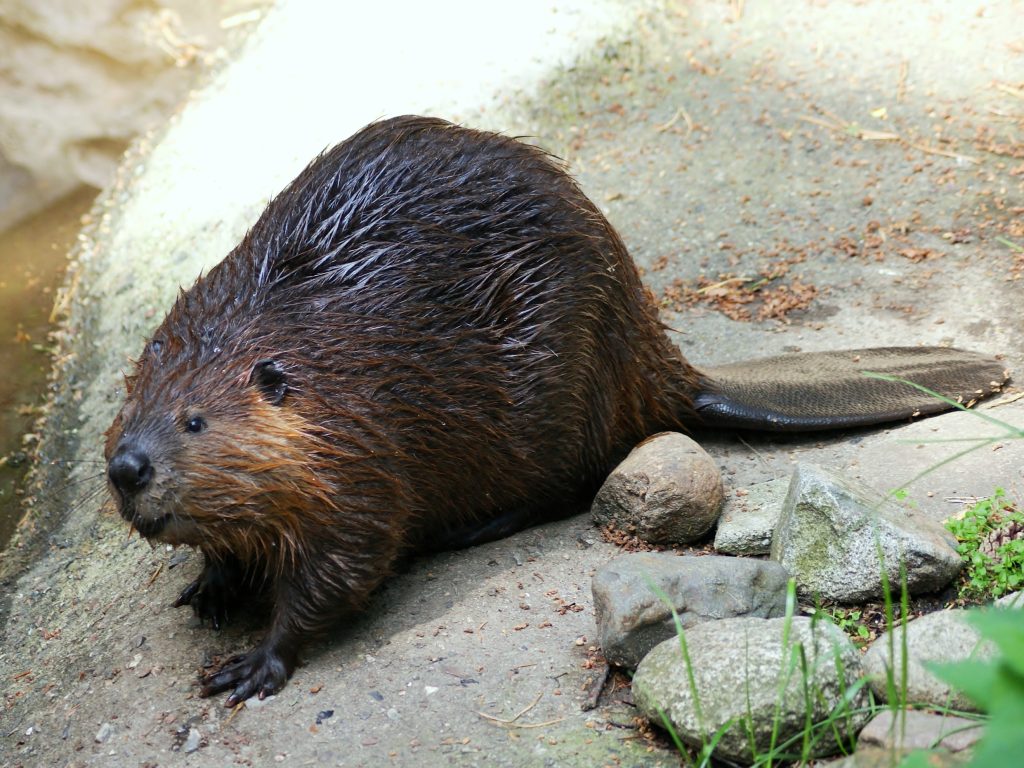
The Eurasian beaver, the species that lives in Scotland, is the largest rodent native to Eurasia. It can weigh up to 30 kilograms, with a body 70 to 100 centimetres long and a flat, scaly tail 30 to 40 centimetres long. Its front teeth are long and orange-brown, strengthened with iron, and strong enough to fell trees. The most obvious sign of a beaver is a tree gnawed into a pencil shape, or felled completely.
Across Europe, the Eurasian beaver has made a strong comeback since reintroductions began. From only a few small surviving groups a century ago, the species has spread back across much of its old range — from Britain to China. Scotland’s beavers are part of that wider recovery.
The other side: farmers’ worries
Not everyone is delighted. Beavers can cause real problems for farmers. Their dams can flood fields. They can block drainage ditches. They can fell trees, including trees planted for timber, and burrow into riverbanks.
NFU Scotland, the farmers’ union, said it recognised the ecological benefits of beavers, but it wants strong measures to protect farmland and rural businesses as more animals are released.
NatureScot’s own assessment noted that beaver activity could affect low-lying farmland in Glen Moriston, around Fort Augustus, and in Stratherrick. But it concluded that the catchment’s steep, rocky ground should limit the damage.
The project has answers ready for those worries. The beavers being released are animals that were already causing trouble on farmland elsewhere in Scotland — on Tayside, for example — and where other solutions had failed or were not practical. Moving them to Loch Ness solves a problem in one place and creates a benefit in another.
A local monitoring group has also been set up to deal with any conflicts as they come up, so that farmers have somewhere to turn if a beaver dam starts flooding a field.
This is the deal at the heart of the project: beavers get a new home, farmers get fewer problem animals, and the landscape gets a species it lost 500 years ago.
What happens next
The first family is now settling into its new home at Dundreggan. Over the coming months, conservationists will watch to see how the animals behave — where they build, what they eat, and whether they stay in the area.
More families will follow. The first seven groups are expected to be in the water between now and spring 2027. After that, releases will continue until at least 15 family groups are living around Loch Ness.
The charities will announce the release sites only after the animals are safely in place. For now, the exact loch where the first family swims is a secret — shared only with the people who need to know.
If the project works as planned, Loch Ness will have a thriving, connected beaver population within a few years: animals breeding, building dams, and slowly reshaping the rivers and wetlands of the Highlands, just as their ancestors did five centuries ago.
A new monster for Loch Ness?
Loch Ness is famous around the world for one animal that may not exist: the Loch Ness Monster, or “Nessie”. People have reported seeing a large creature in the loch for nearly a century, and the monster brings thousands of visitors to the Highlands every year.
The beavers are the opposite of Nessie. They are real, they are here, and they can be seen — if you are patient, and quiet, and lucky.
Conservationists hope the beavers will become a new reason to visit the area. Watching wildlife is already a big part of tourism in the Highlands, and a famous loch with a real returning species is a strong draw. Some reports have already suggested the beavers could boost ecotourism around Loch Ness, bringing visitors — and their spending — to local communities.
For now, though, the beavers have a simpler job: settle in, build a dam, raise their kits, and stay out of trouble. After 500 years away, they have earned a quiet start.
Frequently asked questions
When were beavers last seen at Loch Ness?
The last widely cited record dates from 1526–27, in Hector Boece’s History and Chronicles of Scotland. Beavers were hunted to extinction in Scotland in the 16th century.
When did the first beavers return?
The first family of six was released on Wednesday, 4 November 2026, at a lochan on Trees for Life’s Dundreggan estate in Glenmoriston. The release was the first step of the Ness Beaver Project.
How many beavers will be released?
At least 15 beaver family groups will be released around Loch Ness over three years. The first seven groups are expected between autumn 2026 and spring 2027.
Where do the beavers come from?
They are moved from other parts of Scotland where they were causing problems for farmers — the first family was caught on Tayside. The animals get health checks at a zoo before release.
Why are beavers good for nature?
Beavers build dams that create ponds and wetlands. These slow floodwater, store water in dry weather, and provide homes for fish, birds, insects and plants. NatureScot says they could significantly improve wildlife diversity in the River Ness catchment.
Do beavers cause problems for farmers?
They can flood fields, block drains and fell trees. The project moves beavers away from farmland where they cause trouble, and a local monitoring group will deal with any conflicts around Loch Ness.
Conclusion
Five hundred years is a long time to wait. The beavers last recorded at Loch Ness in 1526 would not recognise the world their descendants have returned to — but the rivers, lochs and woodlands of the Highlands are still there, waiting for them.
The first family of six is a small beginning: a mother, two juveniles and three kits, swimming in a quiet lochan in Glenmoriston. Behind them, at least 14 more families will follow over the next three years, each one moved from a place where it was unwanted to a place where it is welcomed.
If the project succeeds, Loch Ness will gain more than a tourist attraction. It will gain an animal that builds wetlands, slows floods, and brings back the wildlife that depends on slow, shallow water. The loch’s most famous resident may be a monster that nobody can find. Its newest residents are very real — and they are home at last.
Sources
- Trees for Life, “Licence granted for historic return of beavers to waters around Loch Ness” — https://treesforlife.org.uk/licence-granted-for-historic-return-of-beavers-to-waters-around-loch-ness-500-years-after-last-sighting-at-world-famous-loch/
- British Bulletin, “Beaver family reintroduced to iconic Scottish loch 500 years after last sighting” — https://britishbulletin.com/beaver-family-reintroduced-to-iconic-scottish-loch-500-years-after-last-sighting/
- BritBrief, “Beavers return to Loch Ness for first time in 500 years” — https://britbrief.co.uk/environment/wildlife/beavers-return-to-loch-ness-for-first-time-in-500-years.html
- Good News Network, “Loch Ness is about to welcome a new monster: the beaver” — https://www.goodnewsnetwork.org/loch-ness-is-about-to-welcome-a-new-monster-the-beaver-500-years-since-it-last-lived-there/
- Farmers Weekly, “Beaver releases approved for River Ness despite farming concerns” — https://www.fwi.co.uk/news/environment/environmental-issues-wildlife/beaver-releases-approved-for-river-ness-despite-farming-concerns
- Wikipedia, “European beaver” — https://en.wikipedia.org/wiki/European_beaver
This article is for general information and education only. It is not legal or financial advice.
