
Bhutan’s one-day line of prayer: 108 chortens rise in Gelephu
On Sunday 1 November 2026, Bhutan was raising 108 Buddhist chortens in a single day along a river in the south of the country. The plan, known as Project 108, was to complete all 108 of the monuments together in Gelephu Mindfulness City, on a day that brought together a major Buddhist observance and the anniversary of the King’s coronation. Tens of thousands of people had travelled to Gelephu for the event, and many more were expected to watch it online.
A chorten is the Himalayan form of a Buddhist stupa, a sacred monument that holds prayers, sacred texts, relics and ritual objects inside it. The ones in Gelephu are Jangchub Chortens, or Stupas of Enlightenment, which commemorate the Buddha’s attainment of enlightenment. Each one stands 15 metres tall, about the height of a five-storey building, and 108 metres from the next, in a single line along the Mau Chhu river, also written Mao Chhu.
The scale is what makes the day unusual. Bhutan has built chortens for centuries, but it has not, as far as the public record shows, built 108 of them, each 15 metres high, between one sunrise and the next.
At a glance
What happened: Bhutan was raising 108 Jangchub Chortens in one day, on Sunday 1 November 2026, along the Mau Chhu river in Gelephu Mindfulness City in southern Bhutan. Each chorten is 15 metres tall, and the line stretches for about 12 kilometres.
Why it matters: The project joins a sacred building effort to a new city, Gelephu Mindfulness City, and to a test set by the King: that Bhutanese people working together can do something no one had done before. It also brought one of the largest gatherings ever held in southern Bhutan.
What happens next: The Je Khenpo, Bhutan’s chief abbot, was scheduled to preside over the consecration on 2 November, and Buddhist teachers, guests and devotees were scheduled to gather in Gelephu from 1 to 4 November.
What was planned for 1 November
The raising was scheduled to begin in the early hours of 1 November, with 58 sets of dungchens, the long horns used in Tibetan and Himalayan Buddhist ceremonies, sounding to open the day. The main ceremony, including a grand procession and a royal address, was scheduled for later in the morning, when the completion of the chortens was due to be announced.
The date was chosen for two reasons at once. In 2026, 1 November is Lhabab Duechen, the Descending Day of Lord Buddha, which marks the Buddhist account of the Buddha returning to earth after teaching in heaven, including teaching his mother, Mayadevi. In Bhutan the day is also observed as Mothers’ Day. The same date is Coronation Day, the national holiday that marks the coronation of King Jigme Khesar Namgyel Wangchuck. In 2026 it was the 18th anniversary of his coronation.
It is worth being clear about what was known when this article was written. The raising was under way on the morning of 1 November, and the formal completion announcement was still to come. Some early reports described the chortens as already raised, but they were published before the day’s main ceremony, so this article describes the completion as scheduled, not as already confirmed.
A line along the river
The 108 chortens stand in a single file beside the Mau Chhu, not in a cluster on a hill. With 108 structures there are 107 gaps between the first and the last. At 108 metres per gap, those intervals alone cover 11,556 metres, about 11.6 kilometres. Published descriptions of the corridor put it at between about 11 and 12 kilometres, and most describe it as about 12 kilometres long.
On 16 June 2026, the Central Monastic Body performed the Salang Tendrel, the ground-breaking ceremony, at Chortens 1, 92 and 108, and all 108 sites were blessed that day.
The same corridor will also hold a much larger monument: the 80-metre Gelephu Chorten, modelled on Boudhanath in Kathmandu, for which ground was broken on 21 February 2026. It is a separate structure from the 108, and part of the same idea: that the new city’s earliest landmarks should be sacred ones.
Why the number 108
The number 108 runs through the whole project. It is the number of chortens, and it is also the distance in metres between them. In Buddhist tradition, the number carries several meanings. The Kangyur, the translated teachings attributed to the Buddha, traditionally contains 108 volumes. Buddhist prayer beads are commonly arranged in sets of 108, so that a person can count recitations. Teachings also refer to 108 mental afflictions that practitioners seek to overcome.
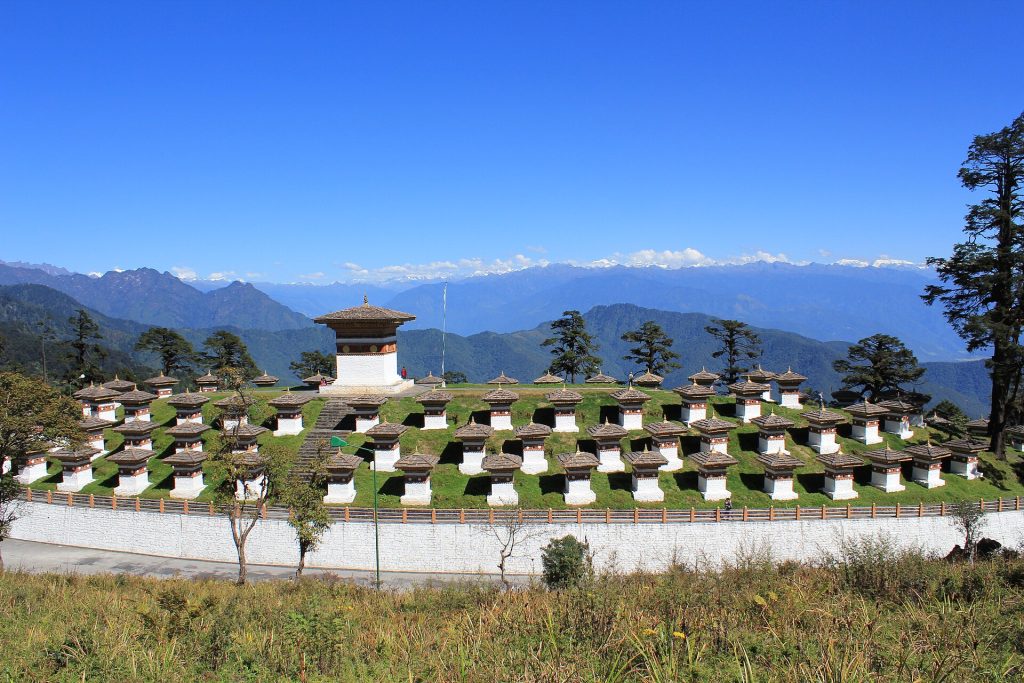
The number has been built into the Bhutanese landscape before. In the seventh century, the Tibetan emperor Songtsen Gampo is said to have raised 108 temples across the Himalayas. In 2004, Bhutan raised 108 chortens on the Dochula Pass, between Thimphu and Punakha. Those are the Druk Wangyal Chortens, built under the patronage of the eldest Queen Mother, Ashi Dorji Wangmo Wangchuck, as a memorial to Bhutanese soldiers who died in December 2003. They were completed in mid-2004 and consecrated in June of that year. The photograph with this article shows those Dochula chortens, the earlier set of 108, not the new Gelephu line.
Project 108 takes the same number and lays it out in a different shape. At Dochula the chortens stand in three tiers on a hill. In Gelephu they run in a single line along a river valley, and instead of being built over months by craftsmen, they were to be raised in one day by trained teams.
What is inside a chorten
The outer form is the part everyone sees. The part the tradition treats as more important is sealed inside: the zung, the sacred inner substance of relics, consecrated texts and prepared objects around a central wooden pole, the sokshing. Monks inscribe the pole with sacred letters and mantras, then arrange the other contents according to ritual instructions. Once the chorten is sealed, this carefully prepared interior is hidden from visitors.
The Central Monastic Body was responsible for the zung. Preparation began at Sarpang Dzong on 16 June, with zung masters drawn from all 20 dzongkhags, Bhutan’s districts, and went on for roughly five months. In July, the Je Khenpo offered 120 sacred Ringsel to be enshrined in the chortens. More than 2,400 monks were mobilised for the work.
Families supported the work with food and provisions, and offerings for the interiors included heirlooms, gold and silver ornaments, ritual objects and farming tools. Scripture rolls had to be tight, even and undamaged; rolls that loosened were opened and made again.
The spiritual preparations were completed in the days before the raising. The Je Khenpo presided over the Sri-Non ritual at the 108 sites on 28 October, a ritual intended to subdue harmful influences and remove obstacles before religious construction. It followed a three-day Sri Drub at Sarpang Dzong beginning on 24 October.
The King’s challenge
Project 108 was announced on 21 February 2026, the King’s birth anniversary, at the opening of the fifth volunteer programme in Gelephu Mindfulness City. More than 16,000 registered volunteers had come to Gelephu for five days of work, the largest public mobilisation the city had seen. The instruction for the 108 was specific. All of them were to be completed in a single day, with 300 workers assigned to each. A month later, on 24 March, the King walked the corridor chosen for them.
The King called it a test of cooperation and determination, saying: “It is an ambitious undertaking that demands courage, unity and deep commitment. We must do it to prove to ourselves that, as we face the challenges ahead, there is no limit to what we can achieve when we stand together.”
He said: “I tell well-wishers of Bhutan that I am not the superstar – it is my people who are the superstars.”
The vision was stated in three ways: a line of prayer strung along the river, meant to bless the ground and everyone who passes; a spiritual foundation for a new city where economic life and mindfulness go together; and proof of what a people can do together, by bringing tens of thousands of people to the same place on the same morning, freely.
Who was building it, and who was watching
The chortens were to be raised through zhabtog, Bhutan’s tradition of voluntary service offered for the common good. Gelephu has been running on zhabtog since 2025, with volunteer programmes clearing and restoring land in turns.
On the day itself, the raising was in the hands of trained teams. More than 2,000 members of the armed forces, together with DeSuups and Gyalsups, were trained over the months before to carry out the work. DeSuups are Bhutan’s volunteer guardians, and Gyalsups are young people in Bhutan’s national service programme.
Registrations grew steadily: more than 30,000 had signed up by late June, 68,914 by 28 September, about 84,000 by 8 October, and more than 120,000 by 21 October. By 29 October, Daily Bhutan reported that more than 200,000 people were expected to gather. Those are registrations and expectations announced before the event, not a final count. Final attendance and expenditure had not been given at the time of writing. An estimated 40,000 volunteers were expected across the sites.
More than 70 spiritual leaders from abroad and more than 100 from Bhutan confirmed plans to attend. Martial artist and film actor Jet Li was scheduled to be in Gelephu from 1 to 4 November.
How it was paid for
The cost of raising one chorten was put at 200,000 US dollars, which puts the full line at about 21.6 million dollars. The money came from public donations and crowdfunding from Bhutan and abroad, alongside sponsorships.
When the public contribution window opened in May, sponsors could pay more than 200,000 dollars to choose a chorten’s number, 200,000 dollars to cover one chorten, or from 20,000 dollars to share one. Crowdfunding accepted any amount, through the Royal Securities Exchange’s online platform.
By 23 May, more than 50 chortens had sponsors, and by 27 June, Kuensel, Bhutan’s national newspaper, reported that almost all had secured funding. When the crowdfunding closed on 21 August, offerings from 7,866 people totalled 28.37 million ngultrum and 84,651 dollars.
A town stretched to its limits
Gelephu is a small town in southern Bhutan, and Project 108 stretched its transport, accommodation and public services further than ever before. Gelephu has about 62 hotels with a normal combined capacity of about 1,100 guests, raised to almost 2,000 beds by adding mattresses wherever space allowed. Temporary campsites were prepared for about 80,000 people, plus a free campsite for up to 30,000 people bringing their own tents.
Free buses and taxis moved people between campsites, parking areas and the event grounds. Sixteen buses began free shuttles on 30 October, more than 130 buses were due to operate on 1 November, and more than 1,600 taxis volunteered for free service from the evening of 31 October. Medical teams prepared too: about 200 volunteer health workers, 13 ambulances, and a temporary 10-bed hospital at Tareythang Gyalsung Academy. India deployed around 500 border personnel along the route between Samthaibari and the Gelephu gate from 25 October to 5 November, and restricted heavy vehicles on the road there from 25 October to 6 November. India’s Union Minister for Parliamentary Affairs, Kiren Rijiju, was also due to attend.
Frequently asked questions
What is Project 108?
Project 108 is Bhutan’s plan to raise 108 Jangchub Chortens, or Stupas of Enlightenment, in a single day, on 1 November 2026, along the Mau Chhu river in Gelephu Mindfulness City. Each chorten is 15 metres tall, and the line stretches for about 12 kilometres.
What is a chorten?
A chorten is the Himalayan form of a Buddhist stupa, a sacred monument that holds prayers, sacred texts, relics and ritual objects inside it. Inside each one is the zung, the sacred contents arranged around a central wooden pole called the sokshing, which is sealed inside once the chorten is complete.
Why were the chortens raised on 1 November 2026?
In 2026, 1 November is Lhabab Duechen, the Descending Day of Lord Buddha, which is also observed in Bhutan as Mothers’ Day. The same date is Coronation Day, marking the King’s coronation, and in 2026 it was the 18th anniversary of that coronation.
Why 108 chortens?
The Kangyur, the translated teachings attributed to the Buddha, traditionally contains 108 volumes, prayer beads commonly have 108 beads, and teachings refer to 108 mental afflictions to overcome. Bhutan had also built 108 chortens before, at Dochula Pass in 2004.
Who built the chortens?
The chortens were raised through zhabtog, Bhutan’s tradition of voluntary service offered for the common good. On the day itself, trained teams of more than 2,000 members of the armed forces, DeSuups and Gyalsups did the raising, with 300 workers assigned to each chorten. An estimated 40,000 volunteers were expected across the sites.
How much did Project 108 cost?
One chorten was put at 200,000 US dollars, giving a combined figure of about 21.6 million dollars for all 108. The money came from sponsorships, public donations and crowdfunding. When the crowdfunding closed on 21 August, offerings from 7,866 people totalled 28.37 million ngultrum and 84,651 dollars.
What happens after 1 November?
The Je Khenpo, Bhutan’s chief abbot, was scheduled to preside over the consecration on 2 November. Buddhist teachers, guests and devotees were scheduled to gather in Gelephu from 1 to 4 November, and general visitor access was due to begin from the third day.
Conclusion
Project 108 was never only a construction job. A line of 108 chortens could have been built over a year, more cheaply and more easily. Building them in one day was the point. It asked tens of thousands of people to arrive on the same morning, in the same place, for the same purpose, and to work without pay, for reasons of faith and national pride.
Whether the day is judged a success will depend on more than whether the structures stood by nightfall. It will depend on whether the chortens become a place people return to, in a new city that is still being built, and whether the cooperation the King described lasts longer than a single day.
This article is for general information and education only. It is not legal or financial advice.
Sources
- https://asiadaily.org/news/17105/ (Asia Daily, 31 October 2026)
- https://www.dailybhutan.com/article/gelephu-expands-free-transport-and-completes-buddhist-rituals-ahead-of-project-108 (Daily Bhutan, 29 October 2026)
- https://www.dailybhutan.com/print/gelephu-prepares-for-more-than-120-000-visitors-ahead-of-project-108 (Daily Bhutan, 21 October 2026)
- https://bht99.com/analysis/project-108-chortens-in-a-single-day/ (Bht99, 1 October 2026)
- https://buddhistchannel.tv/index.php?id=40,13803,0,0,1,0 (The Buddhist Channel, 22 October 2026)
