
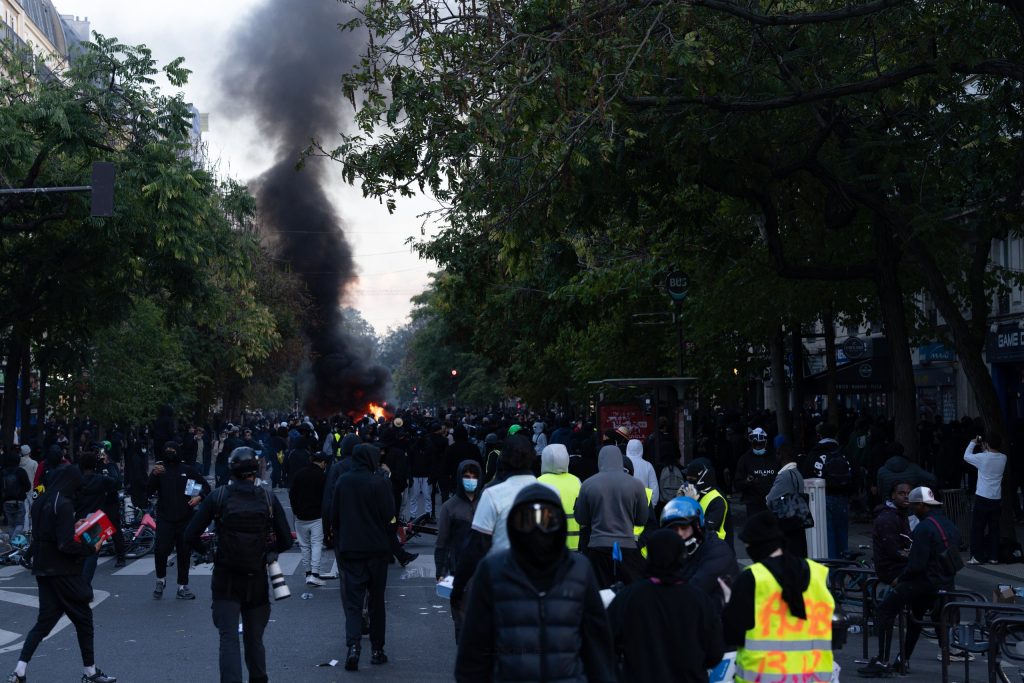
France Protests Hit Fifth Straight Saturday: 106,000 March as Yellow Vests Return and Anger Over a Police Bill Grows
France’s cost-of-living protests reached a fifth straight Saturday on 14 November 2026, with more than 100,000 people marching across the country in a movement that started in school classrooms and has now grown into one of the biggest challenges of Emmanuel Macron’s presidency.
The French Interior Ministry said 106,000 people took part in demonstrations nationwide, including 24,000 in Paris. Student unions put the numbers much higher, at around 200,000 across France, including almost 100,000 in the capital. Both counts agree on one thing: the crowds were smaller than last weekend, when the ministry counted 146,000 people nationwide and 46,000 in Paris.
But the smaller turnout does not mean the movement is fading. Unions have already called a new day of strikes and protests for Tuesday 17 November — the eighth anniversary of the Yellow Vest movement — and a controversial new police bill has given protesters a fresh reason to march.
This is what happened on Saturday, how the protests began, and why they have lasted so long.
What happened on Saturday
The day’s marches were organised by the Yellow Vests — the “Gilets Jaunes” — together with student unions, education unions and campaigners for children’s rights. In Paris, demonstrators gathered at Place de la République, the square that has become the movement’s symbolic home, and marched towards Place de la Nation, passing through Bastille.
Protesters chanted against the rising cost of living, against the Macron government, against police violence, and against poor conditions in schools. Many carried signs aimed directly at the president, whose approval ratings have fallen to their lowest point since he took office in 2017.
Saturday’s rallies stayed largely peaceful, according to the authorities, but there were clashes in several cities. Police used tear gas in Paris, Lyon, Nantes and Bordeaux. By early evening, the Interior Ministry said 121 people had been arrested across the country. The Paris prosecutor’s office reported 22 arrests in the capital, including three minors.
In Marseille, France’s second-largest city, the authorities had banned protests for the weekend — but around 3,500 people marched anyway. Local media reported that police used tear gas and a water cannon, and shared images of fires burning in a popular square.
In Lyon, around 8,000 people took to the streets, according to local authorities. The march there was mostly good-natured, but there were tensions at the front of the procession, where some protesters fired fireworks at police and officers replied with tear gas. A television news crew was attacked on the sidelines of the march, and police had to intervene.
In Bordeaux, the prefecture counted 6,500 marchers, down from 9,100 the previous Saturday.
Around 70,000 police officers and gendarmes were deployed across France on Saturday, the same number as on the previous three Saturdays, under the direction of Interior Minister Laurent Nuñez.
A movement that started in the schools
The protests did not begin as a national movement. They began in September 2026 with small protests by high-school students over conditions in state schools — crowded classrooms, staff shortages and falling standards.
Within weeks, the students were joined by teachers, parents, university students, trade unions, workers, farmers and retirees. The grievances widened: the rising cost of living, low wages, and anger at the government.
The turning point came on 17 October. That day, more than half a million people demonstrated around the country — 110,000 in Paris alone, according to the Interior Minister. The Yellow Vest movement, which had shaken Macron’s first term in 2018 and 2019 over fuel prices, returned to the streets.
But 17 October also turned violent. In Paris, Marseille and Lyon, the unrest was so intense that police lost control of entire neighbourhoods to rioters and looters. Shops were smashed and looted, cars and shared bikes were set on fire, and a city hall was set alight. Smashed windows and ransacked shops, bloodied teenage protesters and burning barricades filled the news.
Since then, the government has expanded police numbers at rallies and tightened controls on transport and on permits to protest. Each Saturday since has been calmer than 17 October — but the crowds have kept coming.
The crackdown — and why it made things worse
The government’s response to the violence has itself become one of the protesters’ main grievances.
A Reuters investigation published on 14 November found that the heavy-handed response — thousands of arrests, police beatings and curbs on marches — has added to the anger driving the movement, rather than ending it. Reuters journalists reviewed dozens of videos of the violence, attended the court hearings of 26 people accused of taking part, and interviewed more than 50 government officials, police officers, lawyers, protesters and witnesses.
The numbers are striking. More than 4,900 suspects have been taken into custody since 17 October, Justice Minister Gérald Darmanin told French television on 3 November. Of those, 2,290 were referred for prosecution and 404 have been handed prison sentences so far. Darmanin said most of those arrested are young men aged 18 to 25.
The Justice Minister has instructed prosecutors to deliver what he called “an extremely firm judicial response” to the violence, including pre-trial detention and fast-track trials for many of the accused. The Tribunal de Paris, France’s biggest courthouse, had to open two extra courtrooms to handle the fast-track cases.
At the same time, the police themselves are under investigation. The Interior Ministry said its internal watchdogs have opened 161 investigations into allegations of officer violence against protesters since September. Police tactics have faced scrutiny since the start of the protests because of the life-changing injuries suffered by some young people, including blown-off hands and lost eyes.
The United Nations and other human rights experts have also questioned the arrest of nearly 7,000 minors during school blockades, describing the detentions as disproportionate.
Government officials have repeatedly blamed far-left radicals and what they call “opportunistic delinquents” for the violence, saying they took advantage of mostly peaceful demonstrations to attack symbols of state authority and big business. But the Reuters investigation found that the crackdown has fed a wider anti-government groundswell that shows no sign of fading before next year’s presidential election.
The police bill fuelling the anger
One issue now brings many different groups of protesters together: a new police bill making its way through parliament.
The bill would give police officers and gendarmes a presumption of legitimate self-defence when they use their weapons while on duty — in plain terms, the law would start from the assumption that an officer who fired a weapon was acting lawfully. Critics have nicknamed it the “licence to kill” bill.
The bill has already passed the lower house of parliament, the National Assembly, and is now awaiting consideration by the Senate. Human rights organisations marched against it on Saturday, alongside students, unions and Yellow Vests.
For protesters, the bill is proof that the government is answering their complaints with force rather than with solutions. For the government, it is a measure to protect officers who face violent crowds. Either way, it has become a central demand of the movement: drop the bill.
The minimum wage row
Money is still at the heart of the protests. The government has offered to bring forward a rise in the minimum wage — an increase of 0.6 per cent — in an attempt to calm the unrest.
The unions rejected the offer. They called it “crumbs” — far too small to make a difference to people struggling with the cost of living — and called a new day of strikes for Tuesday.
That Tuesday is a symbolic date. It is 17 November, the eighth anniversary of the Yellow Vest movement, which began on 17 November 2018 with protests against rising fuel prices and went on to shake the first two years of Macron’s presidency. The Yellow Vest tracking website 17octobregiletjaune.net says the movement will “celebrate” its eight years “where it all started: on roundabouts and toll booths all over France”.
France’s unions have called for a general strike on the same day. If the demonstrations go ahead as planned, it will be the sixth major day of action in just over a month — and the first on a weekday since the strike wave began.
Why this matters beyond France
The protests matter for three reasons.
First, they show how quickly a small, local complaint can become a national crisis. A dispute about school conditions turned within a month into the worst civil unrest France has seen in years, drawing in students, workers, farmers and retirees, and reviving a protest movement many thought had died in 2019.
Second, they are happening in a country where the government is already weak. Macron, who cannot stand again in the presidential election due in April 2027, has seen his approval ratings fall to their lowest since 2017. France has had a string of prime ministers and political crises, and the protest movement adds pressure on a government that is already struggling to pass a budget.
Third, the pattern is familiar across Europe. In Spain, workers held their first general strike in 14 years on 11 November over a housing crisis that eats up almost a whole pay cheque — and the Spanish government has now approved emergency housing measures, though a snap election on 29 November will decide whether they survive. Across the continent, the cost of living, housing and public services have become the issues that fill the streets.
For France, the question now is whether Tuesday’s anniversary protests bring the crowds back to the levels of 17 October — or whether five Saturdays of marching, nearly 5,000 arrests and a promise of a small pay rise are enough to wear the movement down.
What happens next
- Tuesday 17 November: unions have called a day of strikes, and Yellow Vests plan actions on roundabouts and toll booths across France to mark eight years since the movement began.
- The police bill: the Senate will consider the bill giving officers a presumption of legitimate self-defence. Protesters want it dropped.
- The minimum wage: the government’s 0.6 per cent offer has been rejected as too small. Unions are likely to demand a bigger rise.
- The courts: fast-track trials of people arrested since 17 October continue, with 2,290 cases referred for prosecution so far.
- The election: France’s presidential election is due in April 2027. The protest movement is already shaping the debate, and the candidates will have to answer the questions the streets are asking — about the cost of living, schools, wages and the police.
FAQ
How many people marched on Saturday 14 November?
The Interior Ministry counted 106,000 people nationwide, including 24,000 in Paris. Student unions said the real figure was around 200,000 nationwide, including almost 100,000 in Paris. Both counts are lower than last weekend’s 146,000.
What are the Yellow Vests?
The “Gilets Jaunes”, or Yellow Vests, are a protest movement named after the high-visibility jackets French drivers must carry in their cars. It began in November 2018 over rising fuel prices and grew into a broad anti-government movement that lasted about two years. It returned to the streets on 17 October 2026.
What is the “licence to kill” bill?
It is a proposed law that would give police officers a presumption of legitimate self-defence when they use their weapons on duty. Critics call it a “licence to kill”. Supporters say it protects officers. It has passed the National Assembly and is waiting for the Senate.
How many people have been arrested since the protests turned violent?
More than 4,900 people have been taken into custody since 17 October, according to Justice Minister Gérald Darmanin. Of those, 2,290 were referred for prosecution and 404 have received prison sentences.
Why are French students protesting?
The movement began in September 2026 with high-school students protesting over conditions in state schools — crowded classrooms, staff shortages and falling standards. It has since widened to cover the cost of living, low wages, police violence and the new police bill.
What happens on Tuesday 17 November?
Unions have called a day of strikes, and Yellow Vests plan protests on roundabouts and toll booths to mark the eighth anniversary of their movement. It will be the next big test of how much support the protests still have.
Sources
- Al Jazeera — More than 100,000 rally across France in new Yellow Vest protests
- Reuters — Riots in France: How anti-government protests spiralled out of control
- The Hindu — Riots in France: How anti-government protests spiralled out of control
- Daily Sabah — France’s protest movement widens as anger over police bill soars
- Le Temps — Act V of the protests against the high cost of living in France
Related reading on Findivoza:
- France Nationwide Strike: Hundreds of Thousands March as Unions Demand Higher Pay and Better Public Services
- Spain Approves Housing Measures After General Strike — But the 29 November Election Will Decide If They Survive
This article is for general information and education only. It is not legal or financial advice.

Pingback: Portugal Housing Protests: Tens of Thousands March in 30 Cities as Rents Soar and Evictions Loom - Findivoza