
Hubble finally sees the ‘Cat’s Tail’: a 1,000-AU dust trail left by colliding dwarf planets
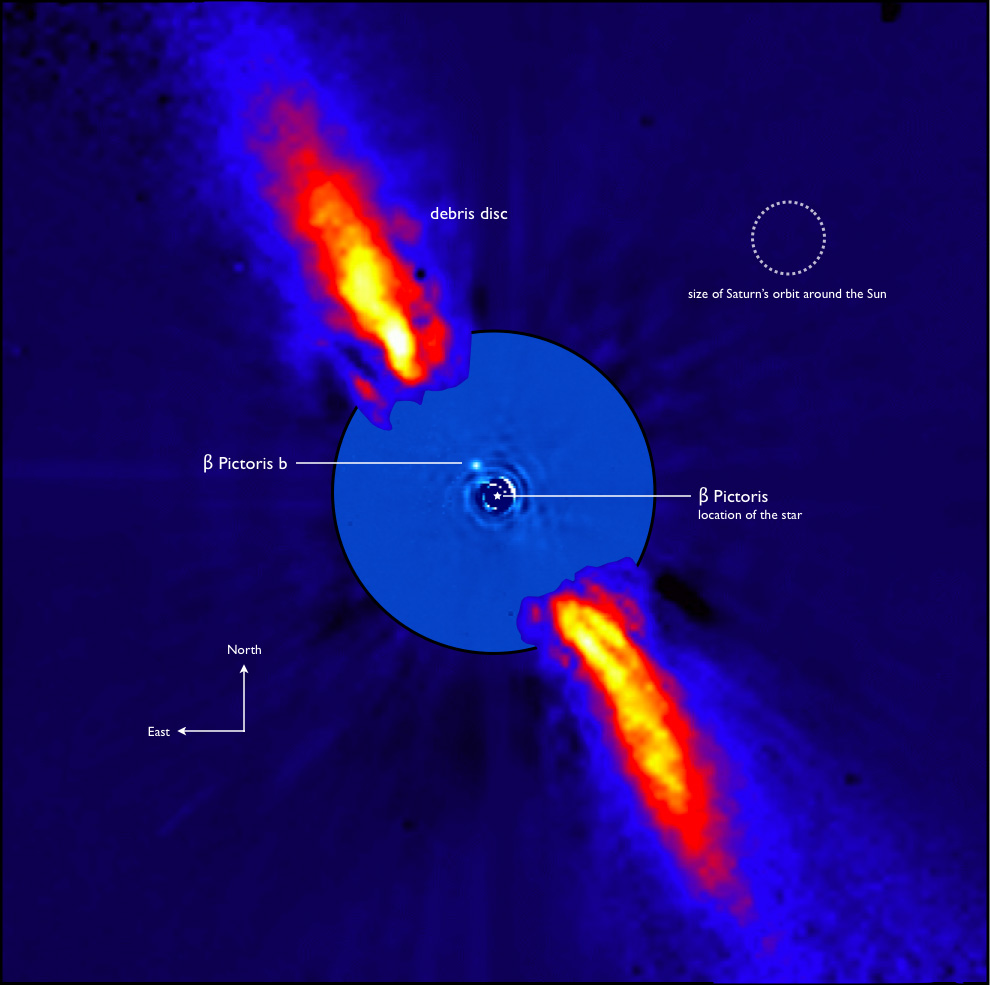
Sixty-three light-years from Earth, a young star is surrounded by the wreckage of a collision so large that its dust trail stretches about 1,000 times farther than the distance between Earth and the Sun. Astronomers have nicknamed that trail the “Cat’s Tail”, and for two years it had only ever been seen in infrared light. Now, in new work reported again on 31 October 2026, the Hubble Space Telescope has captured it in visible light for the first time, and the picture it gives is stranger than scientists expected.
The star is Beta Pictoris, in the small southern constellation Pictor, which means “painter”. It is only about 23 million years old, a tiny fraction of the age of our own Sun, which is about 4.6 billion years old. Around it sits a broad disc of dust and rocky debris left over from planet formation, along with three known giant planets.
Led by University of Arizona doctoral student Arin Avsar, the team published its findings in The Astrophysical Journal Letters. The headline finding is simple to state and hard to picture. The Cat’s Tail is thought to be the debris left behind after two large icy bodies, each roughly the size of a dwarf planet, collided and broke apart. The dust from that smash did not simply drift away. It formed a long, curved trail that reaches far beyond the main disc, a structure so large that the University of Arizona described its length as being like 200 trillion house cats lined up tail to snout.
At a glance
What happened: Hubble captured the Cat’s Tail, a huge dust trail around the young star Beta Pictoris, in visible light for the first time, after it had only been seen in infrared light by the James Webb Space Telescope.
Why it matters: The trail is thought to be the debris of a collision between two Pluto-sized bodies, and its dark, carbon-rich dust helps explain how planets, and the early Solar System, were shaped by violent impacts.
What happens next: Astronomers are expected to keep watching Beta Pictoris with Hubble and Webb, and to run computer models to test whether a giant planet is warping the system’s outer dust halo.
What Hubble actually saw
The Cat’s Tail was first spotted by the James Webb Space Telescope, known as Webb, in images published in 2024. Webb sees infrared light, which is the heat given off by warm objects, so it was well suited to spotting the faint glow of dust grains in the Beta Pictoris disc. But the same feature stayed invisible in visible light, the kind of light our eyes can see, and that puzzled astronomers for two years.
Hubble changed that. Avsar and colleagues used Hubble’s Space Telescope Imaging Spectrograph, an instrument known as STIS, with a coronagraph. A coronagraph works a little like holding your hand up to block the Sun so you can see something faint beside it. In this case, it blocked the bright light of Beta Pictoris itself, letting the much fainter dust around it come into view. The team combined six sets of Hubble images taken between 2012 and 2025, giving them more than 14 years of observations to work with, and compared the result with Webb’s infrared images.
In visible light, the Cat’s Tail looks shorter than it does in Webb’s infrared images. That is not a contradiction. Webb detects the heat given off by dust, while Hubble detects starlight reflected off dust. The farther dust sits from the star, the less starlight it reflects, so the outer part of the trail fades from Hubble’s view even though Webb can still sense its warmth.
Why the tail stayed hidden for so long
The reason the Cat’s Tail was so hard to see in visible light turns out to be what it is made of. According to the researchers, it consists almost entirely of what scientists call organic refractory material. In plain language, that means dark, carbon-rich material that does not easily break down or evaporate. Long chains of carbon atoms absorb visible light instead of reflecting it, so the dust looks almost black.
“The Cat’s Tail is thought to be the aftermath of a collision between large bodies — think something like Pluto,” Avsar said. “Oddly, this feature had previously only been seen with the James Webb Space Telescope, which detects infrared light, but remained invisible at shorter wavelengths, which has puzzled the community for a while.”
The dust grains themselves are also unusual. They are only about a micron across, which is roughly a thousandth of a millimetre, yet they are described as extremely porous, or “fluffy”. That is a strange combination, because tiny grains are usually expected to be solid fragments, not loose, airy clumps. The researchers do not yet have a settled explanation for how such small, fluffy grains formed.
One idea is that the collision was so violent, and the speeds involved so high, that the carbon-rich material was turned into gas and then cooled and reformed as porous dust. Kevin Wagner, a co-author and assistant research professor at the University of Arizona’s Steward Observatory, said it is possible that the carbon grains vaporised, turned into gas, and then recondensed as they cooled, and that is how they became so porous.
How big were the bodies that collided?
To work out what kind of objects could have produced the Cat’s Tail, the researchers looked at how much dark, carbon-rich material the trail contains, and asked what size of parent body would be needed to supply it. Their calculation points to two bodies that were each far larger than an asteroid, and closer in scale to the dwarf planets in the outer Solar System.
The paper estimates that each parent body must have had a mass of about one to three times 10 to the power of 21 kilograms, written as 1–3 × 10²¹ kg, to produce about 2 × 10¹⁹ kg of organic refractory debris in the Cat’s Tail. Put in more familiar terms, that is a few percent of the mass of Earth’s Moon, or about one to three times the mass of Ceres, the largest object in the asteroid belt between Mars and Jupiter.
If those bodies had densities similar to the dwarf planets in our own Solar System, they would have had radii of about 600 to 800 kilometres. That size range is similar to Charon, the largest moon of Pluto, and Makemake, a dwarf planet in the Kuiper Belt, the ring of icy bodies beyond Neptune.
The tail may stretch sideways, not away from us
The second surprise in the new study is about the shape of the Cat’s Tail in three dimensions. Before Hubble’s visible-light images, astronomers thought the tail stretched about 1,000 astronomical units behind the star, away from Earth and out into the background. One astronomical unit, or AU, is the average distance between Earth and the Sun, about 93 million miles, so 1,000 AU is about 93 billion miles.
The new modelling suggests a different arrangement. Instead of pointing away from us, the tail may lie mostly across our line of sight, stretching sideways in the same plane of the sky as the star, and possibly a little behind it.
“We find that instead of extending for 1,000 astronomical units behind the star, the Cat’s Tail may extend straight sideways relative to us, and there is no third dimension to it,” Avsar said. “It’s essentially in the same plane of the sky as the star and possibly extends a little bit behind it.”
That change matters because it changes how scientists reconstruct the original collision. If the debris is spread sideways rather than stretched away from us, the direction the bodies were moving, the angle of the impact, and the way the dust has spread since then all need to be rethought. The total length is still enormous, but its orientation in space is now understood differently.
A giant planet may be warping the dust halo
The Cat’s Tail was not the only new feature in the Hubble images. The team also found a previously unrecognised warp in the broad, faint halo of dust that surrounds Beta Pictoris. The halo is the outer, more spread-out part of the disc, and its shape is not a simple flat ring. One side appears bent or twisted relative to the other, in a pattern the paper describes as a convex and concave asymmetry in the outer halo.
The researchers think the warp is likely caused by Beta Pictoris b, one of the three known planets in the system. Beta Pictoris b is a gas giant about 10 times the mass of Jupiter, and its gravity is strong enough to tug on dust, comets, and icy bodies far beyond its own orbit. The team is careful to say that dedicated computer modelling is still needed to confirm that link, but the warp is a new clue to how giant planets shape the dust around them.
“This gives us another line of evidence into how giant planets influence comets through their immense gravitational force,” Avsar said. “It’s a testament to how much these massive planets really influence their surrounding dust and icy bodies out to hundreds of astronomical units.”
What this tells us about our own Solar System
Our Solar System is about 4.6 billion years old, and today it looks calm and orderly. The planets move in neat, nested orbits, and most of the leftover rock is confined to the asteroid belt or the Kuiper Belt. But that calm surface hides a violent past. In its early days, the young Sun was surrounded by a disc of gas and dust, and space rocks smashed into each other, broke apart, and in some cases grew into planets.
Beta Pictoris offers a way to see that early stage happening now, around another star. It is not an exact copy of the young Solar System, but it is close enough, young enough, and near enough to give astronomers a working model of what the Solar System may have looked like when it was only a few tens of millions of years old. The Cat’s Tail is a preserved record of one violent event in that process, and its exact timing is still an open question.
What happens next
The next steps are expected to be a mix of more observing and more modelling, rather than a single new discovery. Astronomers are likely to keep watching Beta Pictoris with Hubble and Webb, adding new images to the archive that already spans from 2012 to 2025. Longer coverage makes it easier to see whether features in the disc are moving, spreading, or changing shape.
Computer models are also expected to play a large part. The sideways shape of the Cat’s Tail and the warp in the halo both need to be tested against simulations of collisions and planetary gravity. Those models will need to explain not only where the dust is, but why its grains are so small and so porous, and how two Pluto-sized bodies could produce exactly the amount of dark material that is seen.
Frequently asked questions
What is the Cat’s Tail?
The Cat’s Tail is a long, curved trail of dust in the debris disc around the young star Beta Pictoris, about 63 light-years from Earth. It was first seen by the James Webb Space Telescope in 2024 and has now been seen in visible light by the Hubble Space Telescope. It is thought to be the debris left after two large icy bodies collided.
How long is the Cat’s Tail?
It stretches for about 1,000 astronomical units, or AU. One AU is the average distance between Earth and the Sun, about 93 million miles, so 1,000 AU is about 93 billion miles. New modelling suggests the trail may lie mostly sideways across our view, rather than stretching away from us behind the star.
Why could Hubble see it now when it could not before?
The tail is made almost entirely of dark, carbon-rich material that absorbs visible light, so it reflects very little starlight and looks almost black. The new study used deep Hubble images taken between 2012 and 2025, with a coronagraph to block the star’s glare, and combined them with Webb’s infrared images.
What collided to make the Cat’s Tail?
The researchers think two bodies similar in size to dwarf planets in our own Solar System collided. Their estimates point to parent bodies with radii of about 600 to 800 kilometres, each with a mass of about one to three times 10 to the power of 21 kilograms. That is a few percent of the mass of the Moon, and about one to three times the mass of Ceres.
How old is the Beta Pictoris system?
Beta Pictoris is about 23 million years old, which is very young compared with our Solar System at about 4.6 billion years old.
Does this discovery affect Earth or our Solar System?
No, there is no effect on Earth. Beta Pictoris is 63 light-years away, far too distant for its dust or its planets to affect us.
Conclusion
The first visible-light view of the Cat’s Tail does not just add a new image to the collection for Beta Pictoris. It changes the story scientists tell about the feature. The dust is darker and more carbon-rich than ordinary disc dust, the trail is probably spread across the sky rather than stretched away from Earth, and a giant planet may be bending the outer halo around it. Together, those findings point to a young planetary system still being shaped by collisions and by gravity, much as our own Solar System was billions of years ago.
There is still much that is not known, from the exact timing of the collision to the process that made the dust grains so small and so porous. That is why Beta Pictoris will keep being watched and modelled.
This article is for general information and education only. It is not legal or financial advice.
Sources
- https://lpl.arizona.edu/news/spotlight/enormous-cats-tail-tells-cosmic-collision-63-light-years-away (University of Arizona, Lunar and Planetary Laboratory, 28 October 2026)
- https://phys.org/news/2026-10-enormous-cat-tail-cosmic-collision.html (Phys.org, 29 October 2026)
- https://dailygalaxy.com/2026/10/something-shattered-63-light-years-trail/ (The Daily Galaxy, 31 October 2026)
- https://www.universetoday.com/articles/colliding-dwarf-planets-created-a-cats-tail-1000-astronomical-units-long (Universe Today, 29 October 2026)
