
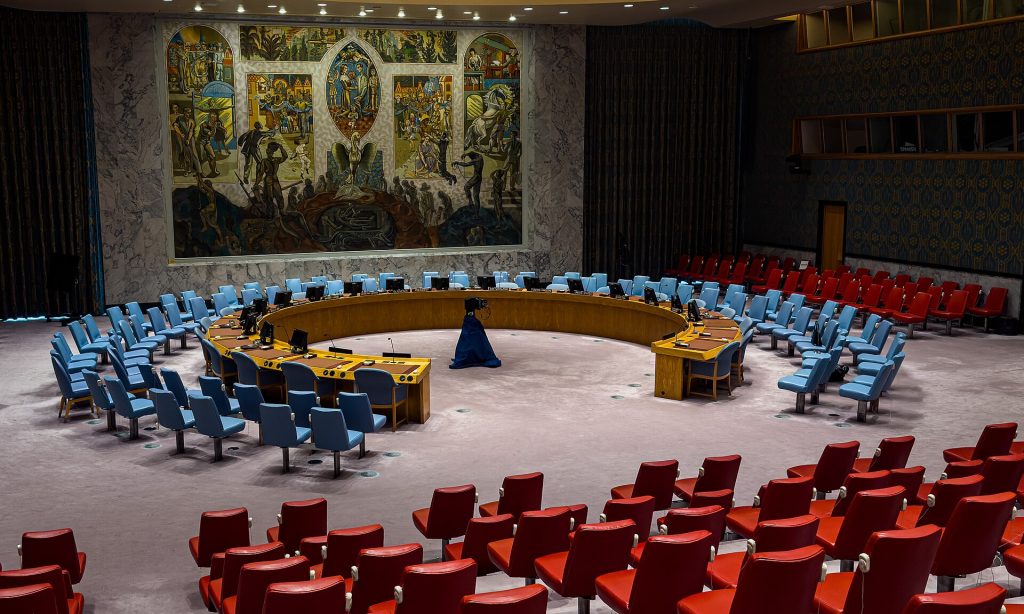
Latvia takes the chair at the UN Security Council for the first time, with Ukraine and new technology at the top of its agenda
On 1 November 2026, Latvia takes the chair of the United Nations Security Council for the first time in its history. For one month, a Baltic state of about 1.857 million people will run the meetings of the world’s most powerful diplomatic body — the only UN organ whose resolutions can be legally binding on every member state.
Latvia has worked towards this moment for a long time. It submitted its candidacy for a Council seat in 2011, was elected on 3 June 2025 with 178 votes out of the 188 countries that took part, and began its two-year term on 1 January 2026. The presidency rotates every month between the Council’s 15 members in English alphabetical order. Greece held it in October; Latvia follows in November; Liberia takes over in December.
Latvia has said plainly what it wants to do with the month. Its ambassador to the UN, Sanita Pavļuta-Deslandes, has said the country will work to keep Russia’s war against Ukraine high on the Council’s agenda, to prevent the normalisation of Russian aggression, and to counter Russian propaganda. Alongside Ukraine, Latvia plans a broad discussion of new technologies, above all artificial intelligence.
At a glance
What happened: Latvia assumed the rotating presidency of the UN Security Council on 1 November 2026, for the first time in its history, and will hold the chair for one calendar month.
Why it matters: The presidency lets Latvia set the Council’s agenda and chair its meetings. Latvia plans to use that platform to keep the war in Ukraine at the centre of attention and to push a discussion on artificial intelligence and other new technologies.
What happens next: Latvia was expected to present its programme at the start of November, including one or two signature meetings on its priority topics, while the rest of the month is filled by the Council’s regular business.
What the presidency actually means
The UN Security Council has 15 members: five permanent members — China, France, Russia, the United Kingdom and the United States — who each hold a veto, and ten elected members serving two-year terms. Latvia is one of the elected members for 2026–2027, alongside Bahrain, Colombia, the Democratic Republic of the Congo, Denmark, Greece, Liberia, Pakistan, Panama and Somalia. Pakistan is therefore sitting on the same Council as Latvia this year, its term running through the end of 2026.
The presidency rotates every month in the English alphabetical order of the member states’ names, and no distinction is made between permanent and elected members. That is why a country of under two million people can find itself chairing the same body as the United States, China and Russia. The president chairs the Council’s formal meetings and its closed-door consultations, approves the provisional agenda, and speaks for the Council when it issues statements that all members have agreed.
The presidency does not give the chairing country an extra vote, and it does not give it any power to override the veto. On substantive matters, a decision needs nine votes in favour, including the concurring votes of all five permanent members — which means any one of them can block a resolution.
What the presidency does give a country is agenda-setting power. About 90 per cent of the Council’s agenda is fixed, regular business: briefings on particular countries and crises, peacekeeping mandate renewals, and reports the Council must hear. The president cannot clear that away, but it can add one or two meetings of its own choosing and shape how the regular business is handled.
For a country that spent more than 50 years occupied by the Soviet Union, restored its independence on 21 August 1991, joined the United Nations on 17 September 1991, and joined NATO and the European Union in 2004, a seat — and now the chair — at the Security Council is the clearest sign of how far its foreign policy has come.
Why this month matters for Latvia
Latvia’s argument for being on the Council has always been about its own security. It shares a border with Russia, lived through Soviet occupation, and sees the war in Ukraine as a warning about what happens when aggression goes unpunished. Its ambassador has said Latvia must defend its independence and freedom every single day, and that strengthening its own security — including by supporting Ukraine — is the main goal of its membership.
Latvia has been one of the most active elected members of the Council in 2026. In its first 100 days, the Council held more than 40 formal meetings, more than 20 closed-door consultations and four Arria-formula meetings — informal sessions where members hear from outside experts and eyewitnesses — and Latvia organised briefings of its own on Ukraine, on the EU–UN partnership on security, and on new technologies.
The presidency also closes a run of four consecutive European presidencies: Denmark in August, France in September and Greece in October. The four countries have coordinated closely, particularly on technology, and Latvia’s ambassador told the specialist UN news outlet PassBlue that they cooperate closely throughout their terms so that work on emerging technologies is approached with continuity.
Ukraine at the top of the agenda
Ukraine is, by Latvia’s own account, the first priority of its presidency. According to Latvian officials, the Council held 16 official meetings on Ukraine in 2026, almost all convened by Latvia with its European allies at Ukraine’s request, covering the war’s humanitarian consequences, attacks on civilian infrastructure and energy, and the deportation of Ukrainian children.
The language Latvia uses about the war is unusually direct for a diplomat. Its ambassador has said Latvia is making every effort to keep the war high on the Council’s agenda, to prevent the normalisation of Russian aggression, to counter Russian propaganda and lies, and to explain Russia’s imperialist goals and their global consequences. The foreign ministry uses similar terms, saying Latvia is working to prevent the normalisation of aggression and to inform the world about what it calls Russia’s imperialist and colonialist objectives.
That bluntness reflects Latvia’s own history. Its ambassador has said that, as a country occupied by the USSR for more than 50 years, Latvia is now being heard. Latvia’s argument is that a just and sustainable peace can only be achieved by putting pressure on Russia and holding it accountable.
There are limits to what a presidency can do on Ukraine, and they are built into the Council itself. Russia is a permanent member with a veto, so the Council cannot adopt a resolution condemning its own actions, however many members support one. What Latvia can do is keep the issue on the agenda, force regular public debate, and build the widest possible coalition outside the Council. In February, for example, Latvia and its allies lobbied for a UN General Assembly resolution on Ukraine that was adopted with the support of 107 countries — 14 more than the previous year, according to the foreign ministry. The General Assembly cannot issue binding decisions the way the Council can, but a vote of that size is a signal.
Technology, artificial intelligence and the new working group
The second pillar of Latvia’s presidency is the effect of new technologies on peace and security. Latvia plans a broad discussion on emerging technologies, and it is working with Greece to create something that would outlast both presidencies — an informal working group in the Council on technology, peace and security.
The idea was reported by PassBlue on 12 October 2026. Greece and Latvia intended to announce the group during the third week of October, and during Latvia’s presidency in November, Latvia would invite fellow Council members to pledge support for it. The group would connect technological concerns to items already on the Council’s agenda, and was meant to complement, rather than duplicate, discussions elsewhere.
The Council has been feeling its way towards artificial intelligence for several years. The United Kingdom held its first meeting on AI in July 2023, and since the launch of ChatGPT in 2022 the Council has held seven meetings on AI. France, which held the presidency in September 2026, convened a high-level debate on frontier technology, with the leaders of Anthropic and OpenAI taking part. Greece, in October, highlighted AI and maritime security. Latvia’s planned discussion is broader: how the Council should handle emerging technologies as a whole.
That breadth runs into disagreement. Council members agree AI offers benefits alongside serious risks, but disagree about who sets the rules, how restrictive they should be, and whether safety controls could reinforce unequal access to technology. There is no mandated regular briefing on AI in the Council, and opposition from a permanent member could block a formal result, such as a resolution. The working group is a modest but practical step: a place where specialists can meet informally and hear briefings about technological risks, including AI-driven disinformation.
The rest of the agenda, and what Latvia cannot do
For all the attention on Ukraine and technology, most of November will be taken up by the Council’s ordinary business. The Council has more than 60 issues on its agenda, from conflicts in particular countries to sanctions, non-proliferation, humanitarian aid and migration. More than half relate to Africa, where there are long-standing conflicts and a critical humanitarian situation.
The Middle East will also be unavoidable. Latvia’s foreign ministry has said the conflict there is not merely regional, and that Latvia is already feeling its impact, including through Iran’s blockade of the Strait of Hormuz — a step it calls categorically unacceptable and a dangerous precedent. The ministry says the blockade directly affects Latvia’s and Europe’s security, trade and energy, through disrupted supply chains and rising global energy prices.
The presidency is a one-month, largely procedural role. It does not change the balance of power in the Council, it does not remove the veto, and it does not let Latvia impose its own views on the other 14 members. A resolution still needs nine votes in favour, including the concurring votes of all five permanent members, and a presidential statement needs consensus. For a small country, the value of the chair is in the debate itself — in keeping an issue visible and forcing governments to state their positions in public.
What it means for Pakistan, and what to watch
For readers in Pakistan, there are two reasons to pay attention. The first is direct: Pakistan is sitting on the same Council as Latvia this year, as one of the ten elected members, and its term runs through the end of 2026. In January, Pakistan organised an Arria-formula meeting on respecting international treaties, during which Latvia highlighted what it said were Russia’s violations of international obligations in Ukraine.
The second reason is the substance of what Latvia is raising. The war in Ukraine affects energy prices, food supplies and shipping far beyond Europe. The debate on artificial intelligence matters for the same reason: the rules that govern AI, disinformation and cyber-attacks will shape every country’s security, including Pakistan’s. And the Middle East crises that will fill much of the Council’s November agenda — Gaza, Lebanon, Yemen, Syria and the Strait of Hormuz — are directly relevant to Pakistan’s region and its interests.
Three things are worth watching in November. The first is the programme Latvia presents at the start of the month: the topics of its signature meetings, and who it invites to brief the Council. The second is the informal working group on technology — if Council members pledge their support, as PassBlue reported was planned, the group will have a mandate to keep meeting after November. The third is the unexpected: how Latvia chairs an emergency meeting will say as much about its presidency as any signature event. When the month ends, the chair passes to Liberia. Latvia’s term ends on 31 December 2027.
Frequently asked questions
What is the UN Security Council presidency?
It is a one-month, rotating chair. Each of the Council’s 15 members takes a turn as president, in English alphabetical order, chairing all meetings and approving the provisional agenda. It does not give the chairing country an extra vote or any power to override the veto.
When does Latvia hold the presidency?
Latvia assumed the presidency on 1 November 2026 and holds it until the end of November. Liberia takes over in December.
Why is Latvia’s presidency historic?
Because it is the first time Latvia has chaired the Council, and the first time it has sat on it at all. Latvia was elected on 3 June 2025, with 178 votes out of the 188 countries that took part, and it began its term on 1 January 2026. It submitted its candidacy in 2011.
What are Latvia’s priorities for November?
Ukraine is the first priority: keeping the war high on the agenda, preventing the normalisation of Russian aggression, countering disinformation and pressing for accountability. The second is new technologies, especially artificial intelligence, including a broad discussion and a new informal working group on technology, peace and security. Latvia also prioritises the UN Charter, gender equality, and addressing hybrid threats, cyber-attacks and disinformation.
Can Latvia pass a resolution on Ukraine?
Not on its own. A substantive resolution needs nine votes in favour, including the concurring votes of all five permanent members, and Russia holds a veto. Latvia can keep the issue on the agenda, convene meetings and build support, but it cannot force a resolution through.
Is Pakistan also on the Security Council in 2026?
Yes. Pakistan is one of the ten elected members, and its term runs through the end of 2026. It sits alongside Latvia and the other elected members — Bahrain, Colombia, the Democratic Republic of the Congo, Denmark, Greece, Liberia, Panama and Somalia — and the five permanent members.
What happens after Latvia’s presidency ends?
The chair passes to Liberia for December 2026. Latvia remains an elected member until 31 December 2027, so it can continue the work it started in November in its remaining year on the Council.
Latvia’s month in the chair will not end the war in Ukraine, settle the argument about artificial intelligence, or resolve the crises that fill the Council’s agenda. No one-month presidency could. But it is a genuine first for a country that waited 15 years from submitting its candidacy to taking the gavel. If Latvia uses the month to keep Ukraine visible and to show that a small country can run the world’s most powerful diplomatic body fairly and effectively, that will be a presidency worth remembering — in Riga, in New York, and in Pakistan.
This article is for general information and education only. It is not legal or financial advice.
Sources
- https://www.byteseu.com/2488597/ (Bytes Europe, 31 October 2026)
- https://www.mfa.gov.lv/en/article/latvias-first-100-days-un-security-council-keeping-russias-war-ukraine-high-international-agenda (Latvian Ministry of Foreign Affairs, 10 April 2026)
- https://www.mfa.gov.lv/en/article/latvia-begins-work-un-security-council-1-january-main-objectives-strengthening-latvias-security-including-supporting-ukraine (Latvian Ministry of Foreign Affairs, 1 January 2026)
- https://news.un.org/en/story/2025/06/1163971 (UN News, 3 June 2025)
- https://passblue.com/2026/10/12/europe-seeks-a-lasting-un-security-council-role-on-ai/ (PassBlue, 12 October 2026)
- https://research.un.org/en/docs/sc/membership (UN Dag Hammarskjöld Library, Security Council membership and presidency)
- https://investinlatvia.org/en/why-latvia/latvia-in-facts (Investment and Development Agency of Latvia, Latvia in facts)
- https://www.byteseu.com/2484204/ (Bytes Europe, 29 October 2026)
- https://112.ua/en/latvia-vperse-ocolit-radu-bezpeki-oon-u-listopadi-2026-roku-prioriteti-vijna-v-ukraini-ta-tehnologii-194895 (112.ua, 30 October 2026)
- http://www.infoplease.com/countries/latvia (Infoplease, Latvia country profile)

Pingback: UN mission in Western Sahara left without a mandate after US and Russia veto each other's plans - Findivoza