
Pakistan Invites India and SCO Nations to Dialogue on Culture, Heritage and Climate Change
Pakistan has invited India and the other members of the Shanghai Cooperation Organisation (SCO) to sit down and talk — about culture, about shared history, and about protecting that history from a changing climate.
The invitation came from Pakistan’s Federal Minister for Climate Change, Dr Musadik Malik, who was speaking at the SCO Ministerial Forum on Dialogue Among Civilisations in New Delhi on Sunday, 22 November 2026. It was the final day of the three-day forum, and Malik used his address to set out a three-point plan for the region’s countries to work together.
The moment matters because it is the first time in more than three years that a Pakistani federal minister has visited India. The two countries have barely spoken at ministerial level since their military confrontation in May 2025. That a Pakistani minister stood in Delhi, spoke in Urdu, quoted the subcontinent’s great poets, and then sat down for an extended conversation with his Indian counterpart is, by itself, a small but real opening.
What Pakistan proposed at the forum
Malik’s proposal had three parts. First, he called for stronger cultural cooperation among SCO countries — more exchanges, more shared work, and more contact between peoples. Second, he called for greater efforts to preserve historical heritage across the region. Third, he called for joint steps to protect cultural landmarks from the damage caused by climate change.
To turn those ideas into something practical, he proposed two concrete things: a network of SCO countries dedicated to preserving cultural heritage, and a digital library where member states could share historical and cultural information, and the methods used to protect it.
The message behind the plan was simple. The countries of the SCO share centuries of common history, and that history is now under threat — from neglect, from conflict, and from a climate that is growing hotter, wetter and more unpredictable. No one country can protect it alone.
A speech in Urdu, with Ghalib and Iqbal
Malik delivered his address in Urdu, a deliberate choice at a forum about civilisations and shared culture. He referred to two of the subcontinent’s most loved poets, Mirza Ghalib and Allama Iqbal, to make his point about what dialogue really means.
Dialogue, he said, can only take place among people with different viewpoints and different cultural backgrounds. If everyone shared identical opinions, it would no longer be meaningful dialogue at all.
It was a gentle argument, but it carried a clear message for a room full of ministers from countries that often disagree: difference is not the obstacle to talking. Difference is the reason to talk.
Malik also spoke about Pakistan’s own place in the region’s story. He said Pakistan is home to ancient civilisations, including the Gandhara civilisation and a rich Buddhist heritage, and that its historical and cultural links stretch from Persia and the Arab world to the Central Asian cities of Bukhara and Samarkand. He invited all member states to make full use of those longstanding connections.
The meeting at the Old Fort
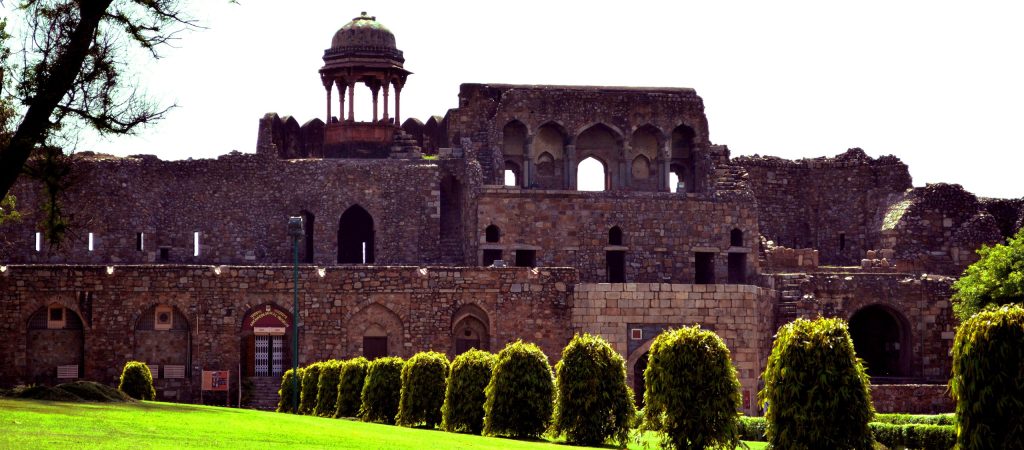
The most watched moment of the visit happened away from the main hall. On the sidelines of the forum, Malik held an informal meeting with India’s Culture Minister, Gajendra Singh Shekhawat, at Delhi’s historic Purana Qila, the Old Fort. The two ministers spoke at length about matters of mutual interest.
The setting was fitting. Purana Qila is a 16th-century fort in the heart of Delhi, and the forum itself was held there — a monument to the shared history the gathering was meant to celebrate. Two ministers from countries that have fought wars against each other, talking at length inside a fort built centuries before either country existed, was a picture the organisers could hardly have planned better.
What the two men actually discussed has not been made public, and neither side has described the meeting as a negotiation. It was informal, and it was about culture, not about the disputes that divide the two countries. But in a relationship where ministers have not met face to face for years, even an informal conversation is a step.
Who else Malik met in Delhi
Malik did not only meet the Indian minister. During the forum he also held separate meetings with the culture ministers of several other countries: Azerbaijan’s Culture Minister Dr Adil Karimli, Kyrgyzstan’s Minister of State for Information, Tajikistan’s Culture Minister Matlubakhon Sattoriyon, and Nepal’s Culture Minister Khadga Raj Paudel. An Iranian delegation led by Dr Mehdi Imani also called on him during the event.
The list shows how the forum worked in practice. For Pakistan, the visit was not only about India. It was a chance to talk to almost every country in the region in one place, in three days, about subjects — culture, heritage, climate — on which agreement is easier than on borders or security.
Why this visit matters
The visit matters for three reasons.
First, it breaks a long silence. The last visit by a Pakistani federal minister to India was in May 2023, when the then foreign minister, Bilawal Bhutto-Zardari, travelled to Goa for a meeting of the SCO Council of Foreign Ministers. Since then, the two countries have gone through a military confrontation in May 2025, after the Pahalgam attack in April that year killed 26 people. Pakistan’s airspace remains closed to Indian aircraft until 23 December, and formal dialogue between the two governments has stayed frozen. Against that background, a Pakistani minister travelling to Delhi, speaking at a public forum and meeting his Indian counterpart is a small but visible change.
Second, the visit was not without controversy at home in India. The invitation drew criticism from India’s Congress party before it began, with opposition leaders asking what had changed since the Pahalgam attack to justify inviting Pakistan. That the Indian government went ahead with the forum anyway, and that the Pakistani minister was received and given the floor, shows that both governments were willing to accept some political cost to keep this channel open.
Third, the SCO is now one of the very few places where India and Pakistan still sit at the same table. The organisation brings together China, Russia, India, Pakistan, Iran and the Central Asian states, and it has become the main multilateral platform where the two South Asian rivals continue to engage officially. A forum about civilisations and culture is one of the safer spaces inside that platform — it deals with shared history rather than disputed territory, which is exactly why it can work when harder talks cannot.
What is the SCO Civilisations Dialogue Forum?
The forum is a new idea. It was proposed by Indian Prime Minister Narendra Modi at the SCO summit in Tianjin, China, in September 2025. The aim was to give the member states a platform to showcase their civilisational heritage — their art, literature, music and cultural traditions — and to promote contact between their peoples.
The first edition of the forum was held in New Delhi from 20 to 22 November 2026, organised jointly by India’s ministries of culture and external affairs. Prime Minister Modi inaugurated the forum when it opened on 20 November. India said 15 countries had confirmed their participation, including China, Kazakhstan, Iran, Tajikistan and Uzbekistan, along with representatives of observer countries.
Pakistan’s decision to attend was not automatic. India had initially invited Pakistan’s minister for national heritage and culture, Aurangzeb Khan Khichi, and Islamabad spent weeks considering the invitation before nominating Malik, its climate change minister, instead. The choice was notable: it put a minister whose portfolio covers climate at a forum about culture, which suited the message Pakistan wanted to deliver about heritage under threat from climate change.
Pakistan’s Foreign Office said Malik had received his invitation from India’s minister of culture and tourism, and that his participation reflected Pakistan’s role as an active SCO member and its commitment to dialogue, cooperation and mutual understanding in keeping with the “Shanghai Spirit” — the organisation’s founding principle of mutual trust and respect.
There is another reason the visit matters for Pakistan. The country currently chairs the SCO Council of Heads of State for 2026–27, which means it will host ministerial meetings, expert group sessions and other events in the run-up to next year’s summit. How Pakistan handles its chairmanship will be watched closely, and this visit was an early test of its ability to work with all members — including India.
Why culture and climate share one agenda
Bringing climate change into a discussion about culture may look odd at first. But the link is direct, and Pakistan knows it better than most countries.
Rising temperatures, heavier rains, floods and heatwaves do not only damage crops and homes. They also damage the places where history lives: old forts, mosques, temples, museums, archaeological sites and entire historic towns. Floodwater weakens foundations, damp eats into ancient walls, and extreme heat cracks stone and plaster that has survived for centuries.
Pakistan has seen this at first hand. The catastrophic floods of 2022 affected 33 million people and damaged homes, farms and infrastructure across the country, and heritage sites were not spared. Prime Minister Shehbaz Sharif pressed the same case at the COP31 climate summit in Antalya earlier this month, demanding grant-based climate finance for countries that have contributed little to global warming but suffer its worst effects.
That is why Malik, a climate minister, was the right person to carry Pakistan’s message to a culture forum. His three-point plan treats heritage protection as a climate issue, not just a cultural one — and asks the region’s countries to face it together, with a shared network and a shared digital library, rather than each struggling on its own.
The idea is not new in principle. The United Nations’ cultural agency, UNESCO, has warned for years that climate change is one of the greatest threats to World Heritage sites. But putting it on the agenda of a regional political forum, and proposing a joint network to deal with it, moves the issue from expert reports into the hands of governments.
What happens next
The forum closed on Sunday, 22 November, with the adoption of the Indraprastha Communiqué, a document capturing the main themes and areas of agreement from the three days of talks and intended as a reference for future cultural cooperation. It is still too early to say whether Malik’s proposal will be taken up. A proposal at a forum is not an agreement, and the SCO works by consensus, so any heritage network or digital library would need the support of all member states before it could be set up.
What is certain is that Pakistan’s turn as SCO chair will give it more chances to push the idea. As chair of the Council of Heads of State for 2026–27, Pakistan will host a series of ministerial meetings and expert sessions over the coming year, and the cultural cooperation plan could return to the agenda at any of them.
The wider question is whether the small opening in Delhi leads anywhere. The meeting between Malik and Shekhawat was informal, and nobody has claimed it will lead to formal talks between India and Pakistan. The airspace ban, the frozen dialogue and the disputes that caused them are all still in place. But for the first time in more than three years, ministers from the two countries have met, talked at length, and done so in public, at a forum both governments chose to attend. In a relationship as cold as this one, that counts for something.
FAQ
What did Pakistan propose at the SCO forum in Delhi?
Pakistan proposed a three-point plan: stronger cultural cooperation among SCO countries, greater efforts to preserve historical heritage, and joint steps to protect cultural landmarks from the effects of climate change. Climate Change Minister Musadik Malik also proposed setting up an SCO network for heritage preservation and a shared digital library for historical and cultural information.
Who is Musadik Malik, and why did he go to India?
Dr Musadik Masood Malik is Pakistan’s Federal Minister for Climate Change and Environmental Coordination. He represented Pakistan at the SCO Ministerial Forum on Dialogue Among Civilisations in New Delhi from 20 to 22 November 2026. His visit was the first by a Pakistani federal minister to India since May 2023, when then foreign minister Bilawal Bhutto-Zardari attended an SCO meeting in Goa.
What is the SCO Civilisations Dialogue Forum?
It is a new forum proposed by Indian Prime Minister Narendra Modi at the SCO summit in Tianjin in September 2025, to promote cultural understanding and people-to-people contact among the member states of the Shanghai Cooperation Organisation. The first edition was held in New Delhi from 20 to 22 November 2026, with 15 countries confirming their participation.
Why is the visit significant for Pakistan-India relations?
The two countries have barely spoken at ministerial level since their military confrontation in May 2025, following the Pahalgam attack that killed 26 people. The SCO is now one of the few platforms where they still engage officially. A Pakistani minister travelling to Delhi, addressing a public forum and meeting his Indian counterpart is a small but visible break in a freeze that has lasted more than a year.
How does climate change threaten cultural heritage?
Floods, heavy rain, heatwaves and rising damp damage old buildings, archaeological sites and museums. Floodwater weakens foundations, damp eats into ancient walls, and extreme heat cracks stone and plaster. Pakistan’s 2022 floods, which affected 33 million people, showed how quickly heritage can be damaged alongside homes and farms, which is why Pakistan wants the region’s countries to protect it together.
Conclusion
Pakistan’s message at the SCO forum in Delhi was modest, but it was carefully chosen. It did not try to settle the disputes between India and Pakistan. Instead, it offered something both sides, and every other country in the room, could agree on: that the region’s shared history is worth protecting, and that climate change now threatens it.
Whether the three-point plan becomes a real network and a real digital library will depend on the months ahead, and on Pakistan’s chairmanship of the SCO. But the visit itself already achieved something. After more than three years without a ministerial visit, and more than a year of frozen relations, a Pakistani minister spoke in Urdu in Delhi, quoted Ghalib and Iqbal, and sat down with his Indian counterpart in a 16th-century fort to talk about what the two countries still share. That is not a breakthrough. It is a beginning.
Sources
- Dunya News: “Pakistan invites SCO members, including India, to dialogue on culture and climate change”
- UrduPoint: “Pakistan Invites All SCO Members, Including India, to Dialogue; Proposes Three-Point Formula”
- The Telegraph India: “Pakistan climate change minister to lead delegation at first SCO dialogue forum in Delhi”
- Outlook India: “Pakistan To Send Minister Musadik Malik To India For SCO Forum, First Such Visit In Over Three Years”
- The Tribune India: “Amid freeze in ties post-Pahalgam, Pak minister to visit Delhi for SCO”
- Press Information Bureau: “First Shanghai Cooperation Organisation (SCO) Civilisational Dialogue Forum”
