
Pope Leo XIV Draws 2.5 Million to Buenos Aires Mass, Then Meets Abuse Survivors in Private
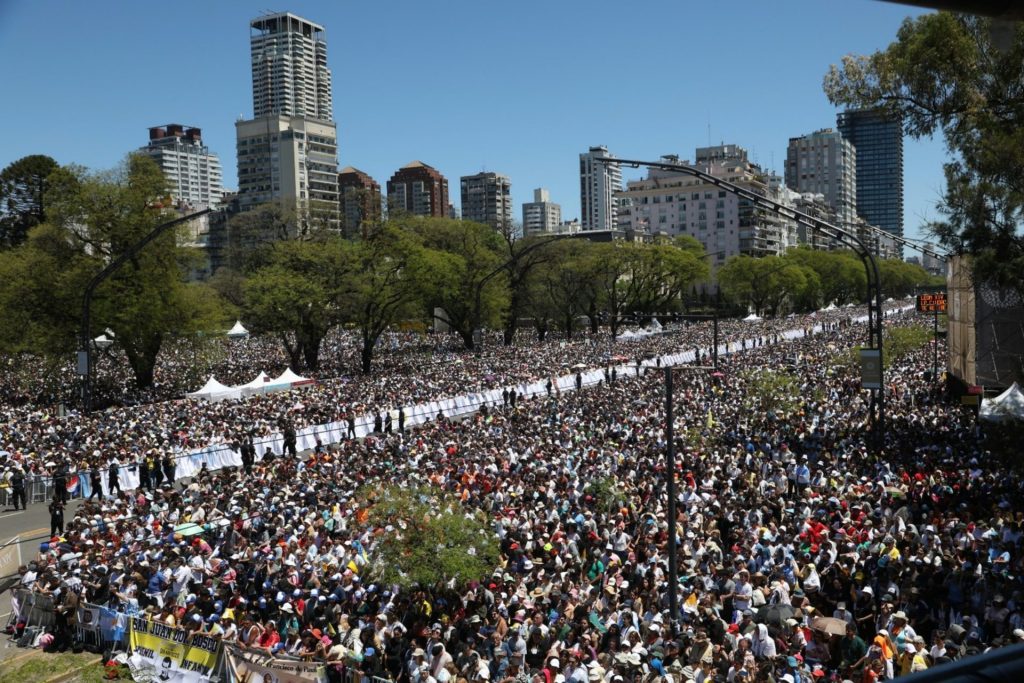
Pope Leo XIV led the biggest gathering of his papacy so far on Monday, 9 November 2026, when about 2.5 million people filled a main avenue in Buenos Aires for an open-air Mass. Hours later, in a much smaller and quieter room, he sat down with five survivors of abuse by clergy and Church institutions in Argentina and listened to each of them, one by one, for more than an hour.
The two moments, only hours apart, captured the two sides of this visit. The first was a celebration: the first papal Mass in Argentina in almost 40 years, in the home country of the late Pope Francis, who never returned during his own papacy. The second was a reckoning: a private meeting with people the Church failed, in a country that has never carried out a full national investigation into clerical abuse.
For a pope who is 71 years old and less than a month out from lung cancer surgery, it was a long and demanding day. It was also, by the Vatican’s own account, a day built around the people society overlooks most: the disabled, the poor, and survivors of abuse.
A sea of people on Avenida del Libertador
The Mass was held at the Monumento de los Espanoles, on Avenida del Libertador, one of the widest and longest boulevards in Buenos Aires. According to local authorities, about 2.5 million people attended. News agency AFP, reporting from the scene, described cheering crowds packed along a kilometres-long stretch of the avenue, with excitement reaching fever pitch as giant screens relayed images of the pope’s journey through the city.
It was the largest crowd of Pope Leo’s papacy to date, and it came in a country that had waited a very long time. The last pope to visit Argentina was John Paul II in 1987. Pope Francis, born Jorge Mario Bergoglio in Buenos Aires, was the first Latin American pope, but he never set foot in his homeland during his 12 years as pope. For many Argentines, this Mass was the homecoming Francis never made.
Pope Leo arrived in Argentina after a stop in Uruguay, where he drew 40,000 people to his first Mass in South America. The Buenos Aires crowd was more than sixty times that size. People travelled from across the country to be there, and the city filled with pilgrims, flags and banners.
During the Mass, the pope urged families to welcome Christ through prayer, forgiveness and mutual listening, and to take a leading role in sharing their faith, according to Vatican News. He also spoke about protecting the most vulnerable people in society, a theme that ran through the whole day.
The scale of the crowd matters for another reason. Pope Leo is still a new pope, and this is his first major trip to Latin America. A crowd of 2.5 million is a powerful sign of how warmly he has been received. It also raises expectations. When a pope draws a crowd that large and then speaks about protecting the vulnerable, people will watch closely to see what he does next.
The private meeting: five survivors, more than an hour
After the Mass, the pope met privately with five people who were abused by clergy or within Church institutions in Argentina. The meeting lasted more than an hour. The five survivors were presented by the local Church, and the pope listened to each of them individually, the Holy See Press Office said.
The Vatican’s statement said the pope listened to “their accounts, the painful experiences they had endured, and their suggestions for strengthening paths toward healing within the Church.” He also conveyed his “commitment to strengthening measures for protection” within the Catholic Church, and expressed his closeness to other victims he had not been able to meet.
This was the first such meeting of the pope’s South America trip, and the Vatican said it would not be the last. According to Al Jazeera, the private meetings in Buenos Aires were the first of several talks the pope is planning to hold with abuse survivors during his 12-day tour of Latin America, which runs from 6 to 17 November and also takes him to Peru.
The meeting was not announced in advance in detail, and no names were released. That is normal for meetings like this: survivors are not identified unless they choose to speak publicly. What matters is that the meeting happened at all, and that it happened on the same day as the biggest public celebration of the trip.
There is a reason for that timing. Abuse survivors and their supporters have criticised the Church in Argentina for failing to deliver on its promises of “zero tolerance” of abusers, according to AFP. Meeting survivors on the same day as the Mass sent a message that the celebration and the reckoning belong together, and that one cannot happen without the other.
Why Argentina is a difficult place for this conversation
To understand why this meeting matters, it helps to know how little Argentina has done, officially, to face the scale of abuse inside its own Church.
Unlike the United States, Australia, France and Germany, Argentina has never conducted a nationwide investigation or public accounting of clerical abuse, according to OSV News. The full dimensions of the crisis in the country remain unknown.
BishopAccountability.org, a United States-based watchdog organisation, lists nearly 100 priests, religious brothers and women religious publicly accused of abusing minors or vulnerable adults in Argentina. That figure only covers cases that have become public. Nobody knows how many cases have never been reported.
This is also the country where Pope Francis spent most of his life as a priest, bishop and archbishop before he was elected pope in 2013. His record on abuse cases in Argentina has been questioned by survivors and their advocates, including cases in which he was said to have intervened. That history makes Argentina a sensitive place for any pope to talk about abuse, and it means Pope Leo’s words and actions there will be examined more closely than anywhere else.
The challenge for Pope Leo is clear. He has now listened to survivors in private and promised stronger protection. Survivors’ groups will want to know what “stronger measures” actually means in practice: whether abusers are removed, whether bishops who covered up abuse face consequences, and whether the Church in Argentina will finally open its records the way Churches in other countries have been forced to do.
Listening is a start, and for the five people in that room, being heard by the pope himself may have mattered a great deal. But listening alone does not change systems. The test will be what happens after the pope leaves.
A day built around the vulnerable
The survivors’ meeting was not the only part of the day focused on people at the margins. Earlier, the pope visited the Pequeno Cottolengo home for people with disabilities in the Buenos Aires suburb of Claypole, run by the Don Orione religious order. There he met residents and staff, spoke about the dignity of people with disabilities, and encouraged young people to volunteer in charitable work, according to Vatican News.
Later in the day, before the survivors’ meeting, he travelled to the Pontifical Catholic University of Argentina for an encounter with representatives of the world of work. In the evening, he greeted the faithful gathered outside the Apostolic Nunciature in Buenos Aires, thanking them for their enthusiasm and joy.
Vatican News summed up the second day in Argentina as one centred on “charity, family life, human dignity, and the Church’s mission.”
It is worth noting the physical effort involved. Pope Leo is 71 and underwent lung cancer surgery less than a month before this trip, according to AFP. A day that included a Mass before 2.5 million people, a visit to a care home, a university event, a meeting with survivors lasting more than an hour, and an evening greeting would be demanding for anyone. That he did it so soon after major surgery underlines how important this trip is to him, and to the Vatican.
What the Pope said, and what he did not say
So far, the Vatican has shared the broad shape of the survivors’ meeting but few specifics. We know the pope listened to each survivor, heard their suggestions for healing, and promised stronger protection measures. We do not know what the survivors asked for, or what specific steps the pope promised in return.
That caution is normal. The Vatican rarely publishes details of private meetings with survivors, and survivors themselves may not want their stories shared. But it also means the public cannot yet judge whether the meeting will lead to real change.
There are three things to watch for in the coming days and weeks.
First, whether the pope raises the subject publicly in Peru, the next stop on his trip. If he speaks about abuse in his public remarks there, it will show the Buenos Aires meeting was not a one-off gesture.
Second, whether the Vatican announces any concrete step, such as a new investigation, new rules for handling abuse cases, or a meeting between Argentine bishops and survivors’ groups. Promises of “stronger measures” need to be turned into something people can see.
Third, how survivors’ groups in Argentina respond. Their reaction will tell us whether the meeting felt like a genuine step forward or a polite gesture. The network of survivors that has criticised the Church’s “zero tolerance” promises will be watching closely.
What happens next
Pope Leo’s tour continues to Peru, where more meetings with abuse survivors are planned, according to the Vatican. Peru is also a country where the Church has faced serious abuse scandals, so the conversations there are likely to be just as difficult.
Back in Argentina, the bishops will be under pressure to show that the pope’s visit changed something. Argentina’s Church has never had its own national reckoning on abuse. The pope’s visit, and the attention it has brought, may make that harder to avoid.
For the millions who came to the Mass, the day will be remembered as a joyful one: a pope, in their capital, after nearly 40 years without one. For the five survivors who sat with him in private, the day will be remembered very differently. Both memories are real, and both belong to the same visit. Whether the Church in Argentina can hold them together, celebration and accountability, is the question this trip leaves behind.
Frequently asked questions
How many people attended Pope Leo’s Mass in Buenos Aires?
About 2.5 million people, according to local authorities. It was the largest crowd of Pope Leo’s papacy so far.
Where was the Mass held?
At the Monumento de los Espanoles, on Avenida del Libertador in Buenos Aires, on Monday, 9 November 2026.
Who did the pope meet after the Mass?
He met privately for more than an hour with five survivors of abuse by clergy or Church institutions in Argentina, listening to each of them individually.
Why is this visit to Argentina significant?
It is the first papal visit to Argentina since John Paul II in 1987. Pope Francis, who was born in Buenos Aires, never returned to Argentina during his 12 years as pope.
Has Argentina investigated clerical abuse nationally?
No. Unlike the United States, Australia, France and Germany, Argentina has never carried out a nationwide investigation or public accounting of abuse in the Church.
Where is the pope going next?
His 12-day tour of Latin America, from 6 to 17 November, also takes him to Peru, where further meetings with abuse survivors are planned.
How is the pope’s health?
He is 71 and underwent lung cancer surgery less than a month before the trip, according to AFP.
Conclusion
Monday in Buenos Aires gave the world two pictures of Pope Leo XIV. One was a pope before 2.5 million people, the largest crowd of his papacy, in a country that had waited almost 40 years for a papal visit. The other was a pope in a quiet room, listening for more than an hour to five people the Church had failed.
The first picture was a triumph. The second was a test. Argentina has never faced the full scale of abuse in its own Church, and the survivors who met the pope have heard promises of “zero tolerance” before. What they, and millions of Catholics around the world, will be watching now is whether listening turns into action, in Peru and back in Argentina, long after the crowds have gone home.
Sources
- Al Jazeera, “Pope meets with clergy abuse survivors in Argentina”, 9 November 2026: https://www.aljazeera.com/news/2026/11/9/pope-meets-with-clergy-abuse-survivors-in-argentina?traffic_source=rss
- Channel News Asia (AFP), “Pope leads mega mass in Buenos Aires, meets abuse victims”, 10 November 2026: https://www.channelnewsasia.com/world/pope-leo-mass-argentina-buenos-aires-6537801
- OSV News via Catholic Review, “Pope Leo meets privately with five Argentine abuse survivors”, 9 November 2026: https://catholicreview.org/pope-leo-meets-privately-with-five-argentine-abuse-survivors/
- The Straits Times (AFP), “Pope Leo leads mega mass in Buenos Aires, meets abuse victims”, 10 November 2026: https://www.straitstimes.com/world/pope-leo-meets-victims-of-abuse-by-clergy-in-argentina
- Vatican News, “Pope Leo XIV concludes his second day in Argentina by greeting the faithful”, 10 November 2026: https://www.vaticannews.va/en/pope/news/2026-11/pope-leo-xiv-nunciature-goodnight-greeting-highlights-day-two.html
This article is for general information and education only. It is not legal or financial advice.
