
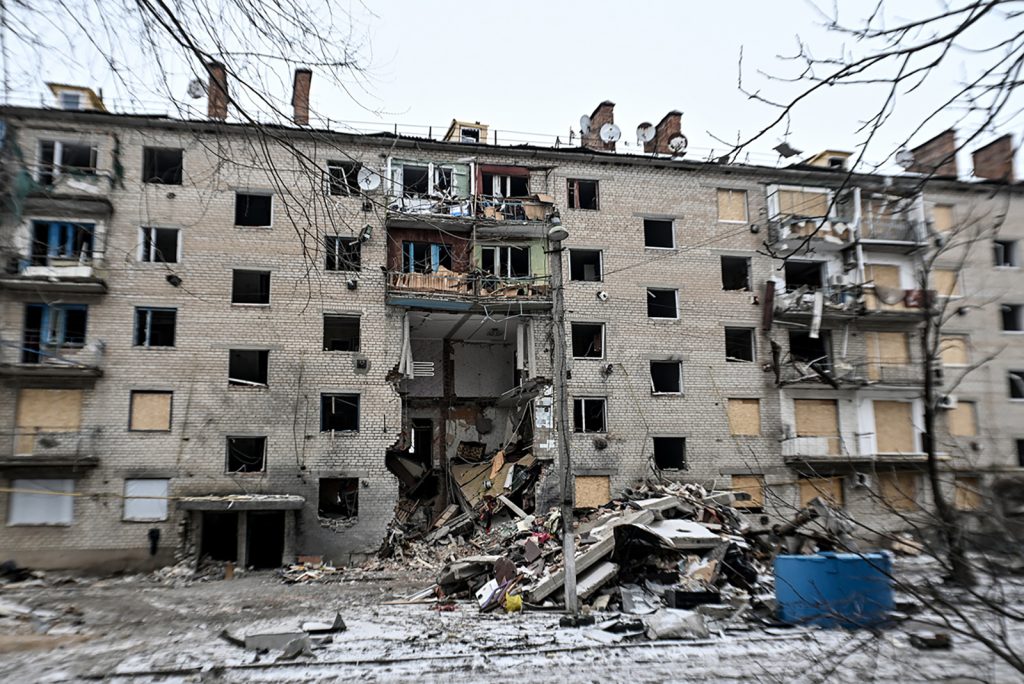
Russian Strike on Ukraine Aid Centre Kills 42 in Komyshuvakha as Rescuers Search the Rubble
A Russian bombing of a humanitarian aid centre in Ukraine has killed at least 42 people, police told Reuters on Thursday, in one of the deadliest attacks on civilians of the war. Dozens more are still missing under the rubble, and the death toll is expected to rise further as rescuers keep digging.
The attack hit the village of Komyshuvakha, in the Zaporizhzhia region of south-eastern Ukraine, on Monday 2 November. Residents had gathered at a former school to collect food and other aid, as they did every week. Russian bombs struck the building first, and then a second wave of bombs hit the underground shelter where people had run to hide. Among the dead are four police officers and two rescue workers who had rushed to help after the first explosions.
President Volodymyr Zelenskyy called the attack “utterly horrific” and one of the largest mass killings of the war. “First, they hit people who came to receive humanitarian aid, and then rescuers and police officers who arrived at the scene,” he said.
At a glance
- What happened: Russian aerial bombs struck a school used as a humanitarian aid distribution point in Komyshuvakha on Monday 2 November, then hit the underground shelter where residents had taken cover.
- The toll: At least 42 people confirmed dead as of Thursday 5 November, according to police. Dozens are still missing, and the number may rise.
- Who was killed: Civilians collecting aid, plus four police officers and two rescue workers who arrived after the first strike.
- Russia’s account: Moscow says it targeted Ukrainian military units in the area. No independent evidence has been found to support that claim.
- What happens next: Rescue work continues at the site, and the United States is due to bring Ukrainian and Russian delegations together in Abu Dhabi on 10–11 November for talks on ending the war.
What happened on Monday
Komyshuvakha is a village in the Zaporizhzhia region, about 17 kilometres (11 miles) from the nearest Russian positions. It sits close to the front line of the war, which has now lasted almost five years since Russia’s full-scale invasion of Ukraine in February 2022.
The building at the centre of the attack was once a school. Classes had long been suspended because of the fighting nearby, but the building had taken on a different role: it was the place where the people who had stayed in the village came to collect humanitarian aid. According to Zelenskyy, aid was handed out there every Monday, and the building also served as a shelter. World Central Kitchen, the charity that delivers food and water to the community, described the site as a humanitarian and administrative centre.
On Monday morning, residents gathered at the school as usual. Then the bombs began to fall.
The first strike hit the aid distribution point itself. People who survived ran for the underground shelter beneath the school, a two-floor space built to keep them safe during bombardments. Then came the second wave: nine more aerial bombs, which struck the shelter where people had taken refuge.
Mykhailo Semikin, the acting head of the Zaporizhzhia regional military administration, said Russia began with KAB-500 guided bombs and then used FAB-3000 bombs, which weigh three tonnes and carry about 1.4 tonnes of explosive. Ukrainian police said several strikes hit the area, including from a 3-tonne FAB bomb fitted with a glide kit — a set of wings that lets a bomb fly long distances after being dropped from a Russian warplane.
A glide bomb is a weapon that can be released far from its target and steered towards it, which means the aircraft dropping it can stay out of range of air defences. The FAB-3000 is one of the largest bombs Russia uses in Ukraine, and its blast can destroy whole buildings.
The rescuers who died
The second wave of bombs did not only hit the people sheltering. It also hit the police officers and rescue workers who had rushed to the scene after the first explosions.
Two members of a rescue crew were killed: Denys Konovalenko and Oleksii Sushchevskyi, both aged 44. Four police officers also died. Emergency services confirmed their deaths, and Ukrainian police later released body-camera footage from one of the officers who was killed.
The footage, which Reuters verified and the BBC’s verification team confirmed was filmed at the same location as images of the aftermath released by Ukraine’s emergency service, shows the moments between the two waves of strikes. In it, 15 to 20 people in civilian clothing gather outside the entrance to the underground shelter after a radio warning that Russian glide bombs are heading towards the village. Residents rush down several flights of stairs and into a room, while the policeman wearing the camera turns into what appears to be a temporary police station. Three other men and a woman are visible in the final frames before a large explosion, and the camera goes black.
It is a rare, terrible record of what a “double-tap” strike looks like from the ground. A double-tap is when an attacker strikes a place, waits for rescuers and helpers to arrive, and then strikes the same place again. The pattern has been seen repeatedly in this war, and it is one of the reasons the death toll in Komyshuvakha kept climbing long after the bombs stopped falling.
Why the death toll kept rising
When Zelenskyy first spoke about the attack on Monday, he said 18 people had been killed and five injured. Within hours, Ukraine’s state emergencies service put the number at 24. By Monday evening, the president said the total had reached 26. On Tuesday, officials confirmed at least 31 deaths, and Zelenskyy said 33 at a press conference in Berlin. On Wednesday, he raised the toll to 40. On Thursday, police told Reuters the toll had reached 42.
The rising numbers do not mean the reporting was wrong at any point. They reflect how rescue work unfolds after a building collapses. Bodies are found one by one as excavators dig through the rubble, and some victims take days to identify. Zelenskyy said on Wednesday that some of the dead had not yet been identified, and that more than 30 people might still be under the rubble.
The number of missing is also uncertain, and different officials have given different figures. Ivan Fedorov, the co-head of the Zaporizhzhia Regional Defense Council, wrote on Telegram that 59 people were missing. Zelenskyy said more than 30 people could still be buried. Local officials had earlier estimated that about 38 people could remain trapped. The figures differ because the search is still going on, and because some people listed as missing may turn out to be among the dead already recovered.
What is certain is that the search has now been going on for three days, and that it is dangerous work. Local authorities said Russian drones were hampering the search for victims, although Semikin insisted the operation would continue. Reuters footage on Wednesday showed men in military fatigues loading bodies in white plastic bags into the back of a van, while excavators dug near a huge blast crater.
The Zaporizhzhia region has declared three days of mourning, from 3 to 5 November.
Russia’s account — and what the evidence shows
Russia’s Defence Ministry has given a very different account of the attack. It said its forces had targeted Ukrainian military units around Komyshuvakha and two other settlements, and claimed up to 25 Ukrainian servicemen were killed, along with 15 vehicles and an electronic warfare station.
That claim has not been independently confirmed. The BBC reported that it found no credible evidence of significant military presence at the site, and independent verification confirmed the school’s use as a civilian aid centre, not a military installation. The people named among the dead so far are civilians, police officers and rescue workers — not soldiers.
The United Nations Human Rights Monitoring Mission in Ukraine said the attack occurred as civilians from the area assembled for the aid distribution, and said on Tuesday that the bombing likely violated international law. Attacking civilians, or attacking a place in a way that shows no care for civilian life, is a war crime under international humanitarian law.
Both Russia and Ukraine deny deliberately targeting civilians. But the pattern in Komyshuvakha — a first strike on people collecting aid, followed by a second strike on the shelter and the rescuers — is why Zelenskyy called it a “vile terrorist strike” and said it showed Russia did not want de-escalation.
“Unfortunately, there has been very little reaction from the world to this insane attack,” Zelenskyy wrote on social media. “But it, like thousands upon thousands of other war crimes Russia has committed against Ukraine and Ukrainians, demands a strong response. Evil always goes further if it is left unanswered.”
The ceasefire that had just expired
The attack came at a bitter moment. It happened a day after a brief, US-brokered local ceasefire expired. The six-day truce had allowed the evacuation of civilians from Oleshky, a Russian-occupied town in southern Ukraine, and nearly 800 people were evacuated, according to US First Lady Melania Trump, who helped broker the arrangement. Zelenskyy awarded her a state honour for her role.
Zelenskyy said the Komyshuvakha attack had wasted the opportunity created by that ceasefire and humanitarian mission. The contrast is stark: one week, a negotiated pause to let civilians escape; the next, one of the deadliest strikes on civilians of the year.
The timing also matters diplomatically. The United States is due to bring Ukrainian and Russian delegations together in Abu Dhabi on 10–11 November for talks on ending the war, post-war security agreements and de-escalation. US envoy Steve Witkoff announced the talks on Monday. Russian President Vladimir Putin agreed to them after meeting Witkoff in St Petersburg on 21 October, although previous rounds of talks have made little progress, with Moscow refusing to compromise on hardline demands including that Kyiv give up territory, demilitarise and guarantee it will not seek to join NATO.
The same week brought more reminders of the war’s cost. On Wednesday, Russian strikes on Ukraine’s energy infrastructure knocked out power and water across Kyiv and surrounding regions, after an overnight barrage that Ukraine’s air force said involved 310 drones, including 81 jet-powered aircraft. Emergency centres were opened and repair crews worked to stabilise a grid struck more than 20 times in 24 hours.
What happens next
Four things will decide how this story develops.
The rescue. Search teams are still working at the site in Komyshuvakha, and the final death toll is not yet known. The number of missing — whether it is closer to 30 or to 59 — will only become clear as the rubble is cleared and victims are identified, including through DNA samples collected from relatives.
The investigation. The UN human rights mission is monitoring the attack, and its finding that the bombing likely violated international law adds to a growing file of alleged war crimes. Ukraine’s police have already published the body-camera footage as evidence, and the question of who gave the order and what they knew about the site will be part of any future accountability process.
The talks. The Abu Dhabi meeting on 10–11 November is the next diplomatic test. The Komyshuvakha strike, coming less than a week before the talks, will shape the mood around the table — and Zelenskyy has already used it to argue that Russia is not serious about de-escalation. Whether the talks produce anything concrete, or follow the pattern of earlier rounds, remains to be seen.
The winter. The strikes on Kyiv’s power grid this week are a reminder of what the coming months hold. Russia has repeatedly targeted Ukraine’s energy system as winter approaches, and the shortage of air-defence interceptors — the missiles Ukraine uses to shoot down Russian attacks — has become one of Kyiv’s most urgent problems. The United States approved the possible sale of 500 Patriot interceptor missiles to Ukraine last week, but those missiles have not been built yet and are not expected to arrive until the 2030s. Zelenskyy has asked allies to send interceptors from existing stockpiles now, at about 100 a month for the winter.
For the people of Komyshuvakha, none of that changes what has already happened. The village’s aid centre is gone, dozens of its residents are dead or missing, and the rescuers who came to help are among the victims. The weekly aid distribution that brought people together on Mondays — food, medicine, a brief moment of normality in a village near the front line — was the very thing that made them a target.
Frequently asked questions
Where is Komyshuvakha?
Komyshuvakha is a village in the Zaporizhzhia region of south-eastern Ukraine, about 17 kilometres (11 miles) from the nearest Russian positions. It lies close to the front line of the war.
What was the building that was hit?
A former school that had stopped holding classes because of the fighting nearby. It was used as a humanitarian aid distribution point — residents gathered there every Monday to collect food and other aid — and as a shelter, with an underground space beneath it.
How many people were killed?
At least 42 people had been confirmed dead by Thursday 5 November, according to police. The toll rose through the week: 18 on Monday, 26 by Monday evening, 33 on Tuesday, 40 on Wednesday, and 42 on Thursday. Dozens are still missing, and the final toll may be higher.
What is a “double-tap” strike?
It is when an attacker strikes a place, waits for rescuers, police and helpers to arrive, and then strikes the same place again. In Komyshuvakha, the first bombs hit people collecting aid, and a second wave of nine bombs hit the shelter and the rescuers who had come to help. Four police officers and two rescue workers were among the dead.
What does Russia say happened?
Russia’s Defence Ministry said it targeted Ukrainian military units around Komyshuvakha and two other settlements, and claimed up to 25 Ukrainian servicemen were killed. No independent evidence has been found to support that claim, and the UN human rights mission said the bombing likely violated international law.
What happens next?
Rescue work continues at the site, with victims still being identified. The United States is due to bring Ukrainian and Russian delegations together in Abu Dhabi on 10–11 November for talks on ending the war.
Sources
- Reuters, “Dozens dead and missing after Russian strike on Ukrainian aid centre, officials say”, 4 November 2026: https://hot96.com/2026/11/04/dozens-dead-and-missing-after-russian-strike-on-ukrainian-aid-centre-officials-say/
- Australian Associated Press, “Dozens dead as Russia strikes Ukraine aid centre”, 4 November 2026: https://aapnews.aap.com.au/news/dozens-dead-as-russia-strikes-ukraine-aid-centre
- Al Jazeera, “Ukraine raises death toll from Russian strike on Zaporizhia to 40 people”, 4 November 2026: https://aljazeeranews-3fuh52rgrl.edgeone.app/news/2026/11/4/ukraine-raises-death-toll-from-russian-strike-on-zaporizhia-to-40-people
- Reuters via Augerton, “A Russian strike on a Ukrainian aid point killed dozens…”, updated 5 November 2026 (death toll reaches 42): https://augerton.com/news/2026/11/04/russian-bombing-ukraine-zaporizhzhia-aid-point/
- France 24 via Avenews, “Russian bombing of Ukraine aid site kills 42, officials say”, 5 November 2026: https://www.avenews.am/en/posts/komyshuvakha-aid-centre-bombing
- Fana News (QNA), “Zelenskyy Says Death Toll from Russian Strike on Aid Center Rises to 40”, 5 November 2026: https://www.fananews.com/language/en/zelenskyy-says-death-toll-from-russian-strike-on-aid-center-rises-to-40/
- Zark News, “Death Toll in Komyshuvakha Aid-Center Strike Rises Past 30 as U.S. Announces Nov. 10–11 Abu Dhabi Peace Talks”, 3 November 2026: https://zarknews.com/death-toll-in-komyshuvakha-aid-center-strike-rises-past-30-as-u-s-announces-nov-10-11-abu-dhabi-peace-talks/
This article is for general information and education only. It is not legal or financial advice.
