
South Korea Moves Its Navy Closer to the Strait of Hormuz — But Says It Will Not Join the Iran War
South Korea is moving its navy closer to the Strait of Hormuz, one of the world’s most important oil shipping routes, as the war between the United States and Iran continues to disrupt trade through the narrow waterway.
Seoul announced on Thursday 5 November 2026 that it will expand the operating area of its Cheonghae anti-piracy unit, sending a maritime patrol aircraft, a bomb-disposal team and mine-clearing drones to waters south of Oman, about 650 kilometres (403 miles) from the strait itself.
But the government was careful to draw a clear line. The mission is strictly for non-combat purposes, officials said, and South Korea will not be drawn into the war in Iran.
What South Korea announced
South Korea’s Ministry of National Defense said the government will ask parliament to widen the operating area of the Cheonghae unit, which has been based in the Gulf of Aden, off the coast of Somalia, since 2009.
Under the plan, the unit will be allowed to operate in the open sea south of Oman, in the Arabian Sea, near the Omani port of Duqm. That is roughly 650 kilometres from the Strait of Hormuz, the narrow channel between Iran and Oman through which a large share of the world’s traded oil passes.
The expansion will add new equipment and people to the mission:
- A P-8A Poseidon maritime patrol aircraft, which can watch over large areas of sea from the air.
- An explosive ordnance disposal team — specialists trained to deal with bombs and sea mines.
- Unmanned surface vessels and underwater robots designed to find and clear sea mines.
- Seventy-five more personnel, taking the unit from 320 to 395 people.
The unit’s operating radius will roughly double, to about 1,930 kilometres (1,199 miles).
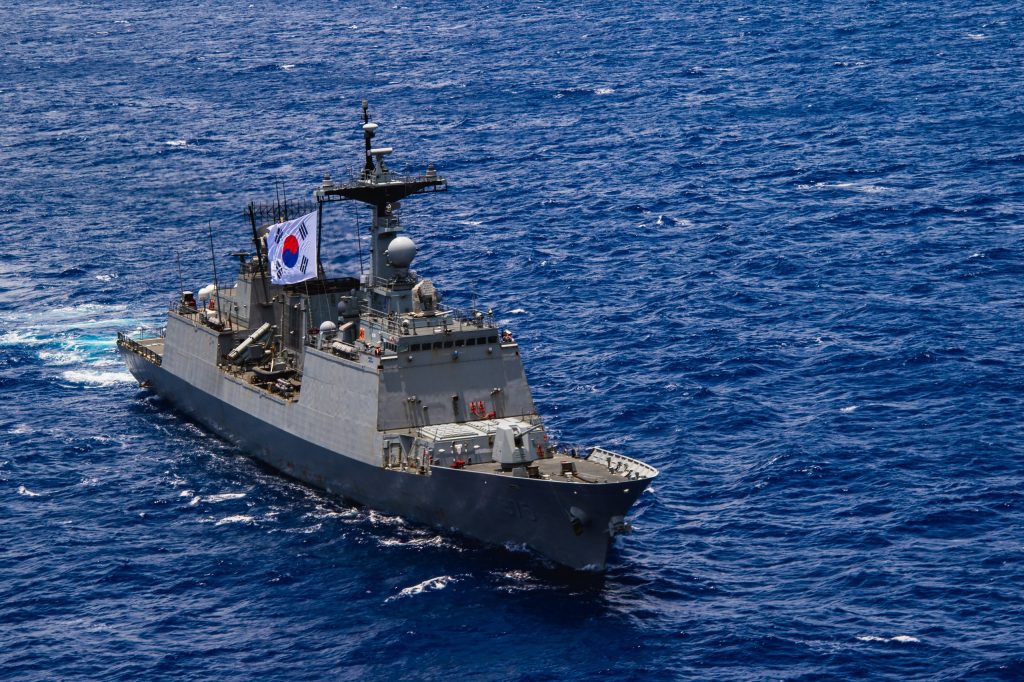
The unit currently consists of a 4,400-ton destroyer, a naval helicopter, up to three fast rigid-hull inflatable boats and around 300 service members. Its 49th contingent, aboard the destroyer Chungmugong Yi Sun-sin, left for the Gulf of Aden on 2 October 2026.
A careful balancing act
The announcement follows months of pressure from the United States. President Donald Trump has pressed Seoul to do more to support the war in Iran, and has criticised South Korea for what he called insufficient support. The United States even scaled back major joint military drills with South Korea this summer, a move that unsettled its ally.
But South Korea has so far turned down Washington’s requests for military support against Tehran. President Lee Jae-myung said on 18 September that he would not deploy military assets to the Middle East in a way that could draw the country into conflict — although he added that Seoul was reviewing a bigger role in safeguarding shipping in the region.
The new plan is Seoul’s answer to that dilemma: a bigger presence near the strait, but with strict limits that keep it out of the fighting.
A defence ministry official, speaking to reporters on condition of anonymity, said the reinforcement was “to protect our citizens and safeguard our economic interests” and was “strictly for noncombat purposes”. The unit will operate independently of any allied forces, the official said.
The limits are unusually specific. Operations will stay in open waters south of Oman, and the P-8A patrol aircraft will be barred from targeting or monitoring Iranian territory, Iranian territorial waters, or the inside of the Strait of Hormuz itself.
The government also plans to add a new line to the unit’s official mandate: to “support efforts to restore freedom of navigation in international shipping routes”.
Why South Korea cares about the strait
For South Korea, this is not a distant problem. The country depends heavily on oil from the Middle East. In 2025, South Korea sourced 70 percent of its oil imports from the Middle East, according to the industry ministry, and most of that oil travelled through the Strait of Hormuz.
When shipping through the strait is disrupted, South Korea feels it quickly — in fuel prices, in the cost of goods, and in the safety of its ships and sailors.
The war in Iran, which began on 28 February 2026, has made the waterway dangerous. Ships have been hit: a Singapore-flagged vessel, the GFS Pride, sank near the strait on 14 October after being hit by a projectile. Iran has also said two oil tankers and a tugboat caught fire in the strait after a mine strike.
At the same time, piracy off Somalia has surged. South Korea’s defence ministry said 36 piracy incidents had been reported off Somalia so far in 2026, up from 11 in all of 2025. Pirates have ranged farther towards Oman, the ministry said, as international naval forces have been pulled away to concentrate on the Red Sea and the Strait of Hormuz.
That is the official reason Seoul gives for the expansion: its anti-piracy unit needs to follow the pirates, and to protect shipping in a region where the war has pulled other navies away.
The mine-clearing plan
There is a second, longer-term reason for the new equipment. Clearing sea mines from the Strait of Hormuz is expected to be one of the first and hardest jobs once the war ends — and South Korea wants to be ready for it.
The mine-clearing systems work like this: uncrewed boats and underwater robots search the sea floor, locate a mine, attach an explosive charge to it, and detonate it from a safe distance. No sailor has to go near the mine.
South Korean officials said the deployment would let their crews test these unmanned systems and learn how they perform in real conditions, because South Korea has only limited experience with them so far.
Seoul has told Britain, France and other partner nations that it is prepared to join a joint operation to restore the strait once there is what officials call a “permissive environment” — meaning either the end of the war, or a formal agreement between the two sides to allow the work to begin.
“We have promised to join upon request under those conditions,” one defence official said. “As a member of the international community, we must participate. We cannot go unprepared when called upon, and that imperative is part of the rationale.”
But any actual operation inside the Strait of Hormuz would need a separate vote in parliament, officials said — and the government says it is prepared to seek one.
What happens next
The plan still has several steps to clear before it can take effect.
Deputy ministers backed the plan on 5 November. The cabinet is set to review it next week. If the cabinet and President Lee approve it, the government will submit a formal motion to the National Assembly.
Under South Korean law, sending troops overseas — or expanding an existing mission — needs parliament’s consent. The National Assembly will have to vote both on widening the patrol area and on extending the deployment, which is currently set to expire on 31 December 2026, through 2027.
Seoul also plans to base the newly added assets in Djibouti, the small country at the southern entrance to the Red Sea, where the Gulf of Aden meets the wider ocean. The government will open consultations with Djibouti once the parliamentary process begins. Djibouti already hosts a United States military base, and allied countries including Japan, Spain and France base maritime patrol units there.
Why this matters
South Korea’s move is small in military terms — one aircraft, one bomb-disposal team, some drones and 75 more sailors, operating 650 kilometres from the strait. But it is significant in political terms.
It shows how the Iran war is pulling in countries far from the Middle East. South Korea is one of America’s closest allies in Asia, and Washington has been pushing it to choose a side. Seoul’s answer is a careful middle path: help keep the shipping lanes open, prepare for the clean-up after the war, but stay out of the fighting and stay away from Iranian waters.
It also shows how the war is reshaping the seas. Piracy is rising because warships have been pulled away. Mines are now a threat to civilian shipping. And countries that depend on Middle Eastern oil — South Korea, Japan, China, India and many others — are having to think about how to protect the ships that carry their energy.
For now, the Cheonghae unit will stay where it is, in the Gulf of Aden, until parliament votes. But if the plan is approved, South Korean sailors will soon be patrolling waters much closer to a war zone — watching, clearing mines, and trying very hard not to become part of the war itself.
Frequently asked questions
What is the Cheonghae unit?
The Cheonghae unit is South Korea’s anti-piracy naval mission. It was formed in 2009 to help with a United Nations mission against piracy in the Gulf of Aden, off Somalia. It escorts commercial ships and protects them from pirates. Its mandate is renewed every year by parliament.
Where is the Strait of Hormuz?
The Strait of Hormuz is a narrow waterway between Iran and Oman, connecting the Persian Gulf to the Arabian Sea. A large share of the world’s traded oil passes through it, making it one of the most strategically important shipping routes on earth.
Is South Korea joining the war in Iran?
No. South Korea has said the expanded mission is strictly non-combat. Its ships and aircraft will stay in open waters south of Oman, about 650 kilometres from the strait, and will not monitor Iranian territory or waters. President Lee Jae-myung has said he will not deploy forces in a way that could draw South Korea into the war.
Why does South Korea need parliamentary approval?
Under South Korean law, any overseas military deployment — or any expansion of an existing one — requires the consent of the National Assembly. The government must submit a motion to parliament, and the unit’s current deployment expires on 31 December 2026.
What are the new mine-clearing systems?
Unmanned surface vessels and underwater robots that search for sea mines, attach explosive charges to them and detonate them remotely. South Korea wants to gain experience with the systems now, so it is ready to help clear mines from the Strait of Hormuz after the war ends.
How much oil does South Korea get through the strait?
In 2025, South Korea sourced 70 percent of its oil imports from the Middle East, according to the industry ministry, and most of that oil was delivered through the Strait of Hormuz.
Sources
- Korea JoongAng Daily, “South Korea to expand Cheonghae mission near Strait of Hormuz”, 5 November 2026 — https://www.koreajoongangdaily.com/korea/korea-to-expand-antipiracy-mission-closer-to-hormuz-send-more-naval-assets/12956896
- BusinessWorld, “South Korea to expand anti-piracy unit operations closer to Strait of Hormuz”, 5 November 2026 — https://bworldonline.com/world/2026/11/05/791735/south-korea-to-expand-anti-piracy-unit-operations-closer-to-strait-of-hormuz/
- SOFX, “South Korea expands navy patrols near Strait of Hormuz as Somali piracy rises” — https://www.sofx.com/south-korea-expands-navy-patrols-near-strait-of-hormuz-as-somali-piracy-rises/
- World Right Now, “South Korea says it will expand naval operations closer to Strait of Hormuz” — https://worldrightnowlive.com/story/south-korea-says-it-will-expand-naval-operations-closer-to-strait-of-h
This article is for general information and education only. It is not legal or financial advice.
