
US Becomes First Country Ever to Skip UN Human Rights Review as Its Seat Stays Empty in Geneva
The United States has become the first country in history to refuse to take part in the United Nations’ regular review of its human rights record. On Tuesday, 10 November 2026, American officials simply did not show up in Geneva, leaving the US seat on the stage empty while diplomats from other countries waited to question Washington about its record.
The UN Human Rights Council had no choice but to postpone the review until January. It was the second year in a row that the United States had skipped its turn — and rights groups say no country, not even the world’s most authoritarian governments, has ever done this before.
The moment matters because the review, known as the Universal Periodic Review, is built on a simple idea: every country in the world answers questions about human rights, without exception. When the most powerful country in the world refuses to take part, that idea is put to the test.
What happened in Geneva on Tuesday
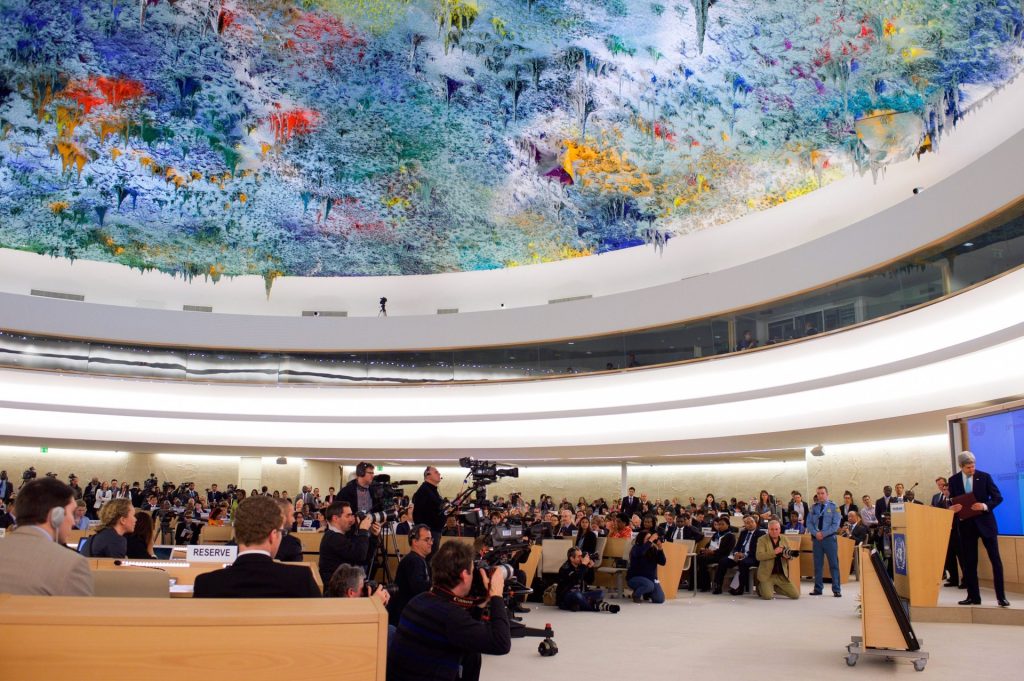
The review was scheduled to take place at the UN’s offices in Geneva, Switzerland, on Tuesday morning. The United States was due to present a report on its own human rights record and answer questions from other governments.
Instead, no American representative appeared. The US seat on the stage of the meeting room was left empty, and the council decided to postpone the session until January, according to a draft UN document and diplomats quoted by Reuters.
A spokesperson for the US State Department said taking part would imply support for the council’s work. “This irredeemable body makes a mockery of human rights through consistent failures to uphold its own ‘values’ as it pushes anti-American rhetoric,” the spokesperson said, without answering the specific criticisms of the US record.
The empty chair was not a surprise. Washington had already pulled out of the Human Rights Council in 2025, saying the body was biased against the United States and against Israel. This was the second year running that the US had skipped its review: last year’s session, due in November 2025, was pushed back to this November in the hope that Washington might change its mind. It did not.
What is the Universal Periodic Review?
The Universal Periodic Review, usually shortened to UPR, is the UN Human Rights Council’s main tool for checking how countries treat people. It works like this:
- Every one of the 193 member states of the United Nations takes part, in cycles lasting about four to five years.
- Each country writes a report about its own human rights situation.
- Other countries then ask questions and make recommendations, which are not legally binding but are made public.
- Civil society groups — charities, campaigners and experts — also send in their own evidence.
The system was set up about twenty years ago, and until now every country had taken part in some form. The whole point is that the rules apply to everyone equally. A small country and a superpower sit in the same chair and answer the same kinds of questions.
That is why the US absence is historic. Amnesty International said the United States now has “the shameful distinction of becoming the first country to avoid participating in all stages of the UN’s Universal Periodic Review peer-review process.” The International Service for Human Rights (ISHR), a Geneva-based group, put it the same way: “In the twenty years since the UPR was established, not a single country has so shamelessly refused to participate in this universal process.”
It is worth noting that the United States did take part in the past. During Donald Trump’s first term as president, the US submitted its review report as normal. Fourteen countries are due to take part in the review process in Geneva this month.
What other countries wanted to ask
UN documents seen by Reuters show that other governments had prepared questions on several sensitive subjects, including abortion and the death penalty.
American and international non-governmental organisations had also sent in nearly 200 written submissions to the UN, covering topics from migration to racial discrimination. These submissions are the raw material of a review: they tell the council what is happening on the ground, beyond what a government says about itself.
The council’s own appointed experts have already criticised the US record in recent months, particularly over the deportation of migrants. Washington has said the deportations were carried out in accordance with US immigration law.
Among those pressing for answers in Geneva was Noor Abdalla, the wife of Mahmoud Khalil, a pro-Palestinian student activist who was held in immigration detention last year. She was among campaigners urging Volker Turk, the UN High Commissioner for Human Rights, to hold a briefing on the US rights situation even without Washington present.
“When the most powerful government in the world is not held accountable, they think that they can do whatever they want,” Abdalla told reporters in Geneva.
Jamil Dakwar, of the American Civil Liberties Union, was blunt about what he sees as the scale of the problem. “We’ve seen attacks on fundamental human rights and civil liberties unprecedented in generations,” he told reporters in Geneva. “Enough is enough.”
Why Washington stayed away
The Trump administration’s position is that the Human Rights Council is not a fair or serious body, and that sitting in its sessions would give it a stamp of approval it does not deserve.
Washington disengaged from the Geneva-based council last year, saying it was biased against the United States. The State Department spokesperson’s statement on Tuesday repeated that view in strong terms, calling the council “irredeemable” and accusing it of pushing “anti-American rhetoric”.
Supporters of the administration’s approach argue that the council has long been criticised for including countries with poor human rights records among its members, and that the US gains little from taking part in a process it sees as political theatre.
Critics answer that refusing to be questioned does not make the questions go away — it simply removes the United States from the room where the answers are discussed. They also point out that the review is a peer process: the countries asking the questions are other governments, not UN officials, and every country faces the same treatment.
Phil Lynch, the executive director of ISHR, said the US record itself deserved close examination, pointing to migration, LGBT rights, racial discrimination and civic freedoms such as the right to protest, as well as US military actions abroad. “No country should be beyond criticism or exempt from basic accountability for their human rights record. The US is no exception,” he said. “What has Washington got to hide?”
What happens next
The immediate answer is: not much, for now. The council has postponed the review until January, but it cannot force the United States to attend. The process requires the country being reviewed to take part — without its representatives present, the review cannot go ahead.
That leaves diplomats and campaigners looking for other ways to keep the pressure on. Ahead of Tuesday’s session, civil society organisations published a joint statement urging council members and the UN High Commissioner for Human Rights to respond to Washington’s absence by scheduling a dedicated debate at the council’s next full session, the 64th session in March 2027, and by placing greater scrutiny on the US record in coming debates.
They also want the UN Human Rights Office to prepare a formal report on the human rights situation in the United States, and for civil society groups and representatives of affected communities to be able to take part in the debate and give evidence from the ground.
“Non-cooperation must carry consequences,” Lynch said. “We call on States to support a dedicated debate on US non-cooperation and for the UN Human Rights Office to prepare a report on the human rights situation in the country.”
Amnesty International’s Amanda Klasing, the group’s national director for government relations, said the Human Rights Council had given the US an extra year to take part, “but the Trump administration still failed to show up.”
For now, though, diplomats in Geneva sounded cautious. Few governments want an open confrontation with Washington, and one diplomat quoted by Reuters summed up the mood in a single sentence: “The view is to leave the door open and hope they come back in two years.”
Why this matters beyond the United States
The US decision matters for reasons that go beyond one empty chair in Geneva.
First, the Universal Periodic Review only works if it is truly universal. Its authority comes from the fact that every country takes part — the rich and the poor, the democratic and the authoritarian, allies and rivals alike. If the world’s most powerful country can simply opt out, other governments may ask why they should bother. The ISHR warned that the principles behind the mechanism — transparency, universality and equal treatment of all countries — have been “seriously undermined” by the US absence.
Second, the decision weakens the system from the inside. The United States helped to build much of the modern human rights system after the Second World War. Eleanor Roosevelt, the former First Lady, was one of the great champions of the Universal Declaration of Human Rights, adopted in 1948. For the US to become the first country to walk away from the review process is, in the words of ISHR, “deeply regrettable”.
Third, the timing is awkward for Washington’s own diplomacy. The United States regularly criticises other governments over their human rights records. That criticism carries less weight when the US itself refuses to submit to the same kind of examination. Rights groups made this point repeatedly on Tuesday, noting that even governments accused of the most serious abuses have still shown up to be reviewed.
Finally, the episode fits a wider pattern. The Trump administration has stepped back from several international bodies and agreements, arguing that they work against American interests. Each withdrawal on its own can be debated on its merits. Taken together, they raise a bigger question about what kind of international order the United States wants — one in which it sets the rules and answers to no one, or one in which it accepts the same scrutiny it demands of others.
The review has been postponed, not cancelled. The door, as the diplomat said, is being left open. Whether Washington walks through it in January — or in two years’ time, when the next cycle comes round — is now the question to watch.
Frequently asked questions
What is the Universal Periodic Review?
It is a process run by the UN Human Rights Council in which every one of the 193 UN member states reports on its human rights record and answers questions from other countries, roughly once every four to five years. The recommendations that come out of it are not legally binding.
Has any country skipped it before?
No — not completely. The United States is the first country to refuse to take part in all stages of the process since it was created about twenty years ago. Even governments accused of serious abuses have previously taken part.
Why did the US refuse?
Washington says the Human Rights Council is biased against the United States, and that taking part would imply endorsement of a body it calls “irredeemable”. It disengaged from the council in 2025 and has now skipped its review for a second year in a row.
What happens to the review now?
The council has postponed it until January 2027. But the review cannot go ahead without the country being reviewed, so it will only happen if the US agrees to take part. Civil society groups want a dedicated debate at the council’s March 2027 session instead.
What did other countries want to ask about?
According to UN documents, planned questions covered issues including abortion and the death penalty. Nearly 200 submissions from non-governmental organisations covered topics from migration to racial discrimination.
Conclusion
An empty chair in Geneva told a larger story on Tuesday. The United States, the country that helped write the world’s human rights rules after the Second World War, became the first nation ever to refuse the United Nations’ routine check on how it treats people.
Washington says the Human Rights Council is not worth its time. Rights groups say that is exactly the point of the review — that no country is above being questioned, and that walking away does not make the questions disappear.
The review has been pushed back to January, and diplomats are hoping the United States returns within two years. Until then, the system designed to hold every government to the same standard has a hole in it, exactly where the world’s most powerful country used to sit.
Sources
- Reuters (via ThePrint), “US skips UN human rights review, drawing criticism”, 10 November 2026: https://theprint.in/world/us-skips-un-human-rights-review-drawing-criticism/3095422/
- International Service for Human Rights, “US skipping mandatory review requires immediate response from UN Human Rights Council”: https://ishr.ch/latest-updates/us-skipping-mandatory-review-requires-immediate-response-from-un-human-rights-council/
- Amnesty International USA, “USA: Shameful failure to participate in Universal Periodic Review is an attempt to avoid scrutiny of human rights violations”: https://www.amnestyusa.org/press-releases/usa-shameful-failure-to-participate-in-universal-periodic-review-is-an-attempt-to-avoid-scrutiny-of-human-rights-violations/
- SRN News (Reuters), “US to skip UN human rights review, drawing censure”: https://srnnews.com/us-to-skip-un-human-rights-review-drawing-censure/
This article is for general information and education only. It is not legal or financial advice.
