
Over 400,000 German Workers Strike for Higher Pay as IG Metall Demands 5% Rise
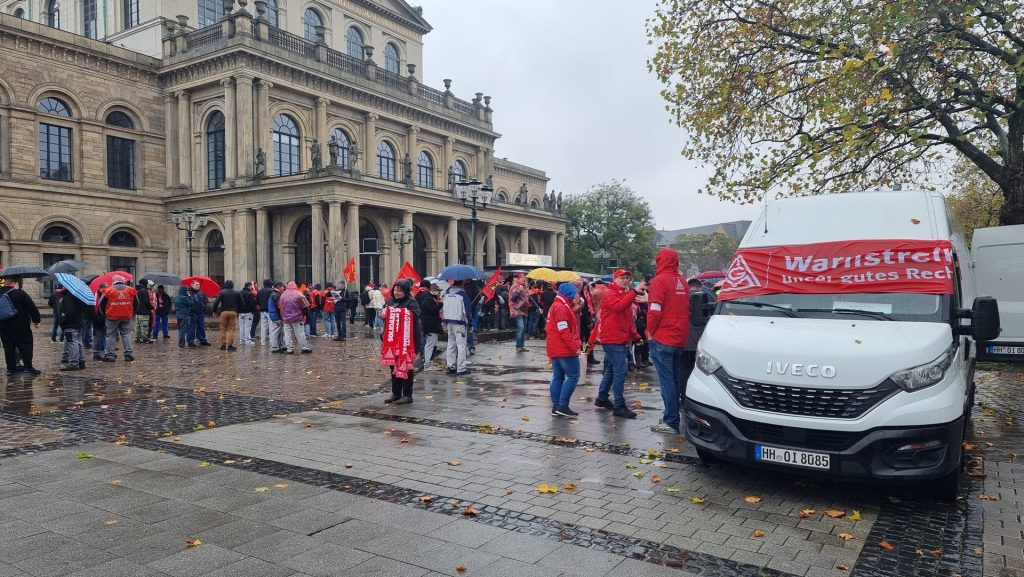
More than 400,000 workers across Germany have downed tools in the biggest wave of industrial strikes the country has seen in this pay round, as a bitter dispute over wages in Europe’s largest economy heads for a decisive week of talks.
Germany’s biggest trade union, IG Metall, said on Friday that over 413,000 workers in the metal and electrical industries took part in more than 2,800 warning strikes and rallies between Sunday and Friday. The workers are demanding a 5% pay rise over 12 months, along with stronger guarantees for their jobs. Employers have so far offered a 1.3% rise that would not even start until July 2028 — an offer the union calls a pay cut in real terms.
The dispute covers around 3.7 million workers, from car factory floors to aerospace plants, and it comes at a difficult moment for German industry. Carmakers are cutting jobs, suppliers are closing plants, and workers say they are being asked to pay the price for a crisis they did not cause. Talks resume on Monday, and the union has warned that longer walkouts — possibly lasting a full day — will follow if employers do not improve their offer.
What happened this week
The strikes began quietly at midnight on Sunday, 1 November, when around 300 workers at steelmaker Thyssenkrupp’s Rasselstein plant walked out. From there, the action spread quickly across the country.
By Monday, workers at Audi, Mercedes-Benz and Tata Steel were on strike. As the week went on, the walkouts reached BMW, Bosch, Siemens, Porsche and Airbus plants, along with hundreds of smaller engineering firms and suppliers. In Bavaria alone, the union called warning strikes at 105 companies, and BMW’s huge Dingolfing plant ended its late shift two and a half hours early as workers walked out.
The scale of the action surprised even the union. IG Metall said participation had already passed the level seen at the same stage of the last wage negotiations in 2024, when more than 100,000 workers joined strike actions on peak days. On Thursday alone, around 12,400 workers at four Airbus sites in northern Germany joined protests, while about 3,300 Mercedes-Benz employees in Bremen took part in warning strikes earlier in the week. Around 3,000 workers each from BMW, Audi and Bosch joined protests in Bavaria.
Thousands of people also rallied in Berlin and more than 30 other German cities over the weekend, turning a factory dispute into a visible public protest about the cost of living.
What workers are asking for
At the heart of the dispute is a simple demand: a 5% pay rise over 12 months for the roughly 3.7 million workers covered by the metal and electrical industry agreement. That includes carmakers, machinery manufacturers, metal producers and their suppliers — the backbone of German manufacturing.
But the union says the dispute is about more than pay. Its full list of demands includes:
- A 5% wage rise over 12 months, to restore purchasing power after years of rising prices.
- Higher pay for apprentices and trainees, so young workers are not left behind.
- Binding guarantees for jobs, factories and investment, so companies cannot take the money saved from wage restraint and spend it elsewhere.
- Profit-sharing at companies that are doing well, so workers benefit when their employer is profitable.
- Extra help for the lowest-paid groups, who have been hit hardest by the rising cost of living.
“Workers are fighting for the future of their families and their jobs,” said Nadine Boguslawski, IG Metall’s chief negotiator. She said workers expected “a tangible increase in purchasing power as well as concrete commitments from employers to safeguard industrial value creation and investment.” The union says it has made a “fair and flexible” offer, and that the ball is now in the employers’ court.
IG Metall’s president, Christiane Benner, struck a similar note, saying workers would not accept sweeping cost-cutting programmes designed to protect company profits at the expense of wages. What German industry needs, she said, is innovation and investment — not wage cuts.
What employers have offered
Employers have held their ground through three rounds of talks, all of which ended without agreement. Their offer has two parts: a one-off payment worth about 1% of a worker’s annual pay in July 2027, and a permanent wage rise of 1.3% starting in July 2028. Companies facing financial difficulties would be allowed to skip the one-off payment altogether.
The union has rejected the offer outright. Its argument is straightforward: with prices still rising, a 1.3% rise that does not arrive until the middle of 2028 would leave workers worse off in real terms — able to buy less with their pay than they can today. In the union’s words, the offer amounts to a pay cut in real terms.
Employers see it differently. Many firms in the metal and electrical industries are under severe strain, they say, with weak orders, high energy costs and fierce competition. Industry groups have argued that large pay rises would put more jobs at risk, not fewer, and some employer representatives have described the strikes as harmful at a time when companies are already struggling. In Bavaria, the employers’ association urged the union to show restraint, warning that escalation could hurt both sides.
This gap — between workers who say they need a real pay rise now and employers who say they cannot afford one — is what the next round of talks must somehow close.
Which companies were hit
The strikes touched almost every big name in German industry. Audi workers walked out in Ingolstadt, Mercedes-Benz employees struck in Bremen and at the company’s Marienfelde plant in Berlin, and BMW plants across Bavaria were affected. Porsche workers rallied at the company’s main plant in Stuttgart, and around 2,000 Volkswagen workers in Osnabrück protested against threatened job cuts.
Suppliers were hit too. Bosch, Siemens and Tata Steel all saw walkouts, and steelworkers at Thyssenkrupp started the whole wave with their midnight strike on Sunday. Airbus, which has been one of the brighter spots in German industry, saw thousands of its workers join the protests.
The picture is uneven. While the car industry and its suppliers have been announcing job cuts and plant closures for months, other parts of the industry — aerospace and defence technology, for example — are booming. That is one reason the union is demanding profit-sharing: it argues that workers in successful parts of the industry should share in that success, rather than being asked to accept the same restrained deal as workers in struggling firms.
Why this dispute matters
This is not just a row about pay. It is a test of how Germany handles the biggest industrial crisis it has faced in years.
German manufacturers have been under mounting pressure from high labour and energy costs and a long period of economic weakness. The car industry, long the pride of the German economy, is struggling with the shift to electric vehicles, weak demand and tough competition, particularly from China. Suppliers have been hit hard, and job cuts have become a regular feature of the news.
At the same time, the cost of living has risen sharply for ordinary workers. Prices for food, rent and energy have climbed, and many workers say their pay has not kept up. That is why the union’s demand is framed not just as a pay claim but as a demand for purchasing power — money that workers can actually spend.
The outcome will also set a pattern. The metal and electrical industry agreement is one of the most important pay deals in Germany, and other sectors watch it closely. A strong settlement would give workers elsewhere confidence to demand more. A weak one would signal that even Germany’s most powerful union cannot win a real pay rise.
There is also a European dimension. Similar disputes are flaring up across the continent, with workers in France protesting over the cost of living and unions in other countries pressing for higher pay. Germany’s answer will be watched well beyond its borders.
How warning strikes work
The strikes this week were “warning strikes” — short, limited walkouts that are a normal part of how pay disputes work in Germany. They typically last a few hours, and their purpose is to show employers how many workers back the union’s demands while talks continue.
Warning strikes are legal once a certain stage of negotiations has passed, and they are a routine feature of German industrial relations. What makes this round unusual is the scale: more than 2,800 separate actions in a single week, involving hundreds of thousands of workers.
But the union has made clear that warning strikes are only the first step. If Monday’s talks fail to produce a better offer, IG Metall has threatened longer walkouts, possibly lasting 24 hours. That would be a serious escalation, hitting production at car plants and suppliers that are already under strain.
What happens next
All eyes are now on Monday, 9 November, when talks resume in Bavaria, North Rhine-Westphalia and Saxony. Those three regions are home to many of Germany’s biggest industrial employers, and the negotiations there will shape the deal for the whole country.
The union’s message is clear: employers must move. Workers have shown, in very large numbers, that they back the demand for a 5% rise and for real guarantees on jobs and investment. If the employers’ side comes back with another offer close to the current one, longer strikes are likely to follow — and the disruption to car production, engineering firms and supply chains would grow.
Employers, for their part, will be looking for flexibility from the union — perhaps a lower headline figure, a longer deal, or concessions on working hours in exchange for job guarantees. IG Metall has already signalled that it is willing to be flexible on some points, as long as job and investment guarantees are binding.
For the workers who stood in the rain outside factories and plants this week, the question is simpler: will their pay finally keep up with the cost of living, or will they be asked to accept another real-terms cut? Monday’s talks will go a long way towards answering it.
Frequently asked questions
What is IG Metall?
IG Metall is Germany’s largest trade union, representing workers in the metal, electrical, steel, automotive and related industries. It negotiates pay and conditions for around 3.7 million workers in the metal and electrical sector, and it is one of the most powerful unions in Europe.
What is a warning strike?
A warning strike, or “Warnstreik”, is a short, limited walkout used during pay negotiations in Germany. Workers stop work for a few hours to show support for the union’s demands. It is a legal and routine part of the bargaining process, and it is meant to put pressure on employers while talks continue.
Why are German workers striking?
Workers are demanding a 5% pay rise over 12 months, higher pay for apprentices, binding guarantees for jobs and investment, and profit-sharing at profitable companies. They say their pay has not kept up with the rising cost of living, and they reject the employers’ offer of a one-off payment in 2027 and a 1.3% rise from July 2028 as a pay cut in real terms.
Which companies have been affected?
Audi, Mercedes-Benz, BMW, Porsche, Bosch, Siemens, Airbus, Tata Steel and Thyssenkrupp have all been hit, along with hundreds of smaller engineering firms and suppliers. In Bavaria alone, warning strikes were called at 105 companies.
What happens if the talks fail?
IG Metall has threatened longer walkouts, possibly lasting 24 hours, if employers do not improve their offer. That would cause far greater disruption to production than the short warning strikes seen this week.
How does this compare with the last pay round?
Participation in this week’s strikes has already exceeded the level seen at the same stage of the 2024 wage negotiations. During that round, more than 100,000 workers joined strike actions on peak days.
Conclusion
More than 413,000 workers, 2,800 strikes and one clear message: Germany’s industrial workers want a pay rise that actually keeps up with the cost of living, and they want real promises that their jobs and factories have a future.
The employers’ offer — a small one-off payment next year and a 1.3% rise in 2028 — has been rejected as a pay cut in real terms. The two sides are far apart, but they are back at the table on Monday. What happens in those talks will decide whether this dispute ends with a deal, or with longer strikes that shut down production at some of the most famous factories in the world.
For now, the workers have shown their strength. On Monday, it will be the employers’ turn to show whether they are listening.
Sources
- https://www.freemalaysiatoday.com/category/business/2026/11/07/more-than-400-000-german-workers-take-action-for-higher-pay
- https://english.news.cn/20261107/e5032410f5c843d99935c50e10b4fc1a/c.html
- https://www.reuters.com/business/world-at-work/german-engineering-industry-workers-begin-wage-strikes-2026-11-01/
- https://www.aljazeera.com/amp/news/2026/11/2/german-unions-launch-wave-of-strikes-over-cost-of-living-pressures
- https://www.srnnews.com/german-metal-workers-step-up-strikes-in-pay-dispute/
This article is for general information and education only. It is not legal or financial advice.
