
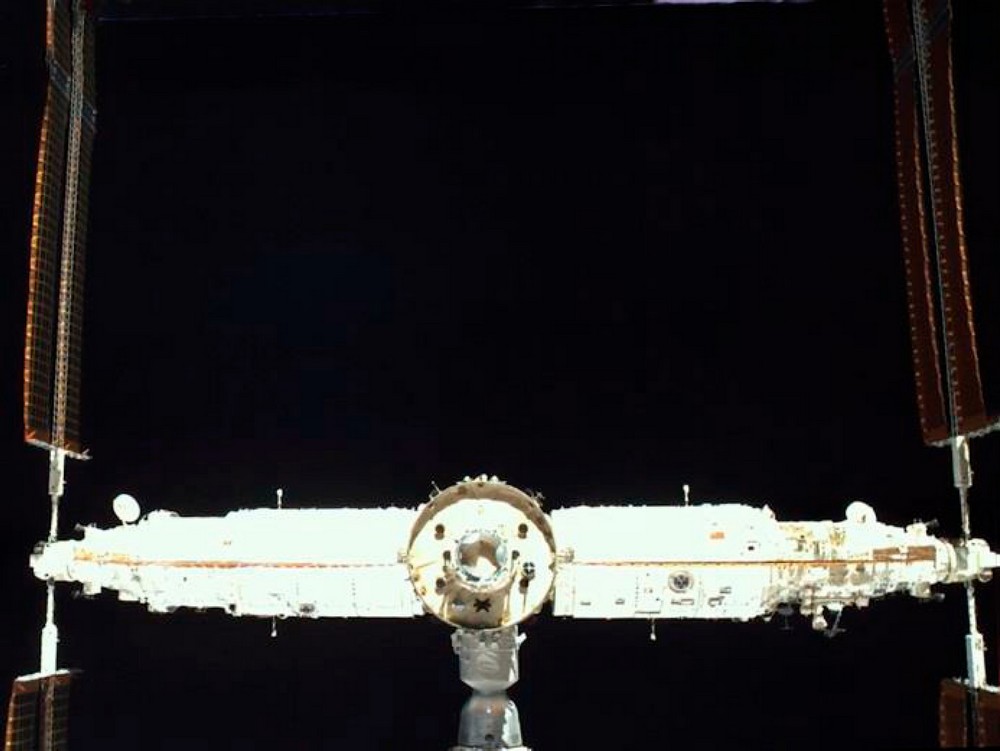
China’s Tiangong Space Station Creates the Coldest Matter Ever Made
Scientists working aboard China’s Tiangong space station have created the coldest matter ever made by humans. They cooled a cloud of rubidium atoms to just 9.7 picokelvin — less than one hundred-billionth of a degree above absolute zero, the lowest temperature that physics allows. The result, published in the journal Science on 5 November 2026, breaks the previous record by a wide margin and opens a new window for experiments that are impossible to run on Earth.
At temperatures this low, atoms stop behaving like individual particles and start acting as a single quantum wave, giving scientists a rare chance to study the strange rules of quantum physics in their purest form.
What exactly did the scientists do?
A team from Peking University and the Shanghai Institute of Optics and Fine Mechanics, working with the Chinese Academy of Sciences, cooled about 20,000 rubidium atoms inside a special experiment rack aboard Tiangong’s Mengtian laboratory module. The experiment used lasers to trap the atoms and slow them down step by step. As the atoms lost energy, they grew colder and colder, until the cloud reached an equivalent temperature of 9.7 picokelvin. The team then let the cloud expand freely and watched it for seven seconds — a long time for an experiment of this kind — to measure how fast the atoms were moving. That speed told them the temperature.
The work was organised by the Technology and Engineering Center for Space Utilization, part of the Chinese Academy of Sciences. Planning for the experiment began with feasibility studies in 2011, and the experiment system was launched into orbit with the Mengtian module in 2022.
How cold is 9.7 picokelvin?
To understand the scale, it helps to start with absolute zero. Absolute zero is minus 273.15 degrees Celsius. It is the lowest temperature that can exist in theory, the point at which atoms would stop moving altogether. Nothing can be colder than absolute zero, and scientists can only approach it, never quite reach it.
A kelvin is the scientific unit of temperature. Room temperature is about 293 kelvin. A picokelvin is one trillionth of a kelvin. So 9.7 picokelvin is 0.0000000000097 kelvin — a temperature so close to absolute zero that the difference is almost impossible to picture.
Put another way, the atom cloud was more than 30 trillion times colder than the room you are sitting in.
The measurement comes with a small margin of error. The researchers give the figure as 9.7 picokelvin, plus 3.2 or minus 2.7 — in other words, the true value lies somewhere between 7.0 and 12.9 picokelvin. Even at the top of that range, it is still the coldest matter humans have ever made.
There is one technical detail worth knowing. The 9.7 picokelvin figure is what physicists call an “equivalent temperature”. The team did not stick a thermometer into the atom cloud. Instead, they measured how quickly the cloud spread out once it was released, worked out the kinetic energy of the atoms from that movement, and converted that energy into a temperature. It is the standard way of describing temperatures in this field, and it is how the earlier records were measured too, so the comparison is fair.
Why did they have to go to space?
The short answer is gravity. On Earth, gravity is always pulling atoms downwards. To hold atoms still enough to cool them, scientists trap them with magnetic fields or laser beams. But a trap strong enough to fight gravity also disturbs the atoms and limits how cold they can get. Weaker traps would let the atoms cool further, but on Earth the atoms would simply fall out of them.
In orbit, that problem disappears. Aboard a space station, everything is in free fall, so the atoms float. The team could weaken their laser traps far more than any laboratory on Earth allows, letting the atoms cool to temperatures that ground-based experiments cannot reach. That is why this record was set in space — and why earlier records were also set away from Earth’s surface.
The previous record was 38 picokelvin, set in 2021 by a German team using a drop tower in Bremen, where experiments fall freely for a few seconds to simulate weightlessness. Before that, NASA’s Cold Atom Laboratory aboard the International Space Station reached 52 picokelvin in 2022. The new Tiangong result of 9.7 picokelvin is about four times lower than the drop-tower record and about five times lower than the International Space Station’s best.
The space station also gave the team something else: time. On Earth, an ultracold cloud can only be watched for a fraction of a second before gravity pulls it apart — ground experiments typically manage about 0.05 seconds. The Tiangong team observed their cloud for a full seven seconds, giving them a much longer window to measure it precisely.
What is a Bose-Einstein condensate?
At temperatures close to absolute zero, something strange happens to atoms. They lose their individual identities and merge into a single quantum state called a Bose-Einstein condensate. In this state, thousands of atoms behave like one giant “super-atom”, moving and rippling as a single wave.
The idea was predicted by Albert Einstein and the Indian physicist Satyendra Nath Bose more than a century ago, in the 1920s. But it was not until 1995 that scientists first created one in a laboratory, a breakthrough that won the Nobel Prize in Physics in 2001. Since then, Bose-Einstein condensates have become one of the most powerful tools in physics, letting researchers study quantum behaviour on a scale large enough to see and measure.
The Tiangong experiment created exactly this state. When the rubidium atoms were cooled to 9.7 picokelvin, they formed a Bose-Einstein condensate — a cloud of matter colder and more orderly than anything humans had made before.
How the experiment worked, step by step
The experiment ran inside a purpose-built piece of hardware called the Cold Atom Physics Research facility, installed in Tiangong’s Mengtian module. Here is the process in simple terms.
1. Trapping the atoms. The team started with a cloud of rubidium-87 atoms — a form of the metal rubidium that is widely used in cold-atom research because it responds well to laser cooling. Laser beams held the atoms in place in what is called an optical trap.
2. Cooling in stages. The scientists lowered the power of the lasers in careful stages. As the trap weakened, the hottest atoms escaped — a process called evaporative cooling, similar to how a cup of tea cools faster when steam carries heat away. The atoms left behind were colder.
3. A final deep-cooling step. The team then used a technique called non-adiabatic diffusion to push the temperature down further still. This was the step that took the cloud below 10 picokelvin for the first time.
4. Measuring the result. Finally, the trap was switched off and the cloud was allowed to expand freely in microgravity. Cameras tracked the cloud’s three-dimensional expansion for seven seconds. From the speed of that expansion, the team calculated the atoms’ energy and therefore the temperature: 9.7 picokelvin.
One detail matters for the future. Earlier space experiments used magnetic traps built on atom chips. The Chinese team used an all-optical trap — one made entirely from laser light — which is a harder technique to master but offers finer control. The success of the optical approach in orbit is itself a technical milestone, and it is one reason the team could push the temperature so much lower than before.
How it compares with past records
| Experiment | Temperature | Year |
|---|---|---|
| Bremen drop tower, Germany | 38 picokelvin | 2021 |
| NASA Cold Atom Laboratory, ISS | 52 picokelvin | 2022 |
| Tiangong space station, China | 9.7 picokelvin | 2026 |
The new record is not a small improvement. It is roughly four times colder than the previous best, achieved in a single jump. It is also the first time any experiment has cooled a quantum gas below 10 picokelvin — the title of the paper published in Science is “Quantum gases below 10 picokelvin in space”.
It is worth remembering that the coldest natural places in the universe are far warmer than this. The coldest known spot in space, the Boomerang Nebula, is about 1 kelvin — roughly a hundred billion times warmer than the Tiangong cloud. The matter created aboard Tiangong is colder than anything that exists naturally anywhere we know of.
Why does it matter?
This is not just a race to set a record. Ultracold atoms are a tool, and colder atoms are a better tool. Here are the main reasons scientists care.
More precise measurements. The experiment is expected to improve a device called an atom interferometer, which uses the wave-like behaviour of cold atoms to measure tiny changes in gravity and acceleration. More precise gravity measurements could help with navigation, mapping underground structures, and even detecting hidden mineral deposits. The seven-second observation time achieved on Tiangong is especially valuable here, because longer measurements mean more accurate results.
Testing the laws of physics. At these temperatures, quantum effects become large and clear enough to study in detail. Ultracold gases let physicists test the relationship between gravity and quantum mechanics — two parts of physics that still do not fit together neatly. The results could help answer some of the biggest open questions in science.
Simulating the early universe. Ultracold atoms can be arranged to mimic other physical systems, including conditions similar to those in the very early universe. Researchers say the new capabilities could support simulations of the early universe and the search for ultralight dark matter, the invisible substance thought to make up much of the universe’s mass.
A new platform in orbit. Perhaps the most important result is not the number itself but the proof that this kind of experiment works in space. Tiangong now hosts a working ultracold-atom laboratory in orbit, and the techniques proven here — the all-optical trap, the long observation times, the deep-cooling steps — can be used for more ambitious experiments in the years ahead.
What happens next?
The experiment is part of a long-running programme. The hardware was launched with the Mengtian module in 2022, and the team spent years preparing the cooling sequence before the record attempt. With the method now proven, the researchers are expected to run further experiments using the same facility, pushing towards even lower temperatures and longer observation times.
Other space agencies are watching closely. NASA’s Cold Atom Laboratory continues to operate aboard the International Space Station, and the competition between the two programmes is driving the field forward quickly — the record has now fallen to Tiangong by a large margin.
For China, the result is also a statement about Tiangong itself. The station has been permanently crewed since 2021, and its laboratory modules — Wentian and Mengtian — were designed to host exactly this kind of frontier science. The coldest-matter record is the most striking result to come out of the station so far, and it shows what a dedicated space laboratory can do that no laboratory on Earth can match.
Frequently asked questions
What is the coldest temperature ever reached? The coldest matter ever created by humans is the rubidium atom cloud cooled to 9.7 picokelvin aboard China’s Tiangong space station in 2026. That is less than one hundred-billionth of a degree above absolute zero.
What is absolute zero? Absolute zero is minus 273.15 degrees Celsius, the lowest temperature that can exist in theory. At absolute zero, atoms would have no thermal motion at all. It cannot be reached in practice, only approached.
Why is it so cold in space if the experiment had to go there? Space itself is not uniformly cold — an object in sunlight can get very hot. What the space station provides is not cold, but weightlessness. In microgravity, atoms float instead of falling, so scientists can use very weak traps and cool the atoms far further than gravity allows on Earth.
What is a picokelvin? A picokelvin is one trillionth of a kelvin, the scientific unit of temperature. Room temperature is about 293 kelvin, so 9.7 picokelvin is roughly 30 trillion times colder than room temperature.
What are the atoms used for? The ultracold rubidium atoms form a Bose-Einstein condensate, a quantum state in which thousands of atoms behave as a single wave. This lets scientists study quantum physics in detail, build extremely precise gravity sensors, simulate the early universe, and search for dark matter.
Is this colder than deep space? Yes. The coldest natural place known, the Boomerang Nebula, is about 1 kelvin. The Tiangong atom cloud, at 9.7 picokelvin, is roughly a hundred billion times colder.
Conclusion
In a laboratory module orbiting 400 kilometres above Earth, Chinese scientists have made the coldest matter in human history: a cloud of rubidium atoms at 9.7 picokelvin, colder than any natural place in the universe. The achievement, published in Science, beats the previous record fourfold and proves that a space station can host quantum experiments no laboratory on Earth can match.
The record itself is remarkable, but the real story is what comes next. With colder atoms, longer observation times and a proven laboratory in orbit, physicists now have a sharper tool for measuring gravity, testing the laws of nature and exploring the invisible universe. The coldest place humans have ever made may turn out to be one of the most useful.
Sources:
- Science News: https://www.sciencenews.org/article/lowest-temperature-china-space-station
- Xinhua: http://chinaview.cn/20261106/b1e05437fb304f60bf51fc68299dfd4f/c.html
- Donga Science: https://dongascience.com/en/news/80727
- Quantum Unzipped: https://quantumunzipped.com/briefings/scientists-achieve-record-breaking-low-temperature-on-chinas-space-station-2
- Science (paper, DOI): https://doi.org/10.1126/science.aea5324
This article is for general information and education only. It is not legal or financial advice.
