
ESA’s Hera Spacecraft Sends First Close-Up of Didymos, the Asteroid Humans Knocked Off Course
Four years ago, humanity hit an asteroid on purpose. This week, we finally got to see what happened next.
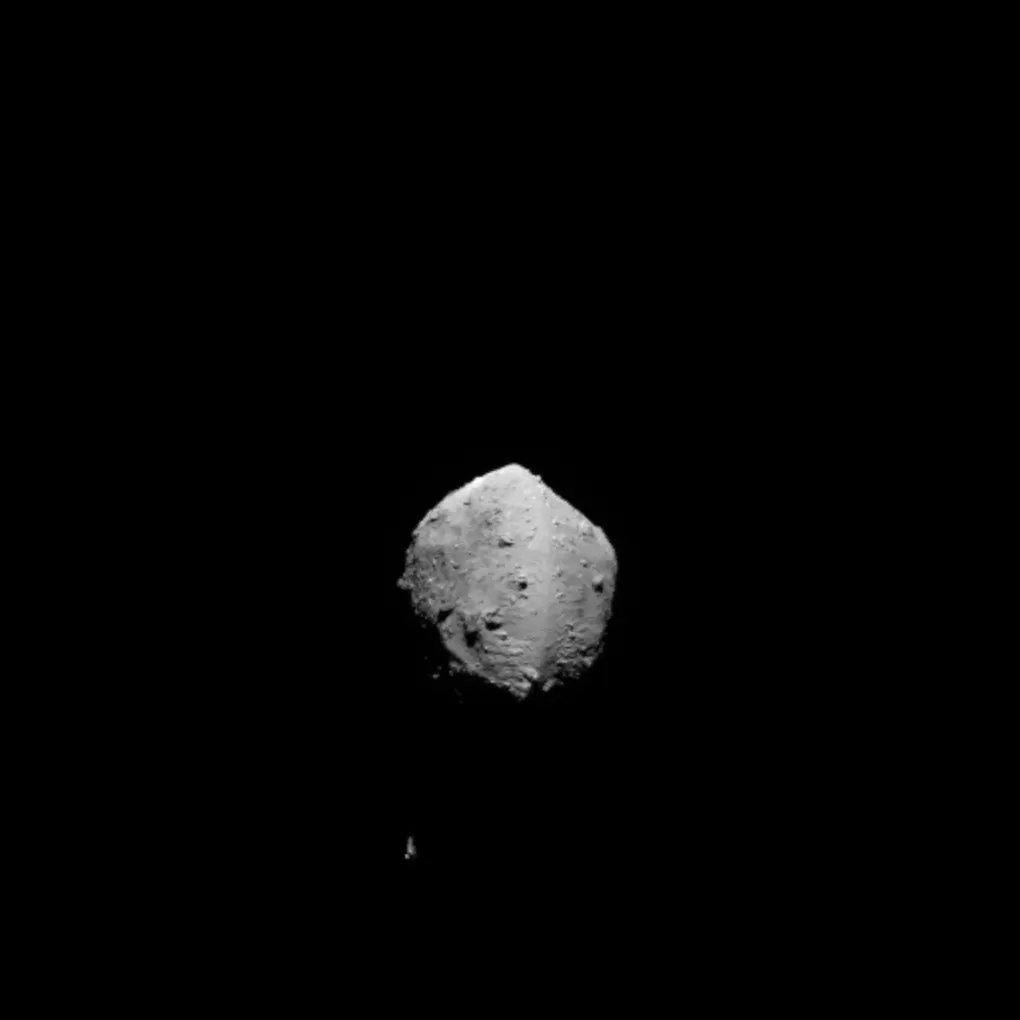
On 5 November 2026, the European Space Agency (ESA) released the first close-up image of the Didymos asteroid system, taken by its Hera spacecraft from just 60 kilometres away. It is the first detailed look at the double asteroid since NASA’s DART spacecraft slammed into its smaller moon, Dimorphos, in 2022 — the first time humans have ever deliberately changed the orbit of a celestial body.
The black-and-white photograph shows Didymos, the larger asteroid, in sharp detail for the first time. Its little moon Dimorphos, the actual target of the 2022 impact, hides mostly in shadow below it, visible only as a thin sliver of light. It is a small image with a very big meaning: the second half of the first planetary defence experiment in history has begun.
What Hera Saw
Hera took the picture with its monochromatic Asteroid Framing Camera, from a distance of about 60 kilometres (37 miles). The Didymos system is currently around 196.8 million kilometres from Earth, so the image took about 11 minutes to travel back to us at the speed of light.
Didymos itself is about 780 metres wide — roughly the size of the Golden Gate Bridge. In the new image it fills most of the frame, a grey, boulder-strewn rock floating against the black of space. Its moon Dimorphos, only about 151 metres across, orbits around it at a distance of roughly one kilometre.
What excited the science team most was not just that the picture was sharp. It was which side of Didymos it showed. This is the face of the asteroid that no camera had ever photographed before — the opposite side from the one NASA’s DART spacecraft saw in its final moments before impact in 2022.
“The first thing we said was wow!” said Hera Principal Investigator Patrick Michel, Director of Research at CNRS and the Observatoire de la Côte d’Azur in France. “This is the other side of Didymos from the one that DART’s camera showed us shortly before impact, so this feels like looking at a whole new world.”
The new side looks familiar in one way and strange in another. It has the same central ridge running around its equator that scientists saw before. But otherwise, Michel said, it “appears very different, with multiple boulders and craters and what look like patterns of grooves or ridges.”
That difference matters. When DART hit Dimorphos, it threw a huge cloud of rock and dust into space. Some of that debris may have travelled the short distance across to Didymos and landed there, changing its surface. ESA mission scientist Michael Kueppers said the team now has “exciting work ahead of us to sort it out.”
“Since we expect a lot of impact-ejected material to have made it across the approximately 1 km of space from Dimorphos to Didymos, it may be that some of these characteristics originate from this transport of material,” Kueppers said. “We look forward to seeing much more of both bodies and systemically mapping all the changes we identify.”
The Crash That Started It All
To understand why this single photograph matters so much, you have to go back to 26 September 2022.
That night, NASA’s Double Asteroid Redirection Test — DART — deliberately crashed into Dimorphos at about 6.1 kilometres per second, or roughly 22,000 kilometres per hour. The spacecraft weighed 580 kilograms, about the same as a small car. It was destroyed on impact, but it did exactly what it was designed to do.
Before the crash, Dimorphos took about 11 hours and 55 minutes to orbit Didymos. After the crash, that orbit had shortened by about 33 minutes — a much bigger change than scientists had predicted. Dimorphos became the first object in the Solar System to have its orbit measurably changed by human action.
It was a test of a simple idea: if an asteroid were ever found heading for Earth, could we push it off course by hitting it with a spacecraft? DART proved the basic idea works. But a single crash leaves many questions unanswered. How much did the impact change Dimorphos itself? Did it leave a crater, or did the whole small asteroid get reshaped? How much debris was thrown off, and where did it go? How heavy is Dimorphos, and what is it made of inside?
DART could not answer those questions, because it was destroyed in the impact. That is why ESA built Hera.
Why Hera Went Back
Hera launched on 7 October 2024 aboard a SpaceX Falcon 9 rocket, beginning a two-year journey to the Didymos system. Its job is what ESA calls a close-up “crash site investigation” — a detailed survey of what DART actually did.
The approach took weeks. On 7 October 2026, Hera first photographed its destination as a single pixel of light from 236,500 kilometres away. On 18 October, from 1,280 kilometres, its camera resolved Didymos and Dimorphos as two separate objects for the first time — though Dimorphos was still barely a single pixel. A braking manoeuvre on 15 October slowed the spacecraft down so it could settle into position near the pair.
Then, on 5 November, came the first close-up: the image released this week, taken from 60 kilometres away.
“Seeing this image is a hugely exciting moment for the whole Hera family,” said Hera mission manager Ian Carnelli. “It has taken years of hard work and dedication to reach this point — but we’re motivated to know that the adventure is only beginning!”
Over the coming months, Hera will spend about six months studying the two asteroids in detail. It will map their surfaces, measure their mass and gravity, and hunt for the crater DART left behind. It will also release two small CubeSats — Milani and Juventas. Milani will study the surfaces of both asteroids by splitting the light they reflect into its colours. Juventas will make the first radar soundings inside an asteroid, probing what lies beneath the surface.
Three Mysteries Hera Will Solve
ESA has set out three big questions that Hera is designed to answer, and each one matters for the future of planetary defence.
First: what is Dimorphos made of? Hera will measure the density and composition of Dimorphos in detail, to work out whether it is a “rubble pile” — a loose collection of rocks held together only by gravity — or a solid core covered in boulders and gravel. The answer changes how an asteroid would react to being hit. A rubble pile soaks up an impact differently from a solid rock, and that affects how much its orbit changes.
Second: what exactly did DART do to the surface? Hera will map the crater created by the impact down to a resolution of about 10 centimetres, helping scientists understand how the surface material responded to the collision. It is even possible that there is no classic crater at all — the impact may have reshaped the entire small asteroid instead. Finding out which is true will tell scientists how reliable the kinetic impactor technique really is.
Third: how did this double asteroid form? About 15 percent of known asteroids are actually binary systems — two rocks orbiting each other — but how they form is still a mystery. Hera will determine whether Dimorphos and Didymos are made of the same material. If they are, it would suggest that the rapidly spinning Didymos once threw debris into space that later clumped together to form Dimorphos.
What Happens Next
The image released this week is only the beginning. ESA has announced that the first detailed, full-resolution images of both Didymos and Dimorphos will be unveiled on 25 November 2026, at a media conference in Berlin. Those images should show the DART impact site on Dimorphos in detail for the first time since 2022.
After that, Hera’s real work begins: months of close-range mapping, measuring and probing, with the two CubeSats adding their own observations. The data will feed into computer models that predict how asteroids respond to impacts — models that could one day be used for real, if an asteroid is ever found on a collision course with Earth.
It is worth remembering the scale of what is being attempted. Didymos and Dimorphos are tiny by space standards, and they are nearly 200 million kilometres away. Guiding a spacecraft to within 60 kilometres of them, after a two-year flight, is itself an extraordinary feat of navigation. Taking a clear photograph from there is the first step toward turning a dramatic one-off experiment into a technique scientists properly understand.
Why This Matters for Earth
Asteroid impacts are rare, but they are one of the few natural disasters humanity can actually prevent — if we see the threat coming and know how to act. The dinosaurs had no space programme. We do.
DART showed that we can move an asteroid. Hera will show us how well we can move one, and how predictable the result is. That difference matters enormously. If astronomers ever spot a real asteroid heading toward Earth, they will need to know exactly how big a spacecraft to send, how fast it must hit, and how much the orbit will change. Guessing wrong could mean the difference between a deflection and a disaster.
That is why a single black-and-white photograph of a grey rock, taken from 60 kilometres away in the dark of space, is front-page science news. It is the first page of the report on the most important experiment humanity has ever run on another world — the test of whether we can defend our own planet.
Frequently Asked Questions
What is the Hera mission?
Hera is the European Space Agency’s first planetary defence mission. It travelled to the Didymos binary asteroid system to investigate the aftermath of NASA’s DART impact in 2022, when a spacecraft was deliberately crashed into the asteroid Dimorphos to test whether an asteroid’s orbit could be changed.
What did Hera’s first close-up image show?
The image, taken from 60 kilometres away on 5 November 2026, shows the asteroid Didymos in detail for the first time, including a side of it that no camera had photographed before. Its moon Dimorphos is mostly hidden in shadow below it. The image reveals boulders, craters and groove-like patterns on Didymos’s surface.
What did the DART mission achieve in 2022?
NASA’s DART spacecraft crashed into Dimorphos on 26 September 2022 at about 6.1 kilometres per second. The impact shortened Dimorphos’s orbit around Didymos by about 33 minutes — much more than scientists had predicted — proving that a spacecraft impact can change an asteroid’s path.
When will we see detailed images of the crash site?
ESA will unveil the first detailed, full-resolution images of both Didymos and Dimorphos on 25 November 2026. Those images should show the DART impact site on Dimorphos in detail for the first time since the collision.
Could an asteroid really hit Earth?
Asteroid impacts are rare, but they have happened throughout Earth’s history. Space agencies track near-Earth asteroids, and missions like DART and Hera are testing the techniques that could one day deflect a dangerous asteroid if one is found heading our way.
Conclusion
Hera’s first close-up of Didymos is a small photograph with a large message: humanity’s first attempt to move an asteroid is now being studied in detail, and the results will shape how we protect Earth in the future. The image shows a world we have already changed, seen from an angle no one had seen before, with more questions than answers — and a spacecraft now in place to answer them.
On 25 November, the next set of images will show the crash site itself. Until then, this first glimpse is a reminder of something remarkable: four years ago we hit an asteroid on purpose, and this week we went back to look at what we did.
Sources
- https://www.esa.int/articles/about-us/directorates/operations/space-safety/hera/hera-s-first-close-up-view-of-didymos-asteroids
- https://earthsky.org/space/hera-mission-dart-asteroid-impact/
- https://www.esa.int/media-advisories/four-years-after-nasa-s-asteroid-impact-esa-s-hera-reveals-what-happened-to-dimorphos
- https://en.wikipedia.org/wiki/Hera_(space_mission)
This article is for general information and education only. It is not legal or financial advice.
