
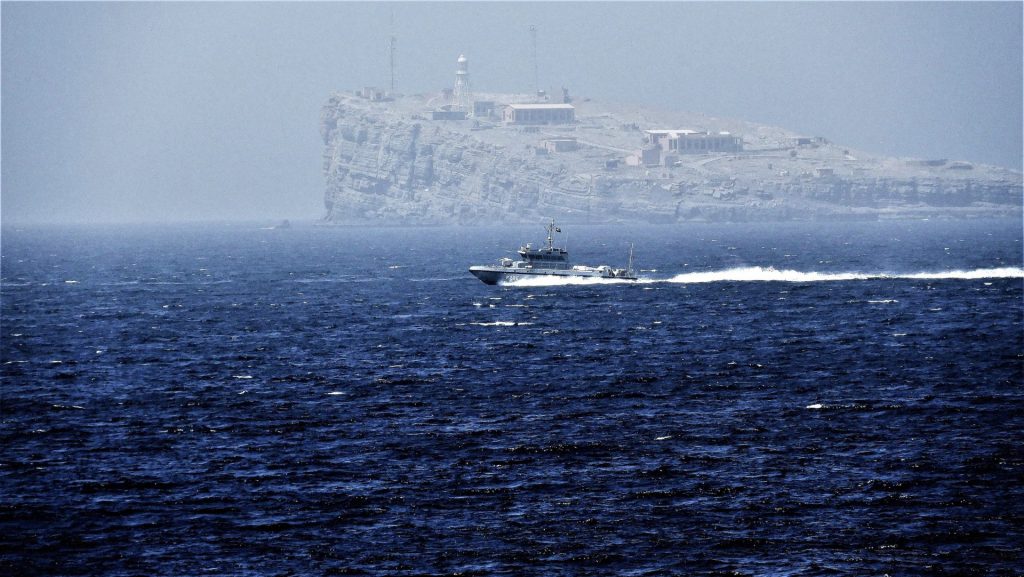
Iran Strikes Navigation Systems on Oman’s Didamar Island in the Strait of Hormuz
Iran has attacked the navigation systems on a small Omani island in the Strait of Hormuz, in a strike that takes its campaign against shipping onto the soil of a country that has stayed neutral in the war. Three sources with knowledge of the matter confirmed the attack to Reuters on Wednesday, 11 November 2026, and Iran’s Revolutionary Guards have claimed responsibility for it.
The island is Didamar, also known as Little Quoin Island. It is a tiny, uninhabited rock about 10 nautical miles (around 19 kilometres) north of the tip of Oman’s Musandam Peninsula, sitting beside the southern shipping lane through the strait. For more than a century it has helped guide ships through one of the narrowest and most important waterways in the world. Now it has become a target.
Oman disputes how much damage was done. A senior Omani official told The Maritime Executive that the island’s navigational aids had not been struck, while The Wall Street Journal reported an Omani coast guard official confirming that an explosion had taken place. What is not in doubt is that something happened on the island on 8 November — satellite images show scorch marks near its radar and radio equipment, and video verified by Reuters shows smoke rising from the rocky outcrop.
What happened on Didamar Island
The attack itself took place on Saturday, 8 November, according to the Institute for the Study of War (ISW), a Washington-based research group that tracks the conflict. But it was only on Tuesday, 10 November, that Iranian state media publicly said the Islamic Revolutionary Guard Corps (IRGC) had carried out strikes destroying what it called “enemy navigation systems” on the island.
Iran’s semiofficial Fars News Agency reported that the IRGC Navy had targeted the island, saying its systems were being used to help vessels pass through the strait without Tehran’s approval. Iranian state television went further, claiming that the island’s personnel and equipment “were helping the flow of oil smuggling by the enemy.”
Three sources confirmed to Reuters on Wednesday that navigation systems and communications equipment on Didamar had been attacked. The sources did not provide an assessment of the damage, and Reuters said it could not determine independently whether any navigation systems had actually been destroyed.
That uncertainty matters. The ISW, in its assessment, said the extent of the damage “remains unclear at the time of this writing” and questioned how much Iran had achieved. Commercial ships, it noted, kept travelling along the southern route through the strait after the attack — the very route the strike was supposed to shut down.
The evidence outside Iran is mixed. Satellite imagery from the European Union’s Copernicus Sentinel-2 programme, dated 8 November, appeared to show scorch marks close to the radar and radio equipment on the island. Reuters confirmed smoke rising from the island in video footage, although it was not clear what was burning. But satellite imagery from the morning of 10 November showed no obvious damage to the lighthouse or the masts, The Maritime Executive reported — although damage to a mast could be hard to see at that resolution.
An IRGC navy official quoted by Fars claimed the navigational aid systems in the south of the strait had been destroyed and that oil smuggling through the strait had been completely halted. The continued flow of ships along the southern route suggests that claim was, at best, overstated.
What the island does — and why it matters
Didamar is small, but its job is large. The island has served as a navigational landmark for ships passing through the Strait of Hormuz for more than a century, and its lighthouse was first established in 1914.
Today the island carries shore radar mounted on a tower about 25 metres tall, along with radio communications equipment that helps vessels navigate the narrow channel. It has also been associated with the Hormuz Control Centre, which coordinates maritime traffic in the area.
The Strait of Hormuz is the only sea passage from the Persian Gulf to the open ocean. Around a fifth of the world’s oil traded by sea normally passes through it, along with a large share of liquefied natural gas. The channel is only about 33 kilometres wide at its narrowest point, and the shipping lanes in each direction are just a few kilometres wide. In a waterway that tight, navigation aids are not a luxury — they are what keep very large tankers from running aground or colliding.
That is why the strike matters even if the physical damage turns out to be limited. Shipping sources told Reuters that the attack would probably have only a limited impact on commercial traffic, because other navigation systems are in place elsewhere. But the target itself sends a message: Iran is now willing to hit the infrastructure that keeps oil moving, not just the ships that carry it.
Why Oman matters
Didamar belongs to Oman. That is what makes this attack different from the dozens of strikes on tankers in recent months.
Oman is the one neutral state in the region. It keeps talking to both sides — to Washington and to Tehran — and it has acted as a mediator between them throughout the conflict. As recently as 5 November, Oman’s foreign minister discussed joint mechanisms for the strait with Iran’s foreign minister. Hitting Omani soil, even an uninhabited island, risks damaging that neutrality and dragging a mediator into the firing line.
It is also the first time, if confirmed in full, that Iran’s campaign against shipping has landed on the soil of Oman. Until now, the attacks have been aimed at ships at sea. The strike on Didamar extends the campaign to land — and to the territory of a country that has not taken sides.
Oman’s response so far has been cautious and fragmented rather than a single formal statement. The denial from a senior official that the navigational aids were struck sits alongside the coast guard confirmation of an explosion reported by The Wall Street Journal. That mixed picture may reflect a government trying to play down an incident it does not want to escalate, while not denying that something happened.
For Muscat, the stakes are real. Oman earns money from the shipping that passes its shores, and its ports have become part of the workaround keeping Gulf oil flowing, with ship-to-ship transfers of oil now taking place off the coasts of Oman and the United Arab Emirates. An attack on Omani infrastructure threatens that business — and the delicate balance Oman has kept between its neighbours.
The wider war on shipping
The Didamar strike did not come out of nowhere. It is the latest step in a maritime campaign that has grown steadily worse since the war on Iran began in late February 2026.
According to figures cited by Reuters, 37 ships were attacked in October — the highest monthly total since the conflict began. Another 10 attacks had already been recorded in November by 11 November. The International Maritime Organization, the United Nations body responsible for shipping safety, has documented 130 maritime incidents across the region since the war began, most of them attacks. At least 25 seafarers have been killed.
Iran’s Revolutionary Guards have sought to enforce restrictions on vessels travelling through the Strait of Hormuz, warning ships against using what Tehran calls unauthorised routes. On Sunday, 8 November — the same day as the Didamar attack — three tankers were hit for allegedly using unauthorised routes, according to Iranian state broadcaster IRIB, citing the IRGC Navy. Also on Tuesday, 10 November, the Liberia-flagged very large crude carrier MT Fujairah Energy was struck by a projectile while sailing from Al Ruwais in the United Arab Emirates to Dubai. Four crew members were injured. That incident is covered in full on Findivoza.
At the same time, American forces have been enforcing a naval blockade of Iranian ports and escorting commercial ships through the strait. The US Navy imposed the blockade in April, after Iran closed the Strait of Hormuz in February. The blockade was lifted in June following a temporary ceasefire, then reinstated in July. Commercial and allied shipping is now advised to use a southern route through Omani territorial waters, outside Tehran’s direct military control and overseen by US Central Command (CENTCOM).
The military backdrop
The strike also follows American military action elsewhere in the waterway. US forces struck targets on Iran’s Qeshm Island on 2 November, in what officials described as limited defensive action against Iranian surface-to-air missile threats. Qeshm Island, near the Strait of Hormuz, is home to Iranian naval facilities and military infrastructure linked to the Revolutionary Guards.
President Donald Trump acknowledged on 6 November that American forces continue to conduct limited strikes against Iranian targets. Iran’s security chief, Mohsen Rezaei, said on Tuesday that Tehran was still waiting for a US answer to its seven conditions for peace talks, and that the Strait of Hormuz would not reopen until those conditions were met. Rezaei also said Iran would not allow any of its enriched nuclear material to be taken out of the country, and that any further US military strikes would trigger retaliation.
The two sides, in other words, are still trading blows at sea while talking — or at least talking about talking — on land. Mediators, including Qatar, have been trying to bring Washington and Tehran towards a settlement. US Secretary of State Marco Rubio said in Paris on Tuesday that the economic pressure campaign against Iran was so effective that “there is no need for major combat operations” right now, while adding that the United States might still respond with force if Iran crossed certain red lines.
What this means for oil and prices
For most people far from the Gulf, the question is simple: will this affect the price of petrol?
So far, the answer is probably not much — at least not from this one strike. Shipping sources told Reuters the attack would likely have only a limited impact on commercial shipping, because other navigation systems are in place. Ships kept using the southern route after the attack, and Gulf oil exports had already recovered to more than 80 per cent of pre-war levels.
But the pattern behind the strike is what traders and governments watch. Every attack on shipping adds to the risk faced by the thousands of civilian sailors who keep the world’s oil moving, and every attack raises the cost of shipping through the Gulf — through higher insurance premiums, longer routes and, in some cases, ships refusing to sail at all.
There is also a longer-term risk. Analysts have warned that restoring shipping through the Strait of Hormuz, even after any agreement, would depend on mine clearance, insurance costs and shipowners’ willingness to return. An attack on navigation infrastructure adds another item to that list: the physical aids that ships rely on to pass safely through the strait.
What happens next
Several things are worth watching in the coming days.
First, whether Oman issues a formal response. So far the government has spoken through unnamed officials, with mixed messages. A clear statement from Muscat — condemning the strike, or confirming the damage — would show how far Oman is willing to go in defending its neutrality.
Second, whether the damage to Didamar’s systems is confirmed. Satellite imagery and independent inspection will settle what Iran’s claim and Oman’s denial leave open.
Third, whether the United States responds. Washington has answered Iranian actions in the strait with limited strikes, including the Qeshm Island operation on 2 November. An attack on the territory of a US partner — and on infrastructure that American-escorted shipping depends on — may draw a response, even a limited one.
Fourth, whether the shipping attacks continue. October was the worst month of the war for attacks on ships, and November has already added 10 more. If the pace holds, the pressure on crews, insurers and oil flows will keep rising — and so will the risk that one incident triggers a wider clash.
For now, the ships are still moving through the southern route, the oil is still flowing, and the damage on a small rocky island off Musandam remains unclear. But Iran has shown it can reach the systems that guide those ships — and that it is willing to strike the soil of the region’s neutral mediator to do it.
Frequently asked questions
What is Didamar Island?
Didamar, also known as Little Quoin Island, is a small, uninhabited rocky island belonging to Oman in the Strait of Hormuz, about 10 nautical miles north of the tip of Oman’s Musandam Peninsula. It has a lighthouse first established in 1914, along with radar and radio equipment that help ships navigate the strait.
What did Iran claim to have done?
Iranian state media said on Tuesday, 10 November 2026, that the Islamic Revolutionary Guard Corps had carried out strikes destroying “enemy navigation systems” on Didamar Island. The IRGC said the island’s systems were being used to help vessels pass through the strait without Tehran’s approval.
How much damage was done?
That is unclear. Three sources confirmed to Reuters that the island’s navigation and communications systems were attacked, and satellite imagery dated 8 November showed scorch marks near the radar and radio equipment. But Reuters could not confirm independently that any systems were destroyed, and a senior Omani official said the navigational aids had not been struck.
Why does the Strait of Hormuz matter?
It is the only sea passage from the Persian Gulf to the open ocean. Around a fifth of the world’s seaborne oil trade normally passes through it. The channel is only about 33 kilometres wide at its narrowest point, so navigation aids and safe shipping lanes are essential.
Why is Oman important here?
Oman is the region’s neutral state and a mediator between the United States and Iran. The strike on Didamar is the first time, if confirmed in full, that Iran’s campaign against shipping has landed on Omani soil. Oman has not taken sides in the war, and its ports and waters have become part of the workaround keeping Gulf oil flowing.
Conclusion
The strike on Didamar Island is a small attack on a small island, and its physical damage may turn out to be limited. But its meaning is larger than its size.
For months, Iran’s campaign in the Gulf has been aimed at ships — tankers hit with projectiles, crews injured, seafarers killed. Now it has reached the land-based systems that guide those ships, and the territory of the one country in the region that has stayed neutral and kept talking to both sides.
Sources
- Reuters (via The Straits Times) — Iran attacks shipping navigation systems on Oman’s Didamar island, sources say
- Fox News — Iran escalates in Hormuz, claims strike on Omani island it says ‘enemy’ uses for US military ops
- Reuters — Iran attacks shipping navigation systems on Oman’s Didamar island, sources say
- Institute for the Study of War — Iran Update, 10 November 2026
- The Maritime Executive, reporting on the Didamar Island incident, 10 November 2026 (via Zark News) — Iran Says It Struck Navigation Systems on an Omani Island in the Strait of Hormuz
This article is for general information and education only. It is not legal or financial advice.
