
Lahore Once Again the World’s Most Polluted City as AQI Hits 465
Lahore is once again the world’s most polluted major city. On Friday morning, 20 November 2026, the city’s Air Quality Index (AQI) reached 465 between 7am and 8am, a level classed as hazardous and far beyond anything considered safe to breathe.
The reading is the latest grim milestone in a smog season that returns to Punjab every winter and keeps getting worse. Lahore was not even the worst-hit city in its own province on Friday. Gujranwala recorded an AQI of 661 and Multan 641, both far above Lahore’s reading, while several other Punjab cities also slipped into dangerous territory.
For the millions of people living under this blanket of grey air, the numbers are not abstract. They mean burning eyes, sore throats, asthma attacks, missed school days and hospital visits. And they raise a hard question: after years of crackdowns, fines and court orders, why is Punjab’s air still getting worse?
What happened on Friday morning
Heavy smog pushed air quality across Punjab into the hazardous category early on Friday. According to real-time air quality data reported by Dawn, Lahore recorded an hourly AQI reading of 465 between 7am and 8am. The city’s historical hourly air quality graph classified the reading as hazardous, meaning extremely polluted conditions and serious health risks for residents.
A separate ranking of Pakistani cities placed Gujranwala at the top with an AQI of 661, followed by Multan at 641 and Lahore at 426. Other Punjab cities also reported elevated pollution levels, including Sargodha at 289, Sialkot at 232, Rahim Yar Khan at 228 and Bahawalpur at 198.
The readings show that the problem is not limited to one city. Smog now covers much of Punjab at the same time, from the industrial cities of the north to the farming districts of the south. Health authorities have warned that the pollution poses serious risks, particularly to children, elderly people and those suffering from respiratory and cardiovascular diseases.
Residents have been advised to minimise outdoor activities, keep windows closed, wear protective masks when going outside and use air purifiers indoors. Prolonged exposure to high concentrations of fine particulate matter, known as PM2.5, can aggravate respiratory and cardiovascular conditions.
The bad air was already building before Friday. On Thursday, Lahore’s average AQI stood at 325, and the city again topped the global list of the most polluted cities. The National Disaster Management Authority has issued a smog alert for several Punjab districts over the next two days, warning that conditions could get worse before they get better.
What the numbers actually mean
Air Quality Index, or AQI, is a scale that turns complex pollution measurements into a single number. The higher the number, the dirtier the air and the greater the health risk. A reading between 0 and 50 is considered good. A reading between 51 and 100 is moderate. Anything above 300 is hazardous, the worst category on the scale, and means the air is dangerous for everyone, not just people with health problems.
Lahore’s reading of 465 sits far above that hazardous line. Gujranwala’s 661 and Multan’s 641 are higher still. At these levels, health experts advise everyone to avoid going outside unless they have to, and to wear a proper mask if they do.
The main danger comes from PM2.5, tiny particles less than 2.5 micrometres wide. They are so small that they pass deep into the lungs and into the bloodstream. They come from burning fuel in vehicles, factories and brick kilns, and from burning crop stubble in fields. Once in the body, they are linked to asthma, bronchitis, heart disease, strokes and lung cancer.
To put Lahore’s air in context, the World Health Organisation (WHO) says the average person should not be exposed to more than 5 micrograms of PM2.5 per cubic metre of air over a year. Lahore’s annual average PM2.5 concentration is above 110 micrograms per cubic metre, more than 22 times that guideline. Pakistan as a whole averaged 67.3 micrograms per cubic metre in 2025, nearly 14 times the WHO guideline, according to the 2025 World Air Quality Report. That gave the country an average AQI of 156 and placed it among the world’s most polluted countries.
Why Lahore’s air is so bad
Lahore’s pollution has several causes, and they pile up at the same time every winter.
The biggest source of the fine particles choking the city is transport. The Pakistan Air Quality Initiative (PAQI) identified vehicles as the largest source of primary PM2.5 emissions in Lahore. Industry comes next, accounting for 28 percent of the city’s primary PM2.5, followed by brick kilns at 17 percent.
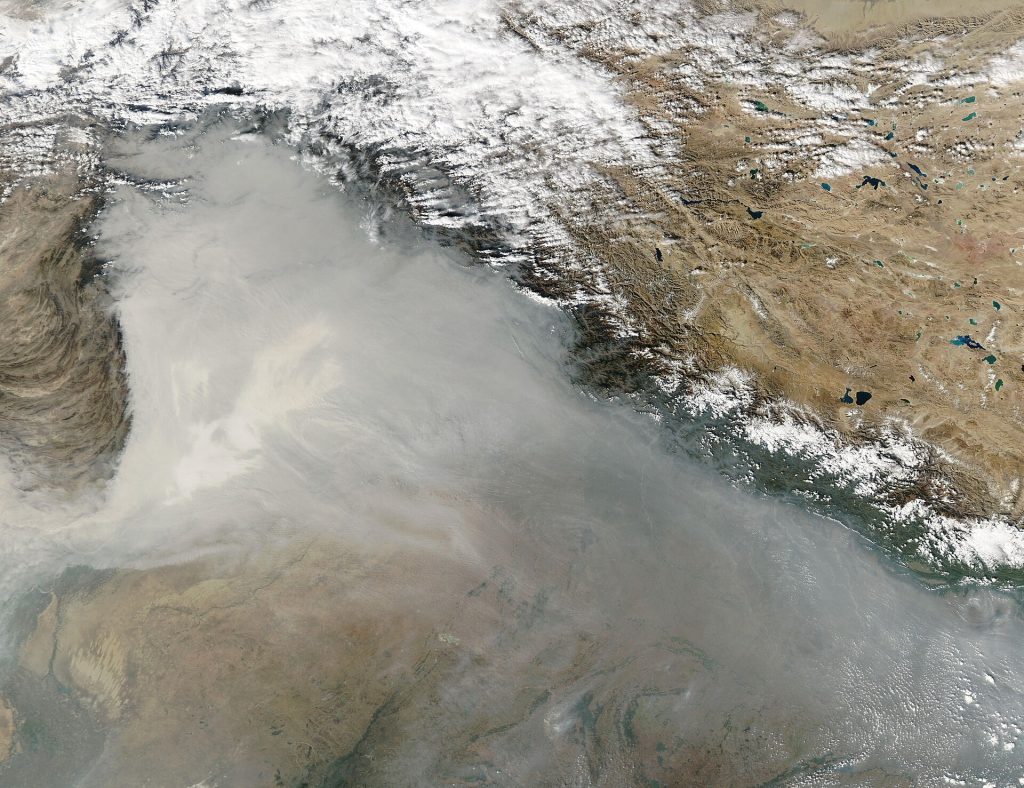
Winter weather makes everything worse. Cold air traps pollution close to the ground, a pattern known as temperature inversion. Instead of rising and dispersing, smoke and exhaust hang over the city like a lid. The same seasonal pattern affects the whole region: Delhi overtook Lahore as the world’s most polluted city just a week ago, showing how the smog belt stretches across the border.
Crop stubble burning adds to the problem. Every autumn, farmers in Punjab burn leftover straw in their fields to clear them quickly for the next crop. The smoke drifts across the province and into the cities. Earlier this month, Punjab sent a 750-member squad to douse stubble fires in an attempt to cut this source of smoke at its root.
Rapid, unplanned growth has made the city more vulnerable. Lahore has grown into a sprawling metropolis of more than 13 million people, with rising vehicle numbers, construction dust and industrial zones pressing in on residential areas. Green cover has shrunk as the city has spread, leaving fewer trees to filter the air.
The crackdown, and why it is not working
The Punjab government has not been idle. The Punjab Environment Protection and Climate Change Department has been running an intensified enforcement campaign against polluters, with a particular focus on brick kilns that burn low-grade fuel and operate without filters.
The scale of the campaign is large. According to departmental figures, enforcement teams conducted 84,370 inspections of brick kilns across the province between 1 January and 18 November 2026. They demolished 1,429 units, sealed 968 and registered 1,248 first information reports (FIRs) against violators. Fines totalling Rs178 million were also imposed.
The effort has been even more concentrated during the smog season. During the critical period from 1 September to 18 November, the department conducted 29,999 visits, demolished 519 kilns, sealed 494 and registered 408 FIRs, besides imposing fines totalling Rs101.45 million. In the first 18 days of November alone, teams made 7,509 visits, demolished 101 kilns, sealed 161 and registered 96 FIRs, while imposing fines of Rs27.6 million. On 18 November alone, 552 brick kilns were inspected, 22 demolished and 19 sealed, with 14 FIRs registered and fines of Rs3.5 million imposed.
The department has also introduced repeated inspections to catch kilns that resume polluting practices after an initial enforcement visit. Environment Protection and Climate Change Department Secretary Silwat Saeed has directed sustained field enforcement and coordination to address pollution at its sources, while Director General EPA Punjab Abdullah Nayyar Sheikh has maintained a zero-tolerance approach towards environmental violations.
And yet the air keeps getting worse. That is the uncomfortable fact behind Friday’s readings. Enforcement alone is not fixing a problem driven by millions of vehicles, industrial emissions, construction dust and cross-border smoke. Kilns are only one part of the picture, and demolishing them does not clean the exhaust of the traffic jams on Lahore’s roads or the smoke drifting in from burning fields.
The courts have noticed. The Lahore High Court on Thursday sought a report from its registrar office on a petition seeking implementation of judicial orders issued to curb smog in the province. The petitioner’s counsel argued that the court’s earlier orders had not been implemented and that Lahore had become the world’s most polluted city.
The human cost of dirty air
Behind the AQI numbers is a heavy human and economic toll, set out in a landmark report released last month by the Pakistan Air Quality Initiative (PAQI). The report, titled “Unveiling Pakistan’s Air Pollution: A National Landscape Report on Health Risks, Sources, and Solutions”, is Pakistan’s first harmonised, multi-sector emissions inventory, with a multi-city analysis covering Karachi, Islamabad, Rawalpindi, Lahore and Peshawar.
The report estimated that air pollution cuts life expectancy in Pakistan by approximately 3.9 years and contributes to around 128,000 premature deaths every year. For Lahore specifically, prolonged exposure to current pollution levels could reduce residents’ life expectancy by as much as seven years.
The economic burden is equally stark. The PAQI report put the cost of air pollution at the equivalent of 6.5 percent of Pakistan’s entire GDP, a bill paid in hospital visits, lost working days, lower productivity and early deaths.
The report also offered some hope. It identified measures that could reduce emissions by up to 50 percent if implemented, including cleaner transport, tighter industrial controls and an end to the most polluting brick kiln technology. The question is whether those measures will be taken fast enough to matter.
Smog is already changing daily life
The smog is not just a health story. It is disrupting everyday life across Punjab. The second Test match between Pakistan and Sri Lanka was moved from Lahore to Rawalpindi because of the smog, a decision that underlined how the pollution now interferes even with international sport. The series decider began in Rawalpindi after the venue switch.
Schools have repeatedly closed or shifted to online classes during bad smog spells in recent years, and hospitals report a surge in patients with breathing problems every winter. Flights are delayed when visibility drops, motorways close, and road accidents rise in the thick haze. The NDMA’s smog alert for the coming days is a reminder that the worst of this season may still be ahead, with winter only just beginning.
What happens next
In the short term, there is little relief in sight. Winter is deepening, and the weather patterns that trap pollution over Punjab are expected to persist for weeks. The NDMA has warned districts across Punjab to prepare for continued smog over the next two days, and residents should expect more days with hazardous readings.
For people in Lahore and other affected cities, the practical advice remains the same: stay indoors when the air is at its worst, keep windows shut, wear a proper mask outdoors, and use an air purifier if one is available. Children, older people and anyone with asthma or heart problems should be especially careful.
The longer-term question is whether this year’s smog season will finally force a different response. Punjab’s enforcement campaign shows the government is willing to act against brick kilns, but Friday’s readings show that kilns alone are not the answer. Transport emissions, industrial pollution and stubble burning all need to be tackled at the same time, and that requires investment, planning and coordination across provincial and national lines.
The PAQI report’s finding that emissions could be cut by up to 50 percent shows the crisis is not hopeless. But every winter that passes with Lahore back at the top of the world’s pollution rankings is a winter of lost health, lost years of life and lost money. The city’s air will only improve when the response matches the scale of the problem.
Frequently asked questions
Why is Lahore the most polluted city in the world?
Lahore recorded an AQI of 465 on the morning of 20 November 2026, driven by transport emissions, the largest source of PM2.5 in the city, followed by industry at 28 percent and brick kilns at 17 percent. Winter weather traps pollutants near ground level, making the problem worse each year. The city’s annual average PM2.5 concentration exceeds 110 micrograms per cubic metre, more than 22 times the WHO guideline.
What does an AQI of 465 mean?
An AQI above 300 is classed as hazardous, the worst category on the scale. At 465, the air is dangerous for everyone, not just people with health problems. Authorities advise minimising outdoor activity, keeping windows closed, wearing a protective mask outside and using air purifiers indoors.
Which other cities in Pakistan have hazardous air quality?
On 20 November 2026, Gujranwala recorded an AQI of 661 and Multan 641, both higher than Lahore. Sargodha recorded 289, Sialkot 232, Rahim Yar Khan 228 and Bahawalpur 198. The PAQI report also examines air quality in Karachi, Islamabad, Rawalpindi and Peshawar.
What is the health impact of Lahore’s air pollution?
Prolonged exposure to Lahore’s current pollution levels could reduce residents’ life expectancy by up to seven years, according to the Pakistan Air Quality Initiative. Nationally, air pollution contributes to an estimated 128,000 premature deaths each year, with the highest risks for children, the elderly and people with respiratory or cardiovascular conditions.
What is the government doing about smog in Punjab?
The Punjab Environment Protection and Climate Change Department conducted 84,370 brick kiln inspections between 1 January and 18 November 2026, demolishing 1,429 kilns, sealing 968 and registering 1,248 FIRs, with fines of Rs178 million. The Lahore High Court has also sought a report on whether its earlier orders to curb smog have been implemented, and the NDMA has issued a smog alert for Punjab districts.
Conclusion
Lahore’s return to the top of the world’s pollution rankings on 20 November 2026, with an AQI of 465, is not a surprise. It is the latest chapter in a crisis that repeats every winter and grows a little worse each year. Gujranwala and Multan recorded even higher readings, and the whole of Punjab is now breathing hazardous air.
The numbers behind the crisis are stark: 128,000 premature deaths a year, up to seven years of life expectancy lost for Lahore’s residents, and a cost equal to 6.5 percent of Pakistan’s GDP. The enforcement campaign against brick kilns is real and large, but Friday’s readings show it is not enough on its own. Until transport, industry and stubble burning are tackled together, Lahore’s winters will keep turning grey, and its people will keep paying the price with their health.
Sources
- Dawn: “Lahore once again ranks as world’s most polluted major city as AQI crosses 400”
- IANS: “Pakistan’s Lahore ranked world’s most polluted city once again”
- Nation Press: “Lahore world’s most polluted city again, AQI hits 465 on 20 November”
- The Nation: “Lahore World’s Most Polluted City as AQI Reaches 325”
- Dawn: “LHC seeks report in smog case”
- Dunya News: “NDMA issues smog alert for several Punjab districts over next two days”
