
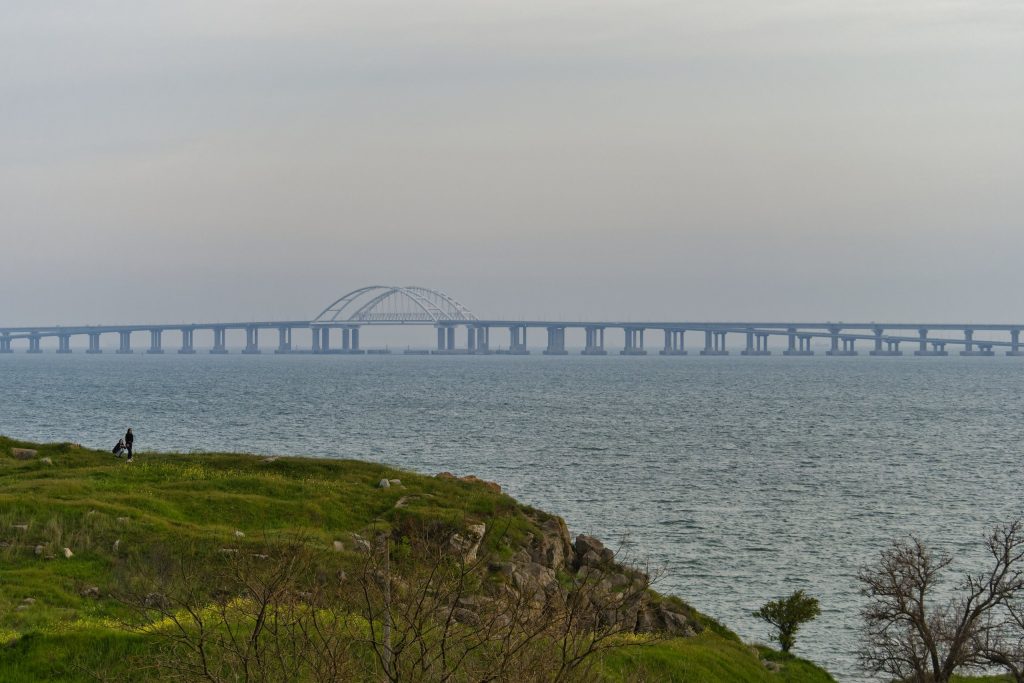
Ukraine Strikes Crimea Bridge in 1,336-Drone Barrage as Traffic Halts Across the Kerch Strait
Ukraine has struck the Crimea Bridge, the 19-kilometre crossing that links Russian-annexed Crimea to mainland Russia, in one of the largest drone attacks of the war. Traffic across the bridge was halted in the early hours of Monday, 16 November 2026, leaving around 2,000 cars stuck in queues and delaying trains to the peninsula, as Russia said its air defences had shot down 1,336 Ukrainian drones overnight.
The strike came just three days before the leaders of Russia, the United States and China are due to meet in Shenzhen for their first-ever three-way summit, and as peace talks between Russia and Ukraine continue in Abu Dhabi. It is the fourth time Ukraine has hit the bridge since Russia launched its full-scale invasion in February 2022.
Here is what happened, what we know about the damage, and why the timing matters.
What happened overnight
The attack began in the early hours of Monday morning. According to the Kerch Bridge operational information channel on Telegram, traffic across the crossing was suspended at around 2:22 a.m. Moscow time.
Sergey Aksyonov, the Russian-installed head of Crimea, confirmed the attack on Telegram a few hours later. “The enemy has hit the Crimea bridge,” he wrote. “As a result, traffic will be restricted, likely until the afternoon.”
Aksyonov said an emergency response headquarters had been set up. He did not say whether anyone was killed or wounded in the strike.
The Russian Telegram channel Mash reported that around 2,000 cars were stuck in a traffic jam on the bridge after the crossing was closed. Four passenger trains travelling to Crimea were also delayed, according to Interfax, citing Grand Service Express, the company that operates the trains.
The pro-Ukrainian monitoring channel Crimean Wind reported that a strike hit one of the arches of the bridge’s navigable span at around 5:38 a.m. local time, and that local residents had seen jet-powered drones and heard explosions in the city of Kerch, on the Crimean side of the strait.
Kyiv has not officially confirmed that it was behind the strike. The Kyiv Independent said it had contacted Ukraine’s Security Service (SBU) and its military intelligence agency (HUR) for information, but had received no confirmation at the time of publication.
The 1,336-drone barrage in numbers
The bridge strike was part of a huge overnight drone attack across Russia. Russia’s Defence Ministry said on Monday that its air defences had intercepted and destroyed 1,336 Ukrainian fixed-wing drones overnight, across 17 Russian regions, occupied Crimea and the waters of the Black Sea and the Sea of Azov.
That figure, if accurate, makes the attack one of the largest Ukrainian drone barrages since the start of the war. According to an AFP tally of official Russian statements, it is the second-highest daily drone figure reported by Moscow so far this year.
The figures have not been independently verified. Russia has in the past reported large numbers of intercepted drones, and independent checks of those claims are rarely possible. But the scale of the attack was also reflected in reports from Moscow itself: the city’s mayor, Sergey Sobyanin, said air defences had intercepted around 600 drones approaching the capital overnight and into Monday morning.
Ukraine has stepped up long-range drone attacks on Russian territory in recent months, targeting oil refineries, airfields, energy infrastructure and transport links. The attacks are designed to put pressure on Russia’s war effort and to show that the war is reaching deep inside Russian-held territory, not just the front lines in eastern Ukraine.
How much damage was done?
The honest answer is that we do not yet know for certain. The early signs suggest the damage to the bridge was limited, but the full picture may take time to emerge.
Several news agencies, including AFP, reported that the strike on the bridge appeared to inflict only minor damage. Social media channels close to the Russian army also indicated that no serious damage had been sustained, according to the reports.
However, Russian media also carried an unverified claim that the warhead of one of the drones had fallen onto the bridge’s right-hand arch on the Crimean side, and that the impact had caused the structure to shift visibly by around 15 degrees. That claim has not been independently verified, and no official source has confirmed it.
The fact that traffic was restricted for most of the day suggests the authorities wanted time to inspect the bridge properly before reopening it. Aksyonov said restrictions would remain in place “likely until the afternoon”, while earlier he had said they would last until around midday.
The uncertainty is normal after an attack like this. After previous strikes on the bridge, it took days for the real extent of the damage to become clear, and both sides have strong reasons to play down or play up the impact. Ukraine has an interest in showing the attack succeeded. Russia has an interest in showing that its most symbolic bridge is still standing.
Why the Crimea Bridge matters
The Crimea Bridge, also known as the Kerch Bridge, is far more than a road and rail crossing. It is 19 kilometres (12 miles) long, making it the longest bridge in Europe, and it connects Russia’s Krasnodar region with the Crimean Peninsula across the Kerch Strait.
Russia built the bridge after it annexed Crimea from Ukraine in 2014, and it opened to road traffic in 2018. For Moscow, the bridge is a symbol of its claim over Crimea: a physical link between the peninsula and the Russian mainland, carrying road and rail traffic, fuel and military supplies.
For Ukraine, the bridge is a legitimate military target. It is a key supply route for Russian forces in Crimea and in southern Ukraine, carrying troops, weapons and equipment to the front lines. Cutting it, even temporarily, disrupts those supplies and forces Russia to rely on slower land routes through occupied southern Ukraine.
The bridge is also heavily defended. Russia has stationed air defence systems, patrol boats and barriers around it, and has repeatedly said it is protected against attack. The fact that Ukraine keeps managing to hit it, despite those defences, is itself significant.
A bridge attacked before
Monday’s strike is the fourth attack on the bridge since the start of the full-scale war in 2022.
In October 2022, a truck bomb exploded on the bridge, killing several people and causing part of the road deck to collapse into the sea. The bridge was partly closed for months while repairs were carried out.
In July 2023, the bridge was hit again, this time by sea drones. The attack damaged the road section and killed two people, according to Russian officials.
In June 2025, Ukraine’s Security Service said it had carried out an underwater attack on the bridge, using explosives attached to its supports. Russia said the damage was minor.
Each time, Russia has repaired the bridge and reopened it. But each attack has also shown that the crossing, for all its defences, remains vulnerable — and each one has forced Russia to spend time, money and military resources on protecting and repairing it.
The timing: days before the Shenzhen summit
The strike comes at a sensitive moment in the diplomacy around the war. On Thursday, 19 November, President Vladimir Putin of Russia, President Donald Trump of the United States and President Xi Jinping of China are due to hold their first-ever three-way meeting in Shenzhen, on the sidelines of the Asia-Pacific Economic Cooperation (APEC) summit.
China confirmed the meeting on Monday. Beijing said the three leaders would discuss “world peace”. Trump has said he intends to discuss denuclearisation and the Iran war, and US officials say Russia’s war against Ukraine is not expected to be a focus of the talks.
At the same time, US-mediated peace talks between Russia and Ukraine are continuing in Abu Dhabi, where a fresh round of talks took place last week. Ukraine’s President Volodymyr Zelensky has said US negotiators floated the idea of Ukraine giving up its eastern Donbas region in exchange for NATO membership — an idea Kyiv has not accepted.
Against that background, the drone barrage looks like a message as much as a military operation. Ukraine has repeatedly shown that it can strike deep inside Russian-held territory, and hitting the Crimea Bridge days before a summit of the world’s most powerful leaders is a reminder that Kyiv will not be a passive bystander while its future is discussed.
It may also be a warning to Moscow. Russia has been pressing Ukraine to give up territory in exchange for peace. The bridge strike suggests Kyiv is not ready to accept a settlement on Russia’s terms, and that it still has the ability to impose costs on Moscow.
What happens next
In the short term, the key question is how quickly the bridge reopens and how much damage it actually sustained. If the damage is minor, traffic should return to normal within a day or two, and the strike will be remembered mainly for its timing and its scale.
If the damage is worse than Russia has admitted, repairs could take weeks or months, as they did after the 2022 and 2023 attacks. That would force Russia to reroute supplies to Crimea and southern Ukraine through land corridors, which are longer, slower and more exposed to Ukrainian attack.
The wider picture is the drone war itself. Both sides are now launching hundreds of drones in single nights, and the numbers keep growing. Russia’s claim of 1,336 drones intercepted in one night, even if exaggerated, shows how large this campaign has become. Ukraine’s ability to send that many drones at once, including around 600 towards Moscow, shows how far its long-range strike capability has developed since 2022.
For the peace talks, the strike is a reminder of how far apart the two sides remain. Russia wants Ukraine to give up land. Ukraine wants security guarantees that would prevent Russia from attacking again. Neither side is close to accepting the other’s terms, and attacks like Monday’s suggest the fighting will continue while the talking goes on.
Frequently asked questions
What is the Crimea Bridge?
The Crimea Bridge, also called the Kerch Bridge, is a 19-kilometre road and rail bridge across the Kerch Strait, linking Russia’s Krasnodar region with the Crimean Peninsula. Russia built it after annexing Crimea in 2014, and it opened to road traffic in 2018. It is a key supply route for Russian forces in Crimea and southern Ukraine.
How many drones did Ukraine launch?
Russia’s Defence Ministry said its air defences intercepted and destroyed 1,336 Ukrainian drones overnight on 15–16 November 2026. That figure has not been independently verified. According to an AFP tally, it is the second-highest daily figure reported by Moscow this year.
Was anyone hurt in the bridge strike?
Sergey Aksyonov, the Russian-installed head of Crimea, did not say whether anyone was killed or wounded. No casualties have been confirmed by any official source so far.
How badly was the bridge damaged?
The extent of the damage is not yet clear. Early reports said the damage appeared minor, but an unverified Russian media claim said one of the bridge’s arches had shifted by around 15 degrees. Traffic was restricted for most of the day while the bridge was inspected.
Has Ukraine attacked the bridge before?
Yes. The bridge was hit by a truck bomb in October 2022, by sea drones in July 2023, and by an underwater explosives attack in June 2025. Monday’s strike is the fourth attack on the bridge since Russia’s full-scale invasion began.
Why does the timing matter?
The strike came three days before a summit in Shenzhen on 19 November between the presidents of Russia, the United States and China, and while US-mediated peace talks between Russia and Ukraine are continuing in Abu Dhabi.
Conclusion
Ukraine’s strike on the Crimea Bridge on 16 November 2026 was one of the largest drone attacks of the war — 1,336 drones, according to Moscow — and it hit one of Russia’s most heavily defended and most symbolic targets.
The damage appears to have been limited, and the bridge will almost certainly be repaired and reopened, as it has been after every previous attack. But the strike’s real significance may be its timing. Three days before the leaders of Russia, the United States and China meet in Shenzhen, and with peace talks under way in Abu Dhabi, Ukraine has shown it can still reach deep into Russian-held territory and disrupt a crossing Moscow calls unbreakable.
Whether that changes anything at the negotiating table remains to be seen. For now, the bridge is closed, the queues are long, and the war’s drone campaign has reached a new scale.
Sources
- “Ukraine hits Russia’s Crimea bridge in 1,300-drone barrage” — The Hindu
- “Ukraine reportedly strikes Crimean Bridge, forcing temporary traffic halt” — Kyiv Independent
- “Ukraine hits Russia’s Crimea bridge in 1,300-drone barrage” — Channel NewsAsia
- “Ukraine hits Russia’s Crimea bridge in 1,300-drone barrage” — Bangkok Post
- “Crimean Bridge Shut After Ukrainian Strike as Russia Claims 1,336 Drones Downed Overnight” — EuropeSays
- “Ukraine Strikes Crimea-Russia Bridge as Moscow Claims Interception of 1,336 Drones” — Kurdistan24
This article is for general information and education only. It is not legal or financial advice.

Pingback: Ukraine Strikes Crimea Bridge Again — Road Arch Collapses Into the Kerch Strait - Findivoza