
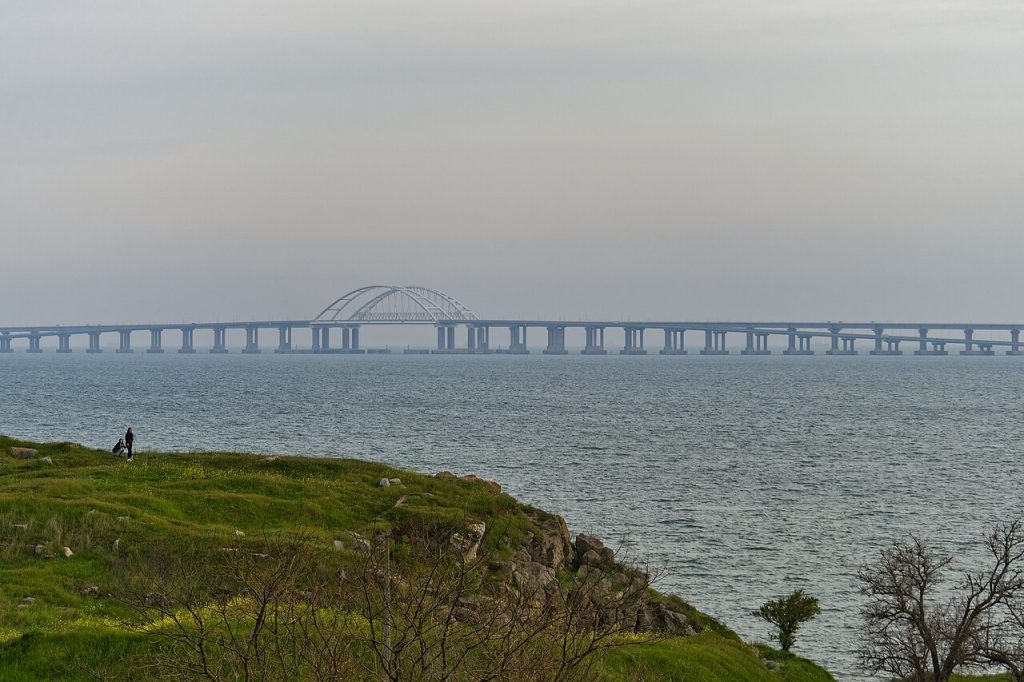
Ukraine Strikes Crimea Bridge Again — Road Arch Collapses Into the Kerch Strait
Ukraine has struck the Crimean Bridge for the second day in a row, and this time part of the bridge has collapsed into the sea. The road arch and a section of roadway fell into the Kerch Strait overnight, in what President Volodymyr Zelenskyy called an “unprecedented” operation that had been prepared over several weeks.
The 19-kilometre bridge is the only direct road and rail link between Russia and the Crimean Peninsula, which Russia annexed from Ukraine in 2014. It carries military and civilian supplies to Crimea and to Russian troops on the front line, which is why Ukraine has targeted it repeatedly since Russia’s full-scale invasion began.
Two people were killed in the strike, according to Crimea’s Russian-installed governor, and traffic across the bridge was suspended. The attack is the most serious damage the bridge has suffered in a single strike, and it comes as both sides trade blows against each other’s infrastructure.
What happened overnight
The attack took place overnight between Monday and Tuesday, 16–17 November 2026. It was the second strike on the bridge in 24 hours: Ukraine had already hit the crossing on Monday in a large drone attack, which halted traffic across the Kerch Strait.
On Tuesday morning, Zelenskyy published video on social media that appeared to show the bridge’s main road arch collapsed into the water, blocking navigation in the strait. Reuters said it could not immediately verify the footage.
Ukraine’s General Staff said the arch and a span of the bridge’s road section had collapsed after being dealt powerful blows, but that the rail part of the bridge was still standing, although its arch was damaged. Ukraine’s Security Service (SBU) confirmed that “one of the metal arches and the automobile span under it were completely destroyed.”
Sergei Aksyonov, the Russian-installed governor of Crimea, said two people were killed in the strike and that traffic across the 19-kilometre (12-mile) road and rail bridge had been suspended. Russia’s Transport Ministry also confirmed that both road and rail traffic had been suspended. Train travel across the bridge resumed on Tuesday after a brief pause, according to Reuters.
There was no official Russian confirmation of the extent of the damage to the bridge. Dmitry Peskov, President Vladimir Putin’s spokesman, said the president had been informed about the attack. Russia’s Investigative Committee said the bridge was attacked by drones and sustained damage, without giving details. A government commission to deal with the consequences of the attack was set up under Deputy Prime Minister Marat Khusnullin.
The weapons Ukraine used
Zelenskyy said the strike was the seventh phase of an operation that had been underway for several weeks, developed and coordinated by the Security Service together with the General Staff of the Armed Forces.
In his words, Ukrainian forces had spent those weeks systematically destroying Russian air defence systems, radar stations and electronic warfare equipment as they worked towards their final target. Only then did they move against the bridge itself.
The final attack used a mix of Ukrainian-made weapons:
- Palianytsia drones struck the road section of the bridge.
- Neptune missiles, along with Ruta drones and FP-5 drones, struck the railway section.
- Flamingo precision-guided missiles delivered the final blow. Zelenskyy said the Flamingo strike was guided with communications working “flawlessly until the final seconds.”
The Flamingo is a Ukrainian-built long-range cruise missile. Denys Shtilerman, co-founder and chief engineer of Fire Point, the company that produces the missile, appeared to confirm its use in the overnight strike in a post on social media. Monitoring channels reported at least 15 strikes on the crossing overnight.
Why the bridge matters so much
The Crimean Bridge, also known as the Kerch Bridge, is one of the most important pieces of infrastructure in the war. It stretches 19 kilometres across the Kerch Strait, which connects the Black Sea and the Sea of Azov, joining Russia’s Krasnodar region with Crimea.
For Russia, the bridge is the main supply route to Crimea and to its forces fighting in southern Ukraine. Fuel, ammunition, equipment and troops all move across it, along with civilian traffic. Cutting the road link forces Russia to move supplies by sea or by land through occupied territory in southern Ukraine — both slower and more exposed to attack.
For Ukraine, the bridge is also a symbol. It is a flagship project closely associated with President Vladimir Putin, built after Russia annexed Crimea in 2014. Hitting it is both a military blow and a message: that no Russian asset, even one so heavily defended, is out of reach.
That is why the bridge has been a target since the beginning of Russia’s full-scale invasion. Each attack has forced Russia to spend more on air defences around the crossing and to repair damage while keeping supplies moving.
The latest strike appears to have done more damage than previous ones. The road section — the part used by cars, buses and trucks — has lost an arch and a span. The railway, which carries heavier military cargo, is still standing but damaged. If the road link stays closed for long, the pressure on Russia’s other supply routes will grow.
Why Ukraine hit the bridge now
Zelenskyy was clear about the reason for the strike: retaliation. “Russia strikes our infrastructure every day, including bridges,” he said in a post on X.
Russia has been pounding Ukraine’s power grid, railways and bridges for weeks as winter approaches. On the same night Ukraine hit the Crimean Bridge, Russian ballistic missiles struck two of Kyiv’s main bridges. The Southern Bridge in Kyiv was damaged in a Russian missile strike on Tuesday.
The timing also matters for the wider war. Peace talks have been taking place in Abu Dhabi, and both sides have been trying to strengthen their positions before any deal. A successful long-range strike shows Ukraine can still hit high-value targets deep inside Russian-held territory, even after nearly five years of war.
The operation also shows how Ukraine’s home-grown weapons industry has developed. The drones and missiles used in the attack — Palianytsia, Neptune and Flamingo — are all domestically developed systems. Ukraine has been building up its own long-range strike capability as Western supplies have become less certain.
Russia’s response
Russia’s immediate response was to hit back in the air. Its Defence Ministry said air defences had shot down 1,441 Ukrainian drones during a second straight night of major Ukrainian attacks — a record number, according to Russian officials. The figure could not be independently verified.
Russia also continued its missile strikes on Ukrainian cities. The ballistic missiles that hit two bridges in Kyiv were part of a wider overnight barrage on the capital’s infrastructure.
Moscow has not said how long repairs to the Crimean Bridge will take, or how it will move supplies to Crimea in the meantime. The government commission under Deputy Prime Minister Khusnullin is assessing the damage. Specialists were still examining the bridge on Tuesday, and according to preliminary information from the Russian side there were no further casualties beyond the two deaths reported by Aksyonov — although Ukrainian and Russian accounts of the damage differ, and the full picture may take days to emerge.
What happens next
Three questions will decide what this strike means for the war.
First, how long will the road link stay closed? If engineers can repair the collapsed span quickly, the disruption may be brief. If the damage is worse than it looks, Russia’s supply lines to Crimea and southern Ukraine will be squeezed for weeks.
Second, can Russia protect the bridge from another attack? Ukraine spent weeks wearing down the air defences around the crossing before striking. Russia will now have to rebuild those defences while also guarding against a repeat — and Ukraine has shown it is willing to return to the same target.
Third, will the cycle of strikes on infrastructure escalate? Both sides are now hitting bridges, power stations and railways almost every night. With winter coming, attacks on energy infrastructure in particular could leave millions of people without heat and light. The Crimean Bridge strike may be answered with heavier Russian attacks on Ukrainian cities, just as Ukrainian cities are already being hit.
For now, the images of the collapsed arch in the Kerch Strait are a reminder of how far this war has spread from the front lines — and how neither side is willing to stop striking at the other’s lifelines.
Frequently asked questions
What is the Crimean Bridge?
The Crimean Bridge, also called the Kerch Bridge, is a 19-kilometre (12-mile) road and rail bridge across the Kerch Strait, linking Russia’s Krasnodar region with the Crimean Peninsula, which Russia annexed from Ukraine in 2014. It is the only direct land link between Russia and Crimea.
What happened to the bridge on 17 November 2026?
Ukraine struck the bridge for the second day in a row overnight. The road arch and a section of roadway collapsed into the Kerch Strait, according to Ukraine’s General Staff and the Security Service. The railway section was damaged but remained standing, and train travel resumed after a brief pause.
How many people were killed?
Two people were killed in the strike, according to Sergei Aksyonov, the Russian-installed governor of Crimea.
What weapons did Ukraine use?
President Zelenskyy said the attack used Ukrainian-made Palianytsia drones against the road section, Neptune missiles and Ruta and FP-5 drones against the railway, and Flamingo precision-guided missiles for the final blow. He described it as the seventh phase of an operation prepared over several weeks.
Why did Ukraine attack the bridge?
Zelenskyy said it was retaliation for Russian strikes on Ukrainian infrastructure, adding that “Russia strikes our infrastructure every day, including bridges.” The bridge is also Russia’s main supply route to Crimea and its forces in southern Ukraine.
Has the bridge been attacked before?
Yes. The bridge has been a target of Ukrainian attacks since the beginning of Russia’s full-scale invasion, and it was struck by drones the day before this attack, on 16 November. The 17 November strike appears to have caused more serious damage than previous attacks.
Is the bridge still usable?
Road traffic was suspended after the attack, and the road arch and a span have collapsed. Rail traffic was also suspended at first but resumed on Tuesday after a brief pause, according to Reuters. The full extent of the damage has not been officially confirmed by Russia.
Conclusion
The collapse of the Crimean Bridge’s road arch is the most damaging single strike on the crossing since the war began. It severs, for now, the road link Russia relies on to supply Crimea and its southern front, and it shows Ukraine’s growing ability to hit heavily defended targets with its own long-range weapons.
Whether the damage lasts will depend on how fast Russia can repair the bridge and rebuild its air defences around it. But the message of the strike is already clear: after nearly five years of war, neither side has run out of targets — or of the will to hit them.
This article is for general information and education only. It is not legal or financial advice.
Sources
- Reuters (via KTWB) — “Ukraine damages Crimean bridge in major strike as Russia pounds Kyiv bridges”
- Associated Press (via NPR Illinois) — “Ukraine strikes major Russian bridge with drones and missiles as aerial attacks escalate”
- Al Jazeera — “Ukraine drone attack kills two in Crimea as Kyiv targets bridge to Russia”
- Kyiv Independent — “Entire section of Crimean Bridge collapses after ‘seven-phase operation,’ Zelensky reveals”
- The New Voice of Ukraine — “Zelenskyy confirms Crimean Bridge strike with Flamingo and Neptune missiles, releases video”
This article is for general information and education only. It is not legal or financial advice.

Pingback: EU Sanctions Russia's Richest Woman: Wildberries Founder Tatyana Kim Targeted Over Alleged Military Supply Links - Findivoza