
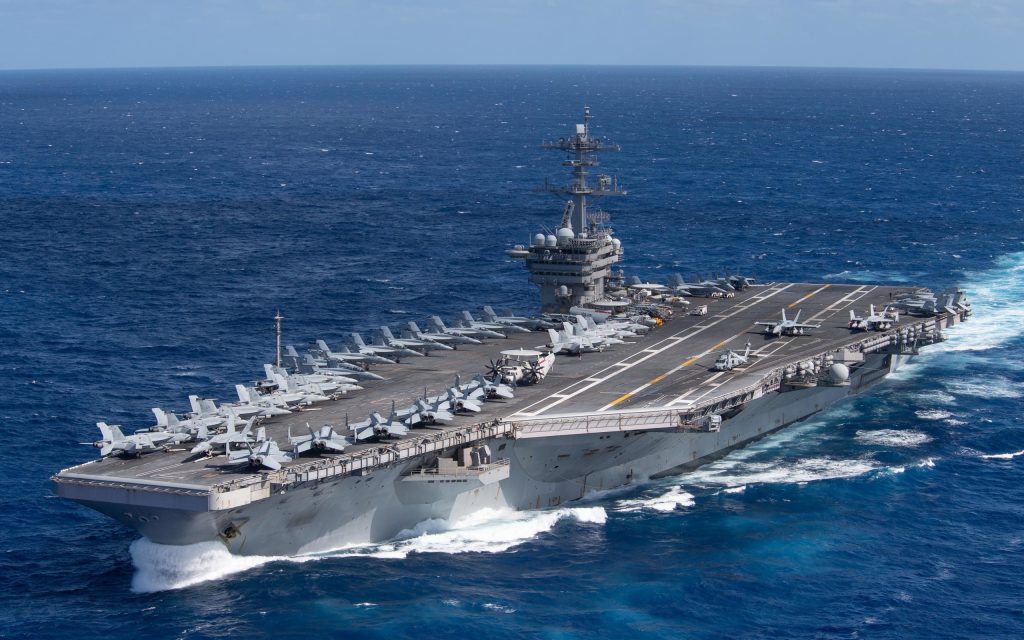
USS Theodore Roosevelt Arrives in the Middle East as US Builds Up Three Carrier Groups Near Iran
The United States has moved a third aircraft carrier into the Middle East, giving Washington its largest naval force in the region in months — just as diplomacy to end the war with Iran stalls and attacks on shipping and Gulf bases pick up again.
The USS Theodore Roosevelt arrived in the region on Sunday, 15 November, according to US officials who spoke to Al Jazeera and The National. It joins two other American carrier strike groups already operating there, the USS George Washington and the USS George H.W. Bush.
The Pentagon and US Central Command (CENTCOM), which runs American military operations in the region, have not formally confirmed the carrier’s arrival. But the reports, from two separate officials, point to a major build-up at a moment when both sides say they want peace — and both sides are also preparing for the possibility of more fighting.
What happened on Sunday
According to a US official who spoke to Al Jazeera on Monday, the USS Theodore Roosevelt had arrived in the Middle East. The National reported the same news, citing a US official who said the carrier arrived on Sunday.
Its arrival brings the total number of US aircraft carrier strike groups in the CENTCOM area of responsibility to three. A carrier strike group is not just one ship: it is a carrier plus its escort warships, its air wing of fighter jets, and thousands of sailors, all sailing together as a single fighting force.
The Roosevelt’s arrival is not a routine rotation. The carrier had been expected to relieve — in other words, replace — the USS George Washington, which has been in the region since August. But the George Washington is still there for now, which means the US has three carriers in the region at the same time instead of two.
The Roosevelt left its home base in San Diego in September. It stopped in Singapore for a port visit on 6 November, then crossed the Indian Ocean towards the Middle East.
Meet the USS Theodore Roosevelt
The USS Theodore Roosevelt, known by its hull number CVN-71, is one of the largest warships in the world. It is named after Theodore Roosevelt, the 26th president of the United States.
The ship is nuclear-powered, which means it can sail for years without refuelling. It was commissioned into the US Navy in 1986, making it one of the older carriers still in service — but it has been modernised many times since.
More than 5,000 sailors and aircrew serve on board, and the ship carries an air wing of more than 60 aircraft, including F-18 fighter jets. The carrier can also resupply other ships at sea and rescue people, including refugees, in trouble on the water.
The Roosevelt is no stranger to combat. It flew missions during the 1990–91 Gulf War and supported US strikes during the Iraq War in 2003, and it has served across the Asia-Pacific region in exercises with allied navies.
Sailing with the Roosevelt this time are the guided-missile cruiser USS Chosin and the destroyers USS Paul Hamilton and USS Decatur, along with Carrier Air Wing 11, the ship’s embarked squadron of jets and support aircraft. That is the standard make-up of a carrier strike group: the carrier provides the air power, while the cruisers and destroyers protect it and add their own missiles.
How big is this force now?
Three carrier strike groups in one region is rare. It gives the US a combined force of hundreds of aircraft and tens of thousands of sailors and Marines within striking distance of Iran.
The build-up goes beyond the carriers. Last month, a US official told Al Jazeera that the Makin Island Amphibious Ready Group, carrying more than 2,000 Marines, had also followed the Roosevelt towards the Middle East. The Wall Street Journal reported that the carrier and naval deployments could involve an additional 9,000 to 10,000 US service members in total, including sailors and Marines. The US military has not confirmed those figures.
The carriers are the tip of a much larger American presence. As of mid-2025, there were between 40,000 and 50,000 US soldiers stationed in and around the Middle East, including at eight permanent bases in Bahrain, Egypt, Iraq, Jordan, Kuwait, Qatar, Saudi Arabia and the United Arab Emirates.
The air build-up has been even bigger. According to open-source intelligence analysts and military flight-tracking data cited by Al Jazeera, the US has deployed more than 120 aircraft to the region since early February, before the war with Iran began. That is the biggest surge in American airpower in the Middle East since the Iraq War. The aircraft include E-3 Sentry early-warning planes, F-35 stealth fighters, F-22 air superiority jets, and F-15 and F-16 fighters.
In March, the Pentagon ordered further reinforcements to the Gulf: two Marine groups built around the assault ships USS Tripoli and USS Boxer, adding 4,500 Marines and sailors, plus about 2,000 soldiers from the 82nd Airborne Division. In total, nearly 7,000 additional troops have been deployed to the Middle East since the war with Iran began.
Why now? Attacks on Bahrain and on shipping
The Roosevelt’s arrival comes at a tense moment. On Sunday, the same day the carrier arrived, Iran attacked a base in Bahrain that hosts US military assets.
The Islamic Revolutionary Guard Corps (IRGC), Iran’s powerful military force, said it launched drones towards the site. It also claimed to have destroyed a US early-warning radar in Bahrain. Bahrain’s military said its air defences had intercepted the drones, and the claim that the radar was destroyed has not been confirmed.
Shipping in the Gulf has also come under attack. Iranian state television said five vessels had struck mines and caught fire within 48 hours, without identifying the ships. The UK Maritime Trade Operations agency said Indian shipping authorities had reported an attack on a tanker in the Gulf, and that the crew were safe, although the extent of the damage was unknown. Read our earlier report on the tanker attacks in the Strait of Hormuz and Pakistan’s call for the UN Security Council to protect Gulf shipping.
The Strait of Hormuz, the narrow waterway between Iran and Oman, is one of the most important shipping routes in the world. Around a fifth of the world’s seaborne oil passes through it. When mines appear in the strait and tankers catch fire, oil prices rise, insurance costs jump, and shipping companies think twice about sending their vessels through. That is why the carrier deployment matters for people far from the Gulf: a wider war could push up fuel prices, disrupt trade and shake stock markets around the world — including in Pakistan, which imports almost all of its oil.
A war that never quite ended
To understand why three American carriers are now sitting off Iran’s coast, it helps to look back at how this conflict began.
The war started on 28 February 2026, when the US launched an attack against Iran, aimed at its nuclear programme. What followed was the heaviest fighting between the US and Iran in decades.
In April, the two sides agreed to a two-week ceasefire, and in June they announced a broader memorandum of understanding — a written agreement setting out the terms for a longer peace. That agreement collapsed in early July, and since then the region has been stuck in a dangerous middle ground: no full-scale war, but no real peace either.
Mediators from Pakistan and Qatar have been working since then to stop the fighting from returning in full. Pakistan has continued to push for dialogue. But the talks have stalled, and the dispute over the Strait of Hormuz — which Iran has sought to close to shipping — remains unresolved.
What each side is saying
The public messages from Washington have been mixed. Last week, after a meeting at the White House with Qatar’s prime minister, President Donald Trump said further military strikes against Iran were “quite unlikely” and declared that the military part of the war was “effectively over”. At the same time, he said the US military remains “locked and loaded” if conditions change.
Secretary of State Marco Rubio has argued that Washington’s economic pressure campaign against Iran is working, so a return to large-scale military operations is probably unnecessary. “The economic pressure on Iran is going to get even worse,” he said.
But Trump has also sounded impatient. Last week he said he had told his lead negotiator, Vice President JD Vance, “We don’t need a deal with Iran.” On his Truth Social platform, he wrote: “Those days have long since passed. We’ve got their money, Hundreds of Billions of Dollars, and we’ve got their Strait!”
Iran, for its part, has set out clear conditions for ending the war: an end to the US naval blockade of Iran’s ports, the lifting of economic sanctions, the release of Iranian funds frozen abroad, an end to fighting on all fronts, and a formal declaration that the war is over.
Iran’s parliamentary speaker and chief negotiator, Mohammad Bagher Ghalibaf, told Al Jazeera last week that Tehran had sent seven conditions for a deal through a Qatari mediator and was waiting for an official US response. Iranian officials have underlined in recent days that Tehran will not accept the current state of “no war, no peace”.
Iran’s deputy foreign minister, Kazem Gharibabadi, warned that his country “will not wait for the US to attack first”. He accused Washington of using diplomacy to buy time to prepare another attack, and said: “Iran is not Cuba that you can blockade, nor is it Venezuela that you can force to surrender.” He added that US forces “have had no success with either an air blockade or a land blockade” in Iran so far, and said the IRGC is now producing missiles with “new ranges”.
Diplomacy is still alive — barely
Despite the build-up and the threats, the talking has not stopped.
Iran’s Foreign Minister, Abbas Araghchi, was in Islamabad on Monday for a meeting of the Economic Cooperation Organisation (ECO), where he called for stronger regional energy cooperation and warned that US attacks threaten stability across the Middle East.
Araghchi is due to visit Muscat on Tuesday for talks with his Omani counterpart. Oman has often acted as a go-between for the US and Iran, and the trip is another sign that back-channel diplomacy is still going on even as warships gather.
Meanwhile, Trump is expected to meet Russia’s President Vladimir Putin and China’s President Xi Jinping this week in Asia, at a trilateral summit in Shenzhen on Thursday, 19 November. Read our report on the Shenzhen summit. The Iran crisis is almost certain to be part of those conversations.
What happens next
The honest answer is that nobody knows — and that is what worries analysts most.
Ali Vaez, the International Crisis Group’s deputy programme director for the Middle East and North Africa, told Al Jazeera that both sides are caught in a “perilous game of chicken”, each convinced that striking first may be safer than waiting to be struck.
“The danger is that their efforts to deter another war could inadvertently ignite one that neither can win, contain or easily end,” he said. “Diplomacy still has a pulse, but it is suffocating under the weight of mutual mistrust and maximalist demands. Unless both sides find a face-saving exit, negotiations risk becoming little more than an intermission between successive rounds of warfare.”
Rashid al-Mohanadi, vice president at the Center for International Policy Research, said the main issues now are sequencing and leverage — who does what, when, and how. “The Iranians perceive they have more leverage. The Americans perceive they have more,” he said. “When you have a situation like that, reaching a diplomatic end is quite difficult.”
Frequently asked questions
Why has the US sent a third aircraft carrier to the Middle East?
The USS Theodore Roosevelt arrived in the region on 15 November, joining the USS George Washington and USS George H.W. Bush. The US says the deployment strengthens its naval presence while diplomacy with Iran is stalled and attacks on Gulf shipping continue. The carrier was originally meant to replace the George Washington, but that ship is still in the region, creating a temporary three-carrier line-up.
How many US aircraft carriers are now near Iran?
Three carrier strike groups: the USS Theodore Roosevelt, the USS George Washington and the USS George H.W. Bush. Each group includes a carrier, escort warships and an air wing. The Pentagon has not formally confirmed the Roosevelt’s arrival.
What is a carrier strike group?
It is a carrier sailing with its escort ships — usually a guided-missile cruiser and several destroyers — plus its air wing of fighter jets and support aircraft. The Roosevelt’s group includes Carrier Air Wing 11, the cruiser USS Chosin and the destroyers USS Paul Hamilton and USS Decatur.
Is the US about to attack Iran again?
There is no public sign of an imminent attack. President Trump said last week that further strikes were “quite unlikely” and the military part of the war was “effectively over”, but he also said US forces remain “locked and loaded”. Analysts warn that with both sides armed and mistrustful, a miscalculation could restart the fighting.
What does Iran want in return for a deal?
Iran’s conditions include an end to the US naval blockade of its ports, the lifting of sanctions, the release of frozen Iranian funds, an end to fighting on all fronts, and a formal declaration that the war is over. Tehran says it will not accept the current “no war, no peace” situation.
Why does the Strait of Hormuz matter?
About a fifth of the world’s seaborne oil passes through this narrow strait between Iran and Oman. Attacks on tankers and mines in the waterway push up oil prices and shipping costs, which affects fuel prices and economies far beyond the Gulf, including Pakistan’s.
Conclusion
The arrival of the USS Theodore Roosevelt is the clearest sign yet that the US-Iran confrontation is entering a new and dangerous phase. Three carrier strike groups now sit within reach of Iran — even as both sides insist they would rather talk than fight.
The diplomacy has not died. Mediators in Pakistan, Qatar and Oman are still working, Iran has put written conditions on the table, and a summit between the US, Russian and Chinese leaders this week could change the picture. But the gap between the two sides is wide: Washington wants to keep the economic pressure on, and Tehran wants the blockade and sanctions gone before it will call the war over.
Until one side blinks, the carriers will stay — and the Gulf will remain on edge.
Sources
- Al Jazeera, “USS Roosevelt arrives in Middle East: Is the US-Iran war about to resume?”
- The National, “USS Theodore Roosevelt aircraft carrier arrives in Middle East”
- Army Recognition, “U.S. Masses Three Aircraft Carrier Strike Groups Near Iran as USS Roosevelt Arrives”
This article is for general information and education only. It is not legal or financial advice.

Pingback: Iraq Orders Army Into Kataib Hezbollah Stronghold in Oil Smuggling Crackdown - Findivoza
Pingback: Bahrain Sentences 64 Shia Clerics to Life in Prison Over Iran-Linked Terror Plot - Findivoza
Pingback: US and Venezuela Sign Military Deal as Hegseth Makes Surprise Visit to Caracas - Findivoza