
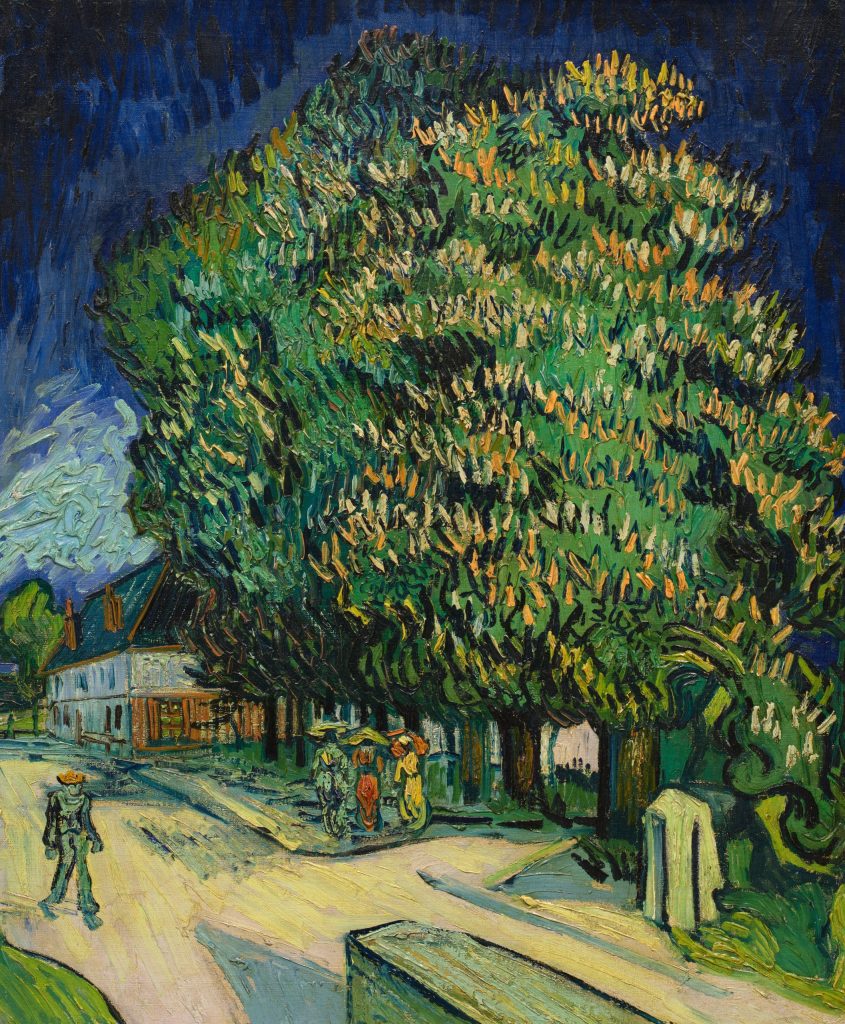
Van Gogh’s $180 Million ‘Blossoming Chestnut Trees’ in Doubt as Heirs Challenge 1936 Nazi-Era Sale
One of the most valuable paintings ever offered at auction may not reach the auctioneer’s hammer at all. Vincent van Gogh’s Châtaigniers en fleurs — Blossoming Chestnut Trees — is due to be sold at Sotheby’s in New York on Wednesday, 18 November 2026, with a reported value of about $180 million. If it sells for anything close to that figure, it will break the auction record for a Van Gogh by more than $60 million.
But just days before the sale, the descendants of the painting’s former Jewish owners have asked Sotheby’s to withdraw it. They say the work was sold under duress in 1936, after their family fled Nazi Germany. Sotheby’s says its research has not established that the 1936 sale was forced — and lawyers for both sides were due to meet in New York on Monday to try to find a solution.
The row has turned what was meant to be a celebration of the art market’s biggest week into a test of how the art world handles the darkest chapter of its own history.
A $180 million painting, two days from the hammer
The painting is the star lot of Sotheby’s “Legendary: The Blaquier-Arrieta Collection” evening auction, which takes place in New York on Wednesday, 18 November 2026, at 6pm local time. The sale offers 12 Impressionist and modern masterpieces from a single private collection, with a combined value expected to reach about $450 million.
Van Gogh painted Châtaigniers en fleurs in Auvers-sur-Oise, France, in May 1890 — about two months before his death at the age of 37. The oil-on-canvas work, measuring 70 by 58 centimetres, shows a great chestnut tree in full blossom against a deep blue sky, with a village street and small figures below. It is one of the last paintings Van Gogh ever made.
The current auction record for a Van Gogh stands at $117.2 million. That was set in November 2022, when Verger avec cyprès (Orchard with Cypresses), painted in Arles in 1888, sold at Christie’s in New York as part of the collection of Microsoft co-founder Paul Allen. A sale at $180 million would beat that record by more than $60 million.
Sotheby’s has also guaranteed the painting, promising the seller a minimum price if the bidding falls short. The amount of that guarantee has not been made public.
The Blaquier-Arrieta sale is the centrepiece of New York’s autumn auction week, in which total sales are projected at about $2.4 billion. The same sale also includes a Paul Cézanne portrait, Arlequin, valued at about $120 million, which could break Cézanne’s own auction record of $137.8 million, set by La Montagne Sainte-Victoire in the 2022 Paul Allen sale.
The painting’s journey: from Berlin to Buenos Aires
To understand the dispute, it helps to follow the painting’s journey through the twentieth century.
The work entered the collection of Samuel Fischer in 1909, when the prominent German publisher bought it from a gallery in Paris. Fischer founded the S. Fischer publishing house in Berlin, one of Germany’s most important literary publishers, and built a notable art collection.
When the Nazis came to power in Germany in 1933, Jewish families like the Fischers faced growing persecution. The family fled Berlin, and the painting was left with art dealers. Records show that it was sold in June 1936 for 68,000 Swiss francs — about $22,000 at the time — to a collector in Paris.
From there, the painting passed through several owners before it was bought in 1975 by the Argentine collectors Carlos Pedro Blaquier and Nelly Arrieta de Blaquier. It has spent the past half-century in their private collection and has not been on public display for decades.
Carlos Pedro Blaquier died in 2023 and Nelly Arrieta de Blaquier in 2020. Their heirs decided this year to sell the collection, which the couple had assembled over decades. Sotheby’s unveiled the paintings in London on 30 September 2026, and the Van Gogh appeared on the cover of the sale catalogue.
What the heirs are saying
The Fischer family’s descendants say the 1936 sale was not a free choice. Their lawyer, Gunnar Schnabel, wrote to Sotheby’s restitution department asking the auction house to withdraw the painting from Wednesday’s sale.
The heirs argue that the family’s circumstances under Nazi persecution were directly connected to the sale. The Nazis restricted what Jews were allowed to take with them when leaving Germany, and the Fischer family was forced to pay the “Reich flight tax” — a punishing levy imposed on Jews emigrating from the country. The family’s publishing business had also suffered heavy losses under Nazi rule.
In his letter, Schnabel challenged Sotheby’s to prove two things: that the painting was sold at fair market value in 1936, and that the family would have sold it even if the Nazis had never come to power. “Otherwise,” he wrote, “no auction may take place.”
Schnabel has said his clients are prepared to work towards “a fair and just solution under the Washington Principles” — the international guidelines agreed in 1998 for handling claims involving Nazi-confiscated art.
The family has pursued restitution before. According to Sotheby’s, the heirs previously recovered works that were sold in a forced sale in 1938 — but they never recovered the works sold in 1936, including this Van Gogh.
What Sotheby’s says
Sotheby’s has acknowledged the claim and says it has researched the painting’s ownership history in depth. But the auction house says that research has not established that the 1936 sale was a forced sale.
“While our research to date has not established that the painting was sold under duress, we recognize the importance of engaging thoughtfully and constructively with the family and are committed to working toward a mutually satisfactory resolution,” Sotheby’s said in a statement.
The auction house’s case rests on the details of the 1936 transaction. According to information Sotheby’s shared with the art press, archives from the art dealer Paul Cassirer confirm that the painting sold for 68,000 Swiss francs in June 1936. Sotheby’s considers that a strong price for a Van Gogh at the time. Its legal representative, Luke Nikas, confirmed that the painting was sold to an independent buyer at fair market value.
As of Monday, Sotheby’s had not said whether the painting would remain in Wednesday’s auction as scheduled. Lawyers for the auction house and the heirs were expected to meet in New York on Monday to discuss a possible settlement.
Why the 1936 sale is so hard to judge
The dispute turns on a difficult legal question: can a painting sold outside Nazi Germany, to an independent buyer, at what appears to be a fair price, still count as a forced sale?
The heirs’ argument is that the sale cannot be judged on price alone. Even if the money was fair, they say, the family only sold because Nazi persecution had destroyed their business and forced them to flee, paying heavy taxes to leave. In their view, the pressure of persecution is what caused the sale, and that makes it a sale under duress.
Sotheby’s argument is that the facts of the transaction matter. The painting was consigned to a gallery in Amsterdam and sold to a collector in Paris — outside Germany — to a buyer with no connection to the Nazi regime, at a price the auction house describes as strong for the time. In Sotheby’s view, that points to a voluntary sale, not a forced one.
Courts in the United States have wrestled with similar questions before, and the results have been mixed:
- In Zuckerman v. Metropolitan Museum of Art in 2018, a federal judge ruled that a 1938 sale did not meet the legal standard for duress. An appeals court upheld the dismissal in 2019, partly because of the delay in bringing the claim.
- In Bennigson v. Solomon R. Guggenheim Foundation in 2024, a New York judge found that economic pressure from Nazi persecution alone was not enough to establish duress without some contribution from the buyer.
These cases show why the Van Gogh dispute is so finely balanced. Neither side has a clear-cut win, which is why a negotiated settlement — rather than a court battle — may be the most likely outcome.
The law that changed the rules
One reason the heirs have been able to press their claim now, ninety years after the sale, is a change in American law.
In April 2026, the United States Congress amended the Holocaust Expropriated Art Recovery (HEAR) Act. The amendment removed laches — a legal defence that allowed courts to throw out restitution claims simply because too much time had passed since the original sale.
Before that change, the delay in bringing a claim was often enough to defeat it, as happened in the Zuckerman case. Now, heirs can pursue claims over artworks sold during the Nazi era even decades later, and courts must consider the facts of the sale itself rather than dismissing the case for lateness.
The Washington Principles, agreed by 44 countries in 1998, add a moral dimension. They call on museums and collectors to identify art confiscated by the Nazis and to reach “a just and fair solution” with the families who lost it. The principles are not legally binding, but they carry real weight in the art world — and the Fischer heirs have invoked them directly.
A record-breaking week at stake
Beyond the legal arguments, there is a great deal of money at stake.
The Blaquier-Arrieta collection is one of the most valuable single-owner sales ever offered. Its 12 works are expected to bring about $450 million, and the Van Gogh alone accounts for about $180 million of that total. The sale could set new auction records for both Van Gogh and Cézanne on the same night.
For Sotheby’s, the stakes are high. The auction house has invested heavily in promoting the sale, sending the paintings on a tour of Hong Kong and Taipei before they arrived in New York. A withdrawal of the star lot — or a public legal fight on the eve of the sale — would be a serious blow to the most important auction of the season.
The sale has drawn attention for another reason too. A Guardian investigation linked the collection’s late owner, Carlos Pedro Blaquier, to the alleged disappearance of civilians during Argentina’s military dictatorship, which began in 1976. That chapter of the family’s history is separate from the Nazi-era claim, but it has added to the scrutiny surrounding the sale.
What happens next
Three outcomes are possible in the coming days:
- A settlement before Wednesday. Lawyers for both sides were due to meet in New York on Monday. A deal could involve compensation for the heirs, a share of the sale price, or an agreement to let the auction go ahead with the dispute resolved. This is the outcome Sotheby’s will be hoping for.
- The painting is withdrawn. If no agreement is reached, Sotheby’s could pull the lot from Wednesday’s sale while the claim is resolved. That would leave a large hole in the evening’s auction — and the painting’s future uncertain.
- The auction goes ahead as planned. Sotheby’s could decide that its research supports the sale and proceed on Wednesday, leaving the heirs to pursue their claim afterwards. That would risk a public legal fight and could make buyers nervous.
For now, the art world’s eyes are on New York. A painting made in the last months of a troubled artist’s life, unseen in public for half a century, is about to test how much the market has really learned from history.
Frequently asked questions
What is the Van Gogh painting at the centre of the dispute?
Châtaigniers en fleurs (Blossoming Chestnut Trees), painted by Vincent van Gogh in Auvers-sur-Oise, France, in May 1890, about two months before his death. It shows a blossoming chestnut tree against a deep blue sky. It measures 70 by 58 centimetres.
How much is the painting worth?
It is reported to be valued at about $180 million. If it sells for that amount, it would break the auction record for a Van Gogh, which currently stands at $117.2 million, set in November 2022.
When is the auction?
Wednesday, 18 November 2026, at 6pm New York time, at Sotheby’s in New York. The painting is the star lot of the “Legendary: The Blaquier-Arrieta Collection” evening sale.
Why do the heirs say the painting was sold under duress?
The painting belonged to the family of Samuel Fischer, a Jewish German publisher. The family fled Nazi Germany in the 1930s, was forced to pay the Reich flight tax, and lost money as their publishing business suffered under Nazi rule. The heirs say the family only sold the painting in 1936 because of that persecution.
What does Sotheby’s say?
Sotheby’s says its research has not established that the 1936 sale was forced. The auction house says the painting sold in June 1936 for 68,000 Swiss francs — about $22,000 at the time — to an independent buyer at a fair price, outside Germany. It says it is committed to working towards a mutually satisfactory resolution with the family.
What are the Washington Principles?
Guidelines agreed by 44 countries in 1998 for dealing with art confiscated by the Nazis. They call for identifying such works and reaching a just and fair solution with the families who lost them. They are not legally binding, but they are widely followed in the art world.
Has this kind of claim succeeded before?
Results have been mixed. In 2018, a US federal judge ruled that a 1938 sale did not meet the legal standard for duress, and an appeals court upheld that decision in 2019. In 2024, a New York judge found that economic pressure from Nazi persecution alone was not enough to prove duress. However, a 2026 change to US law removed the time-limit defence that had defeated some earlier claims, making it easier for heirs to bring cases.
Conclusion
The fight over Van Gogh’s Blossoming Chestnut Trees is about far more than one painting. It is about how the art world deals with works that changed hands during the darkest period of the twentieth century — and about whether a sale made under the pressure of persecution can ever truly be called voluntary.
For Sotheby’s, the next two days will decide whether the biggest auction of the year goes ahead as planned. For the Fischer family, the case is a chance to recover a piece of their history, ninety years after they were forced to leave it behind. And for the art market, it is a reminder that behind every masterpiece there is a human story — and sometimes, that story is still unfinished.
Sources
- Jewish heirs seek to halt $180 million Van Gogh auction over alleged Nazi-era forced sale
- Business Times, “At Sotheby’s, risk-taking leaves a US$180 million Van Gogh in the lurch”
- Ynet, “Jewish heirs seek to block $180 million Van Gogh auction over Nazi-era sale”
- Haaretz, “Jewish heirs seek to pull Van Gogh piece from auction over Nazi-era sale”
- USA Art News, “Sotheby’s Defends $180M Van Gogh Sale Amid Claim”
- Barnebys, “Masterpieces Could Set New Auction Records for Van Gogh and Cézanne”
- The Value, “Van Gogh and Cézanne head to Hong Kong and Taipei ahead of US$450m Sotheby’s sale”
This article is for general information and education only. It is not legal or financial advice.

Pingback: Van Gogh's 'Chestnut Trees in Blossom' Sells for a Record $190.4 Million at Sotheby's - Findivoza