
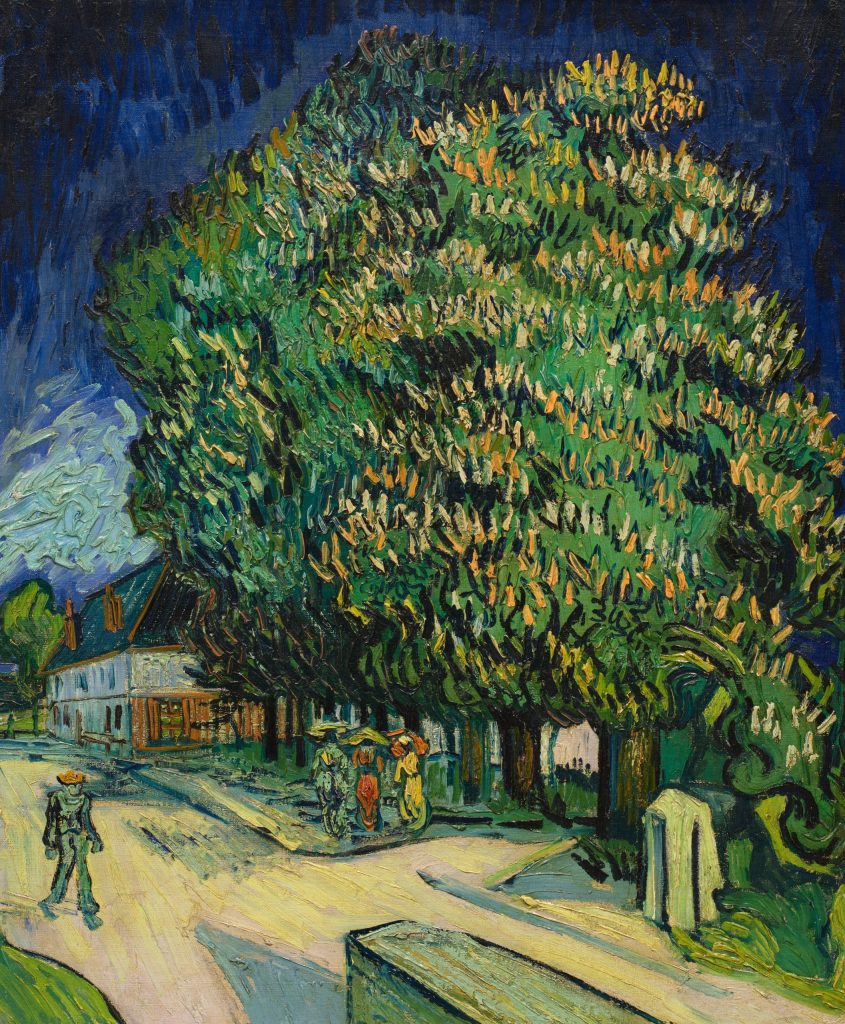
Van Gogh’s ‘Chestnut Trees in Blossom’ Sells for a Record $190.4 Million at Sotheby’s
A Vincent van Gogh painting has sold for $190.4 million at Sotheby’s in New York, setting a new auction record for the Dutch artist. The sale of Châtaigniers en fleurs — Chestnut Trees in Blossom — on Wednesday, 18 November 2026, came just one day after a last-minute settlement cleared the way for the auction to go ahead, ending a dispute over the painting’s ownership that stretched back to the Nazi era.
The result makes the painting the fourth most expensive painting ever sold at auction, and the second most expensive work of art ever sold by Sotheby’s. It is also the most expensive work sold so far in this season’s New York auctions.
For a painting that had not been seen in public for more than 50 years, it was a remarkable return to the spotlight.
What happened at Sotheby’s on Wednesday night
Châtaigniers en fleurs, painted in 1890, went under the hammer at Sotheby’s in New York on Wednesday evening, 18 November 2026, as the top lot in the sale of the Blaquier-Arrieta Collection.
The painting had been estimated to fetch around $180 million. After nearly five minutes of bidding, it sold for a hammer price of $165 million. With the auction house’s fees added, the final price came to $190.4 million.
That was below the estimate on the hammer price, but well above Van Gogh’s previous auction record. The old record was $117.2 million, set in November 2022 when his 1888 painting Orchard with Cypresses sold at Christie’s in New York as part of the collection of the late Microsoft co-founder Paul Allen.
The new result beat that record by more than $73 million.
Sotheby’s did not name the buyer in its announcement. The New York Times reported that the winning bidder was William Acquavella, a veteran art dealer and the head of Acquavella Galleries in New York.
The painting: one of Van Gogh’s last works
Châtaigniers en fleurs is one of the last paintings Vincent van Gogh ever made. He painted it in 1890 in Auvers-sur-Oise, a village north of Paris, in the final weeks of his life. According to Sotheby’s, it was painted on or just before 24 May 1890. Van Gogh died in July 1890, at the age of 37.
The painting shows a cluster of large chestnut trees in blossom in the centre of the village, on what is today the Avenue Charles de Gaulle in Auvers. Three women in brightly coloured clothes, seen from behind, walk in the shade of the trees. The work is known for its spectacular colouring — the deep blue sky, the thick green foliage, and the bursts of yellow and white blossom — and for the thick, expressive brushstrokes that are Van Gogh’s signature.
Sotheby’s described it as one of the most important works from that period of Van Gogh’s career still in private hands. Most of his great late paintings are in museums. This one had been hidden away for decades.
The painting comes from the collection of the Blaquier-Arrieta family of Argentina. It was built by Nelly Arrieta de Blaquier, the heiress to an Argentine sugar fortune, and her husband, Carlos Pedro Blaquier, who served as president of Argentina’s largest sugar producer. The family bought the Van Gogh in 1975 and had owned it for more than half a century. In all that time, it had not been shown in public.
A sale that almost did not happen
The sale nearly did not take place at all. Just days before the auction, the heirs of the painting’s previous owners asked Sotheby’s to withdraw it, saying it had been sold under duress during the Nazi era.
The story goes back to 1909, when the influential German Jewish publisher Samuel Fischer bought the painting in Paris. His family sold it in 1936. His heirs argued that the family had not sold it freely, but had been forced to part with it because of the economic and political pressure created by the Nazis.
It was a serious challenge. In recent years, auction houses have faced growing pressure over artworks that changed hands in Europe in the 1930s and 1940s, when Jewish families were persecuted, forced to flee, or murdered. Many of those sales are now being re-examined, and some have been reversed.
On Tuesday, 17 November — the day before the sale — Sotheby’s announced that an agreement had been reached between the Blaquier-Arrieta family and all of the legal descendants of Hedwig and Samuel Fischer. The details of the agreement remain confidential.
In a statement, Sotheby’s said: “In recognition of the painting’s complex Nazi-era history and the suffering endured by the Fischer family during the Holocaust, the two families have reached a mutually satisfactory resolution and the work will be sold pursuant to their agreement.”
With the dispute settled, the sale went ahead as planned on Wednesday night. Findivoza reported on the dispute and the questions over the painting’s 1936 sale before the auction took place.
A record night for Sotheby’s
The Van Gogh was the star of a huge night for Sotheby’s. The painting was one of 12 masterpieces from the Blaquier-Arrieta Collection sold on Wednesday, and all 12 found buyers, bringing in a total of $412 million including fees. The collection had been billed as the most valuable to come to auction in New York this season, and had been expected to bring in roughly $450 million.
The Van Gogh sale was followed immediately by a second auction, Sotheby’s Modern Evening sale, which brought in another $365.8 million including fees. Together, the two back-to-back sales totalled $777.8 million including fees — more than the $706 million achieved in similar sales last November, when the auction house sold the Klimt collection of Leonard Lauder.
The night also set new auction records for two other artists. A work by the American painter Mary Cassatt sold for $13.3 million, and a work by Aaron Douglas, the leading artist of the Harlem Renaissance, sold for $14.5 million.
Not everything sold above expectations. Just over a third of the works in the two sales went for less than their pre-sale estimates, and the Blaquier-Arrieta collection as a whole fell short of its roughly $450 million estimate. But the Van Gogh result alone was enough to make the evening a landmark.
Why the price matters
The $190.4 million price tag puts Châtaigniers en fleurs among the most expensive paintings ever sold at auction. Only three paintings have sold for more. It is also the second most valuable object ever sold at Sotheby’s, behind only Gustav Klimt’s Portrait of Elisabeth Lederer (1914–16), which fetched $236.4 million including fees in November 2025.
The result says something about the art market as well. The very top of the market — rare works by famous names, fresh to auction after decades out of sight — is still strong, even when the wider market is uneven. A painting that nobody had seen in public for more than 50 years, by one of the most famous artists in history, with a dramatic story behind it, was always going to attract intense interest.
The price also reflects how rare Van Gogh’s late works have become on the open market. He painted for only about ten years, and produced around 900 paintings in that short career. Most of the best ones are in museums and will never be sold. When a major late Van Gogh does come up for sale — especially one from his final weeks in Auvers-sur-Oise — collectors are willing to pay extraordinary sums.
There is a human story here too. The settlement between the two families, reached just a day before the sale, closed a painful chapter that began in 1936. The Fischer family lost the painting at a time of persecution; ninety years later, their descendants reached an agreement that allowed the sale to proceed. Sotheby’s statement acknowledged “the suffering endured by the Fischer family during the Holocaust” — a rare public recognition of that history on the night of a record sale.
What happens next
The buyer, reported to be the dealer William Acquavella, has not said what he plans to do with the painting. Dealers who buy at this level often resell to a private collector or a museum, sometimes after a period of time. For now, the painting’s next home is unknown.
What is certain is that Châtaigniers en fleurs has now joined the small group of paintings that have sold for more than $150 million at auction — a list that includes works by Leonardo da Vinci, Pablo Picasso, Amedeo Modigliani, and Gustav Klimt. For Van Gogh, an artist who sold almost nothing in his lifetime and died poor and largely unknown, it is a strange kind of fame: his work is now among the most valuable objects on earth.
Frequently asked questions
How much did the Van Gogh painting sell for?
Châtaigniers en fleurs (Chestnut Trees in Blossom) sold for $190.4 million including fees at Sotheby’s in New York on 18 November 2026. The hammer price — the winning bid before fees — was $165 million.
What was Van Gogh’s previous auction record?
The previous record was $117.2 million, set in November 2022 when Van Gogh’s 1888 painting Orchard with Cypresses sold at Christie’s in New York as part of the collection of the late Microsoft co-founder Paul Allen.
When was Chestnut Trees in Blossom painted?
The painting was made in 1890 in Auvers-sur-Oise, France, in the final weeks of Van Gogh’s life. Sotheby’s says it was painted on or just before 24 May 1890. Van Gogh died in July 1890.
Why was the sale disputed?
The heirs of Samuel Fischer, a German Jewish publisher who owned the painting before his family sold it in 1936, argued that the sale had been made under duress because of Nazi persecution. They asked Sotheby’s to withdraw the painting. A settlement was reached between the Fischer heirs and the Blaquier-Arrieta family, the painting’s owners since 1975, on 17 November — the day before the sale.
Who bought the painting?
Sotheby’s did not name the buyer. The New York Times reported that the winning bidder was William Acquavella, a New York art dealer and head of Acquavella Galleries.
What is the most expensive painting ever sold at auction?
Châtaigniers en fleurs is the fourth most expensive painting ever sold at auction. It is the second most expensive work ever sold by Sotheby’s, behind Gustav Klimt’s Portrait of Elisabeth Lederer, which sold for $236.4 million in November 2025.
Conclusion
The $190.4 million sale of Van Gogh’s Chestnut Trees in Blossom is a record in more than one sense. It is the highest price ever paid for a Van Gogh at auction, the fourth highest price ever paid for any painting at auction, and the second highest price ever achieved by Sotheby’s.
But the sale will also be remembered for what happened the day before it: the settlement of a dispute that stretched back to 1936, when a Jewish family parted with the painting under the shadow of Nazi persecution. That agreement allowed the auction to go ahead, and it acknowledged a painful history in the middle of a glittering night.
A painting unseen for more than half a century, made in the last weeks of a short and troubled life, has now become one of the most valuable objects in the world. That is the strange, enduring power of Van Gogh — an artist who died unknown and poor, whose work now sells for sums he could never have imagined.
Sources
- Reuters: “Van Gogh’s ‘Chataigniers en Fleurs’ sells at auction for record $190.4 million”
- The Art Newspaper: “Van Gogh painting sells for record $190m at Sotheby’s following Nazi loot claims”
- The National: “Van Gogh painting sells for record $190.4 million after Nazi-era ownership dispute resolved”
- artnet news: “Sotheby’s Notches $778M Night, $190M Van Gogh, But Bidding Is Thin for Blaquier-Arrieta Works”
- The Philippine Star: “Van Gogh painting sells for record P12-b after dispute”
